



Peak Detector: How It Works and Practical Applications
A peak detector is a simple circuit that captures the maximum voltage of an AC waveform and holds it as a DC level. It consists of a diode and a capacitor in series, with the capacitor’s voltage reflecting the peak of the input signal.
Peak Detector Operation
The schematic below and its SPICE netlist illustrate the basic principle. When the AC source is applied, the diode conducts during the positive half‑cycles, charging the capacitor up to the instantaneous peak minus the diode’s forward drop. Once the input voltage falls below this stored level, the diode becomes reverse‑biased, preventing the capacitor from discharging back into the source. Thus the capacitor retains the highest voltage reached during the cycle.
This device is essentially a half‑wave rectifier followed by a filtering capacitor.
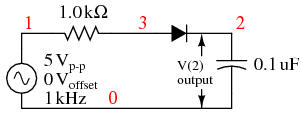
*SPICE 03441.eps
C1 2 0 0.1u
R1 1 3 1.0k
V1 1 0 SIN(0 5 1k)
D1 3 2 diode .model diode d
.tran 0.01m 50mm
.end
Note: The diode conducts on positive half‑cycles, charging the capacitor to the peak voltage minus the forward drop.
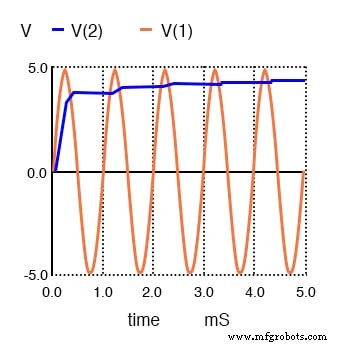
Because of the series resistance and the diode’s forward voltage (~0.7 V for silicon), the capacitor does not rise all the way to the 5 V peak of the input. It takes a few cycles for the capacitor to reach the steady‑state peak voltage.
In power‑supply applications, the same concept is employed in a half‑wave rectifier. The series resistor is replaced by a transformer secondary (typically a few ohms) and a much larger filter capacitor (hundreds of microfarads). Such a 60 Hz supply can deliver about 100 mA, although half‑wave designs are generally limited by the need for substantial filtering.
Peak detectors are also found in radio circuits, such as crystal radios, where the rectified signal is used to demodulate amplitude‑modulated waves.
Related Worksheets
- Basic Oscilloscope Operation Worksheet
Industrial Technology
- Capacitor Types: Polarized, Non-Polarized, and Variable Explained
- Clamper Circuits – DC Restorers for Composite Video
- Understanding Capacitor Transient Response: Charging Dynamics, Asymptotic Behavior, and SPICE Simulation
- AC Capacitor Circuits: Capacitive Reactance, Phase Shift, and Power Behavior
- Why Capacitors Beat Inductors: Lower Loss, Compact Size, and Superior Isolation
- Electric Pendulum: How Capacitors and Inductors Exchange Energy
- Carbon Monoxide Detectors: Technology, Design, and Safety Standards for Home Protection
- Smoke Detectors: Life‑Saving Technology, History, and Modern Innovations
- Converting RF to DC with a Raspberry Pi: Building and Troubleshooting an Envelope Detector
- Precision Bearing Temperature Sensor – Accurate Detection & Monitoring