



Ohm’s Law Explained: How Voltage, Current, and Resistance Interact in Electrical Circuits
Ohm’s Law, first articulated by Georg Simon Ohm in 1827, is the cornerstone of circuit analysis. It links the three fundamental electrical quantities—voltage, current, and resistance—through a simple, yet powerful equation.
Voltage, Current, and Resistance
In any closed conductive path, electric charge moves continuously. This movement is called current (symbol I) and is analogous to the flow of water through a pipe. The driving force behind this flow is voltage (symbol V or E), a relative measure of potential energy between two points in the circuit.
Current encounters opposition in the form of resistance (symbol R). Resistance depends on the material, length, and cross‑section of the conductor, and it limits how much current can flow for a given voltage.
All three quantities are always defined between two distinct points, which is why we frequently say “voltage across a resistor” or “current through a wire.”
Units of Measurement: Volt, Amp, and Ohm
To quantify electrical behavior, we use the following SI units:
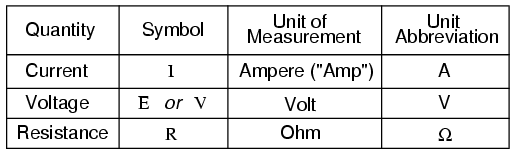
• Voltage – volts (V), symbol V or E • Current – amperes (A), symbol I • Resistance – ohms (Ω), symbol R These symbols are standardized across physics and engineering, ensuring clear communication worldwide.
Coulomb and Electric Charge
Electric charge is measured in coulombs (C). One coulomb equals the charge of approximately 6.25 × 10¹⁹ electrons. Current (in amperes) represents the rate at which charge flows: one ampere equals one coulomb passing a point every second.
Voltage, meanwhile, is the potential energy per unit charge. One volt equals one joule per coulomb. Understanding joules (the SI unit of energy) is key: 1 J is the work done by a 1 N force moving an object 1 m in the force’s direction.
The Ohm’s Law Equation
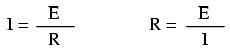
Ohm’s Law is expressed algebraically as:

From this base equation we derive two additional forms:
Analyzing Simple Circuits with Ohm’s Law
Consider a basic series circuit containing a single voltage source and a single resistor (e.g., a battery and a lamp).
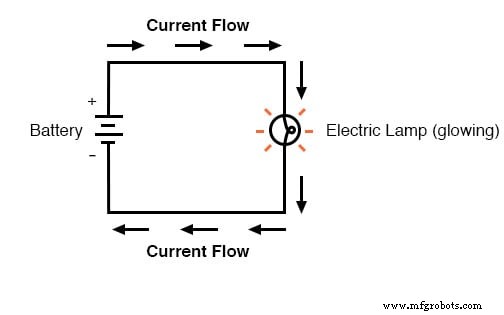
With any two of the three quantities known, Ohm’s Law lets you solve for the third.
1. Calculate current (I) when voltage (E) and resistance (R) are known:
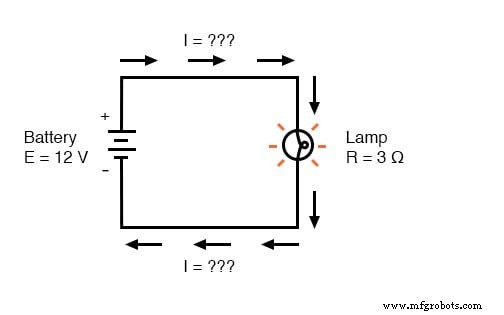
What is the current?
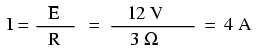
2. Determine resistance (R) when voltage (E) and current (I) are known:
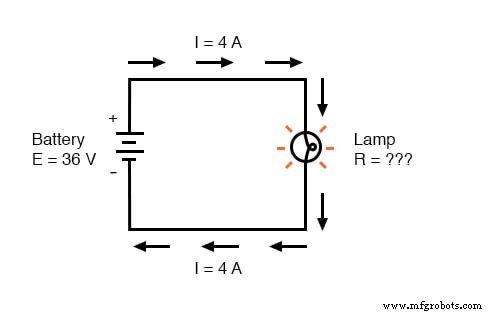
What is the resistance?

3. Find voltage (E) when current (I) and resistance (R) are known:
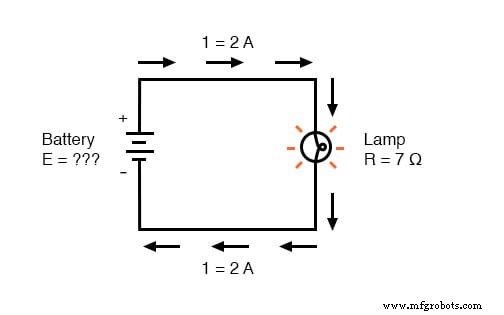
What is the voltage?

Ohm’s Law Triangle Technique
For quick reference, place the three variables—E, I, and R—into a triangle:
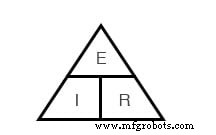
To find a missing variable, remove the two known ones from the diagram and read the remaining expression. This mnemonic is handy until you’re comfortable manipulating the algebraic forms.
Review
- Voltage: volts (V), symbols E or V
- Current: amperes (A), symbol I
- Resistance: ohms (Ω), symbol R
- Ohm’s Law: E = I × R; I = E / R; R = E / I
Related Worksheets
- Ohm’s Law Worksheet
- Ohm’s Law Practice Worksheet With Answers
Try our Ohm’s Law Calculator in the Tools section for instant calculations.
Industrial Technology
- Practical Ohm’s Law Experiment: Measuring Voltage, Current, and Resistance
- Understanding Voltage and Current: The Foundations of Electrical Flow
- Voltage and Current in a Practical Circuit: Understanding Their Relationship
- Ohm’s Law Explained: A Water‑Pipe Analogy for Clear Intuition
- Understanding Ohm’s Law and the Real Risks of Electrical Shock
- Capacitors & Calculus: How Voltage Change Drives Current
- Calculating Voltage and Current in Reactive DC Circuits
- Advanced Analysis of DC Reactive Circuits with Non‑Zero Initial Conditions
- Understanding Resistance, Reactance, and Impedance in AC Circuits
- Precise Power Measurement Using Digital and Analog Multimeters