



Ohm’s Law Explained: A Water‑Pipe Analogy for Clear Intuition
Ohm’s Law can be grasped intuitively using a familiar water‑and‑pipe system. Imagine a pump generating pressure (voltage) that forces water (current) through a pipe with a narrowing or valve (resistance). The interplay between these three variables mirrors electrical behavior.
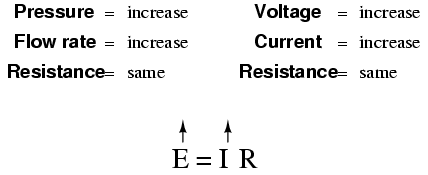
When the pipe’s restriction stays constant and the pump’s pressure climbs, the flow rate rises proportionally. This is analogous to a fixed resistance with an increasing voltage, which drives more current through the circuit.
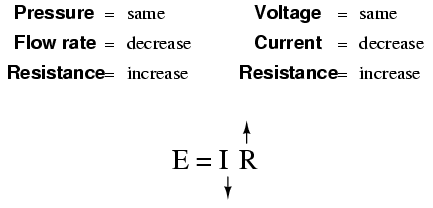
Conversely, if the pressure remains unchanged while the pipe’s restriction tightens, the flow rate drops. In electrical terms, the same voltage applied to a higher resistance yields a lower current.
And if the flow rate is held steady but the restriction eases, the pump can lower its pressure. This reflects a situation where current is unchanged while resistance falls, requiring less voltage to maintain the flow.
Although fluid dynamics introduces additional complexities beyond the simple linear relation found in electricity, the core concept remains the same. For engineers and physicists, the math behind Ohm’s Law stays straightforward, making it a powerful tool for design and troubleshooting.
Quick Review:
- With a constant resistance, current rises with voltage and falls with lower voltage.
- With voltage constant, a higher current implies a lower resistance, and vice versa.
- With current constant, an increase in resistance demands a higher voltage.
Related Worksheets:
- Ohm’s Law Worksheet
Use our Ohm’s Law Calculator in the Tools section to practice solving real‑world problems.
Industrial Technology
- Practical Ohm’s Law Experiment: Measuring Voltage, Current, and Resistance
- Lever Analogy: Clarifying Divided Feedback in Amplifiers
- Ohm’s Law Explained: How Voltage, Current, and Resistance Interact in Electrical Circuits
- Understanding Ohm’s Law and the Real Risks of Electrical Shock
- Mastering Ohm’s Law: Correct Application and the Table Method for Accurate Circuit Analysis
- U.S. IoT Security Law Sets New Standards and Liability Requirements
- Choosing and Optimizing Bulk Solid Feeders for Reliable Production
- Federal Smart Gun Regulations: Enhancing Police Safety & Accountability
- Choosing Corrosion-Resistant Materials for Offshore Platforms
- Expert Guide to Selecting Resistance Welding Electrodes for Optimal Performance