



Understanding Ohm’s Law and the Real Risks of Electrical Shock
When safety signs warn, "It’s not the voltage that kills, it’s current!", the truth is nuanced. Voltage alone is harmless, but it is the voltage that drives current through a body, and that current is what can burn tissue, freeze muscles, and induce cardiac arrhythmias. Understanding the relationship between voltage, current, and resistance is key to preventing electrical injury.
Ohm’s Law in Context
Ohm’s Law relates voltage (V), current (I), and resistance (R) with the equation I = V / R. In the context of a human body, the current that passes through depends on the voltage applied between two points on the skin and the resistance offered by the body between those points. Higher voltage, or lower resistance, yields greater current and a higher risk of harm.
Body resistance is variable. It changes from person to person, with hydration, skin condition, and the type of contact (hand‑to‑hand, hand‑to‑foot, etc.). For example, a dry hand‑to‑hand contact can present about 1 MΩ, while a sweaty hand can drop to 17 kΩ or even 1 kΩ with a conductive ring or metal object.
Such variability is why a single safety threshold cannot be applied universally. The following table illustrates the effects of current on the body, drawn from peer‑reviewed studies and industry safety guidelines.
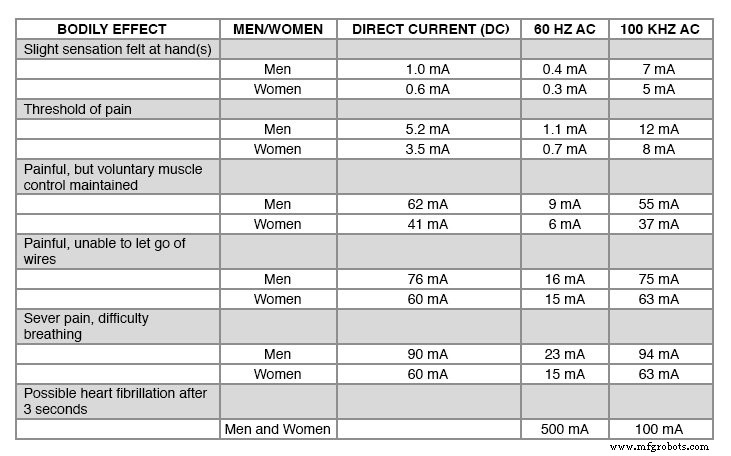
Key take‑aways from the table:
- As little as 1 mA can cause a painful shock.
- 10–20 mA is enough to cause muscle tetanus, making it hard to release a live conductor.
- 17 mA AC can induce ventricular fibrillation in susceptible individuals.
- At 60 Hz, 20 mA requires about 20 kV across dry skin, but only 340 V across wet skin, and as little as 20 V across 1 kΩ of body resistance.
How Contact Conditions Alter Resistance
The resistance values for common contact scenarios are summarized below. These figures show how moisture, contact area, and metal objects can dramatically reduce resistance.
- Finger touching a wire: 40 kΩ–1 MΩ dry; 4 kΩ–15 kΩ wet.
- Hand holding a wire: 15 kΩ–50 kΩ dry; 3 kΩ–5 kΩ wet.
- Metal pliers held by hand: 5 kΩ–10 kΩ dry; 1 kΩ–3 kΩ wet.
- Palm contact: 3 kΩ–8 kΩ dry; 1 kΩ–2 kΩ wet.
- 1.5‑inch metal pipe grasped with one hand: 1 kΩ–3 kΩ dry; 500 Ω–1.5 kΩ wet.
- 1.5‑inch metal pipe grasped with both hands: 500 Ω–1.5 kΩ dry; 250 Ω–750 Ω wet.
- Hand immersed in conductive liquid: 200 Ω–500 Ω.
- Foot immersed in conductive liquid: 100 Ω–300 Ω.
Notice that gripping a pipe with both hands halves the resistance compared to one hand, because the current has two parallel pathways, reducing overall resistance.
In industrial settings, a conservative threshold of 30 V is often used to flag potentially hazardous voltages. Above this level, reliance on body resistance alone is insufficient; protective measures such as insulated gloves, boots, and tool sheathing become essential.
Practical Safety Tips
- Keep voltages above 30 V away from contact or ensure proper insulation.
- Remove all metal jewelry when working near electricity; rings can bridge contacts and create low‑resistance pathways.
- Use one hand to work on live circuits, placing the other hand out of the current path. For most people, the right hand is preferable, but the choice should reflect the worker’s dexterity and comfort.
- Wear insulated tools and footwear; the combined resistance of glove, body, and boot significantly reduces current.
- Never rely solely on body resistance—environmental factors such as sweat or water can quickly lower it.
- Low voltages can still be hazardous by causing involuntary movements that lead to contact with higher‑voltage sources.
For a quick check of potential currents in a given circuit, use our Ohm’s Law Calculator.
Related Worksheets
Industrial Technology
- Practical Ohm’s Law Experiment: Measuring Voltage, Current, and Resistance
- Hands‑On Guide to Current Dividers: Build, Measure, and Simulate with a 6 V Battery
- Precision 4‑Wire Resistance Measurement: The Kelvin Method
- Understanding Electrical Resistance and Circuit Safety
- Ohm’s Law Explained: How Voltage, Current, and Resistance Interact in Electrical Circuits
- Ohm’s Law Explained: A Water‑Pipe Analogy for Clear Intuition
- Mastering Ohm’s Law: Correct Application and the Table Method for Accurate Circuit Analysis
- Kirchhoff’s Current Law (KCL): Fundamentals and Practical Application
- Precision 4‑Wire Kelvin Resistance Measurement: Eliminating Wire‑Resistance Errors
- Understanding Resistance, Reactance, and Impedance in AC Circuits