



Kirchhoff’s Current Law (KCL): Fundamentals and Practical Application
What Is Kirchhoff’s Current Law?
Kirchhoff’s Current Law, abbreviated as KCL, states that the algebraic sum of all currents entering and exiting a node must equal zero. This principle describes how charge flows into and out of a junction point on a circuit.
In the following sections we will illustrate KCL with a practical example, explain its importance, and outline its derivation.
Review of a Parallel Circuit
Consider the parallel circuit shown below:
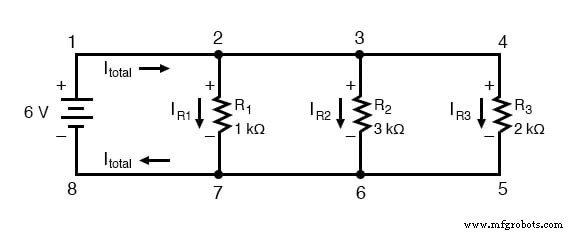
Solving for all voltages and currents yields:
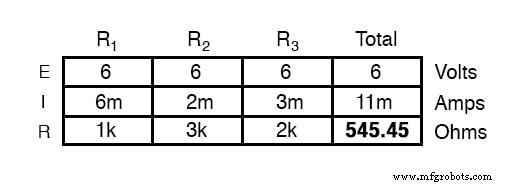
From these results we can identify each branch current and the total current. While the total current equals the sum of branch currents, the node‑level analysis reveals a deeper consistency governed by KCL.
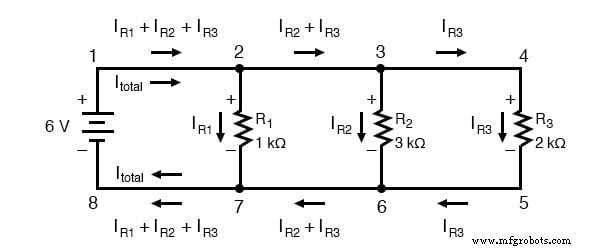
Currents at a Node
On the positive rail (wires 1‑2‑3‑4) the main current splits into the branch resistors at each node. On the negative rail (wires 8‑7‑6‑5) the branch currents recombine to form the return current. This behavior is analogous to a water‑pipe system where each tee fitting either splits or merges flow without loss.
Take node 6, for example. The currents entering the node are 2 mA and 3 mA, while the current leaving is 5 mA:
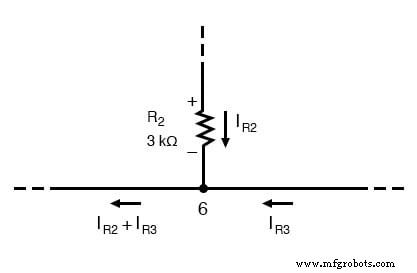
Because no current is lost at the fitting, the magnitude of the exiting current equals the sum of the entering currents. The same rule applies to every node, regardless of how many currents meet there.
The general relationship is expressed mathematically as:
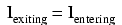
Kirchhoff’s Current Law
Kirchhoff formalized this observation as KCL, which can be written in the form shown below:

In words, KCL reads: “The algebraic sum of all currents entering and exiting a node must equal zero.”
Assigning a sign to each current (positive for entering, negative for leaving) allows us to sum them to zero. For node 6, the KCL equation is:
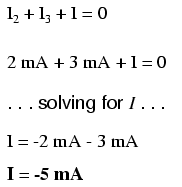
The negative sign on the 5 mA term indicates it is leaving the node, while the 2 mA and 3 mA terms are positive, indicating entry. The sign convention is arbitrary, so long as it is applied consistently.
Combined with Kirchhoff’s Voltage Law, KCL becomes a powerful tool for circuit analysis, especially in network studies. Mastery of both laws is essential for any electronics practitioner.
Review:- KCL: “The algebraic sum of all currents entering and exiting a node must equal zero.”
- Kirchhoff’s Law Worksheet
Industrial Technology
- Hands‑On Guide to Current Dividers: Build, Measure, and Simulate with a 6 V Battery
- Mastering SPICE: Common Quirks & How to Avoid Them
- Common-Emitter Amplifier Limitations: Distortion, Temperature, and High‑Frequency Challenges
- Insulated‑Gate Bipolar Transistors (IGBTs): Merging FET Precision with BJT Power
- DIAC: The Bidirectional Trigger for AC Thyristors
- Understanding Electrical Resistance and Circuit Safety
- Ohm’s Law Explained: How Voltage, Current, and Resistance Interact in Electrical Circuits
- Understanding Ohm’s Law and the Real Risks of Electrical Shock
- Kirchhoff’s Voltage Law (KVL): A Practical Guide to Voltage Circuits
- Kirchhoff’s Laws: Current & Voltage (KCL & KVL) – Step‑by‑Step Solved Example