



Why Grounding Matters: Preventing Shock from a Single Wire
Electricity demands a closed circuit to sustain flow. Consequently, the brief jolt from static discharge occurs only while equalizing charge between two objects, making such shocks typically harmless.
Shock risks arise only when current can enter and exit the body through two distinct contact points. This principle explains why birds safely perch on high‑voltage lines—they make contact at a single point, so no voltage drives current through their bodies.
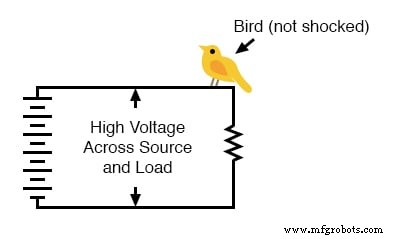
For current to traverse a conductor, a voltage must exist between two points; voltage is never inherent to a single point. Therefore, a bird touching only one wire experiences no voltage across its body, and no current can flow.
While birds can touch both feet to the same conductor, their feet remain electrically common—no potential difference exists between them. This eliminates the driving force for current through the bird.
Many might think that touching only one live wire is always safe, but humans typically stand on the ground. If a power system’s live conductor is referenced to earth, touching that wire completes a circuit through the ground, posing a shock hazard.
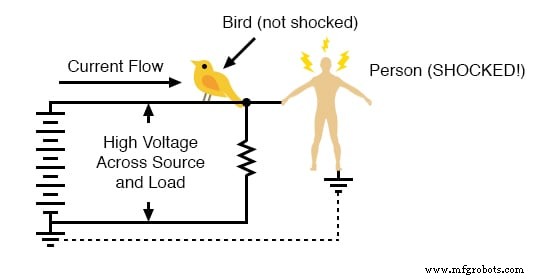
The ground symbol—three horizontal bars of diminishing width—represents a metallic conductor buried deep to provide a low‑impedance path to earth. When a person’s feet contact the ground, they effectively join the circuit at a second point, completing the loop.
Students often ask:
- Why incorporate a grounding point if it can create a shock path?
- Do shoes protect against ground‑based shocks?
- Could the earth serve as a reliable conductor in power systems?
Grounding a circuit ensures that one terminal is always at zero potential relative to earth, making that point safe to touch. For instance, if the lower rail of the diagram is grounded, a person contacting it receives no shock even though their feet still touch the earth.
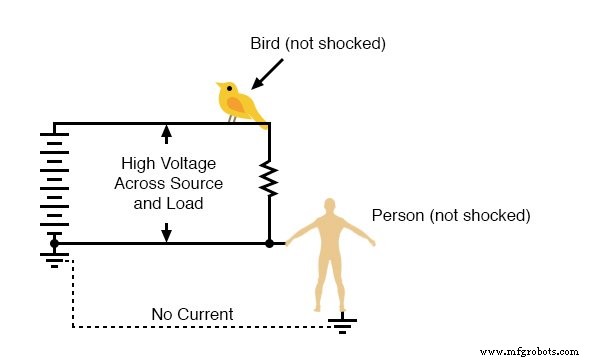
In an ungrounded system, touching any single point would normally be safe because no complete path exists through the body. However, accidental ground faults—such as a tree branch bridging a live conductor to the earth—can create a dangerous circuit.
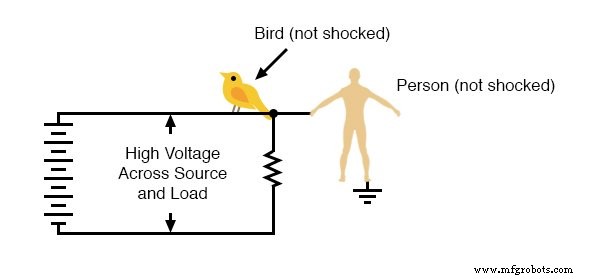
Ground faults arise from various sources: contaminated insulators, groundwater infiltration, or wildlife bridging conductors. These faults are unpredictable, and a single accidental connection can turn a previously safe point into a hazardous one.
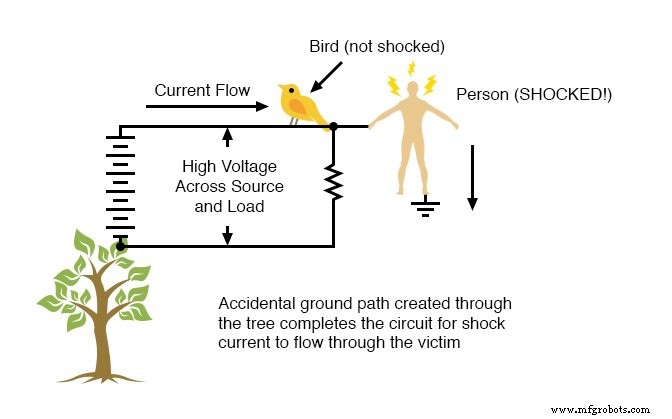
Ground Faults
Ground faults may be triggered by:
- Dirt buildup on insulators creating a conductive water film during rain.
- Water ingress in buried conductors.
- Birds bridging conductors to support poles.
Because the occurrence of a fault is random, the only guaranteed safe point in an ungrounded system is one explicitly tied to earth. This is why industrial and residential designs mandate grounding per NEC and IEEE standards.
Consider a tree contacting the top wire: the entire circuit becomes grounded at that point, leaving the bottom wire at full line voltage relative to earth—exactly the opposite of a typical ground fault scenario.
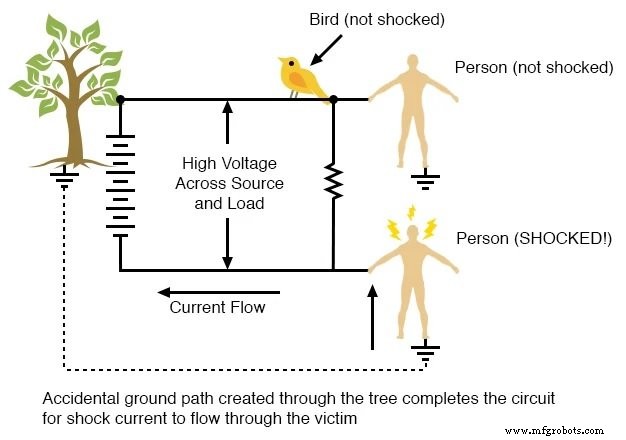
In a truly ungrounded system, two people touching separate wires can create a lethal path: current flows from one through the earth to the other. The only truly safe animal is the bird that remains electrically isolated from earth.
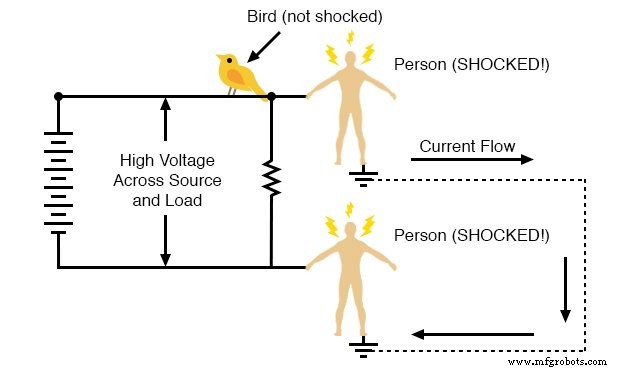
Thus, grounding is a deliberate safety measure, not a risk factor. It guarantees a single safe touch point and limits the voltage available at any ungrounded location.
Regarding footwear, rubber‑soled shoes provide modest insulation (typically 20 MΩ for a dry rubber sole). However, common footwear is not engineered for electrical safety; moisture or sweat can drastically reduce resistance, dropping it to 5–20 kΩ. Specialized safety shoes and mats are required, and they must remain dry and clean.
Research on human contact resistance shows:
- Rubber‑insulated hand/foot contact: ~20 MΩ.
- Dry leather sole contact: 100 kΩ–500 kΩ.
- Wet leather sole contact: 5 kΩ–20 kΩ.
Dirt is a poor conductor when dry, but its resistance can drop in the presence of moisture or electrolytes, making it capable of carrying hazardous currents from high‑voltage systems.
Concrete typically offers lower resistance due to inherent water and ionic content, whereas asphalt’s oil base provides higher resistance.
Review
- Shock requires two circuit points and voltage across the body.
- Grounding connects one circuit point to earth, ensuring that point is safe to touch.
- A ground fault is an unintended bridge between a conductor and earth.
- Specialized safety footwear and mats must be dry and clean; ordinary shoes do not guarantee protection.
- Even dry dirt can conduct enough current to be lethal when high voltage is present.
Related Worksheet
- Electric Shock Worksheet
Industrial Technology
- Hands‑On Guide to Current Dividers: Build, Measure, and Simulate with a 6 V Battery
- Build a Reliable Current Mirror Circuit: Step‑by‑Step Guide
- Mastering AC Circuit Equations: Impedance, Reactance & Resonance
- Understanding Electrical Resistance and Circuit Safety
- Voltage and Current in a Practical Circuit: Understanding Their Relationship
- How Ammeter Resistance Affects Circuit Measurements: Insights & Solutions
- Series RC Circuit Analysis: Impedance, Phase Relationships, and SPICE Validation
- Preventing High Inrush Currents in Capacitor Switching: Proven Strategies for Reliable Power Systems
- How Current Limiting Circuits Protect Electronics & Power Supplies
- Building a TDCS Circuit: Step‑by‑Step Guide to Brain Stimulation