



Essential Electrical Safety: Zero Energy State & Lock‑Out/Tag‑Out Procedures
Before working on any circuit, always disconnect the power. Only when all sources of harmful energy are removed can a system be deemed safe. In industrial settings, this is referred to as placing the equipment in a Zero Energy State. While the focus here is electrical safety, the same principles apply to hydraulic, pneumatic, and mechanical systems.
Zero Energy State: Eliminating Stored Energy
Securing a device in a Zero Energy State means eliminating all forms of stored or potential energy, including:
- High voltage potential
- Spring or mechanical tension
- Hydraulic fluid pressure
- Pneumatic air pressure
- Suspended or hoisted loads
- Flammable or reactive chemicals
- Radioactive or fissile materials
Voltage is a form of potential energy. A pair of conductors carrying high voltage can store lethal energy even if no current flows. The danger lies in the potential, which must be neutralized before contact is made.
All properly designed circuits feature a dedicated disconnect switch that isolates the energized portion. In many cases, the same device also functions as a circuit breaker, automatically opening under excessive current conditions. Whether manual or automatic, the disconnect switch is a critical safety element and should be kept separate from the regular on/off switch.
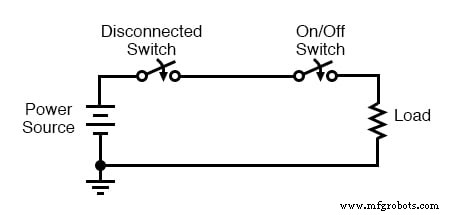
With the disconnect in the open position, the circuit is broken and no current can flow. The full source voltage appears across the open contacts, while the load experiences zero voltage.
Because the lower conductor is typically grounded, a disconnect is rarely required on that side. For added protection, a temporary ground can be applied to the top side of the load, ensuring both conductors are earth‑referenced and the load is fully de‑energized.
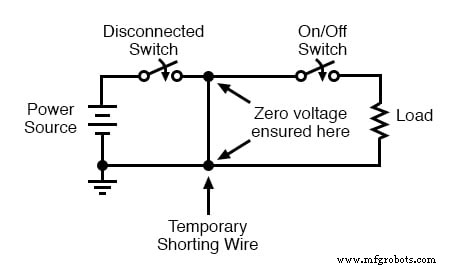
Connecting a grounding wire across the load achieves the same effect as short‑circuiting the load. This technique is common in high‑voltage maintenance work and provides an additional safety layer against accidental energization.
When the disconnect is closed while the load remains grounded, the short circuit immediately trips overcurrent protection devices—circuit breakers or fuses—shutting the system down again. While these devices are designed to protect conductors from overheating, they also serve as a valuable safety mechanism when temporary shorting wires are used.
Structured Safety Systems: Lock‑Out/Tag‑Out
To maintain a Zero Energy State during maintenance, a structured Lock‑Out/Tag‑Out (LOTO) system is essential. OSHA’s standard 1910.147 requires each worker to lock every energy source with a personal padlock or combination lock and affix a tag that identifies the task, duration, and responsible person.
When multiple energy sources exist—electrical, mechanical, hydraulic, pneumatic—each must be locked out. The system remains de‑energized until every lock is removed, signifying that all workers have released their portion of the lock. If the system is re‑energized while a lock remains, the tag will reveal the responsible individual.
Even with a robust LOTO program, vigilance is vital. Workers must verify that the system is truly dead by testing for voltage with a calibrated meter before touching any conductors.
Follow this three‑step verification process:
- Confirm meter accuracy on a known voltage source.
- Test the locked‑out circuit for residual voltage.
- Re‑check the meter on a known source to ensure reliability.
Defective meters can mislead workers into dangerous conditions. Performing a second check with an independent meter provides an extra layer of assurance.
When the final safety check confirms a Zero Energy State, make brief contact with the conductor using the back of your hand before gripping it or a tool. If a shock occurs, the muscle reflex will break contact, reducing injury risk. This step should never replace meter testing.
Key Takeaways
- A Zero Energy State eliminates all potential energy, safeguarding personnel during maintenance.
- Disconnect switches are mandatory in well‑designed electrical systems to achieve de‑energization.
- Temporary grounding or shorting wires provide additional protection when servicing a load.
- Lock‑Out/Tag‑Out ensures that all energy sources remain isolated until every worker releases their lock.
- Always verify system de‑energization with reliable test equipment before making contact.
- Use a brief back‑hand touch as a final safety measure before handling conductors.
Industrial Technology
- Amplifiers: Harnessing Active Devices to Boost Power
- Safe Meter Usage: A Professional Guide for Electronics Technicians
- Thevenin’s Theorem: Simplifying Linear Circuits for Power System Analysis
- Understanding Voltage Regulation in Power Transformers
- ConocoPhillips Billings Refinery Earns EPA Energy Star for Energy Efficiency
- On-Site Energy Solutions for a Carbon-Free Future
- Effective PCB Heat Management: Techniques for Optimal Thermal Performance
- 50 Proven Best Practices for Effective IT Asset Management
- Harnessing Solar Energy: Your Complete Guide to Clean, Reliable Power
- Thermal Energy Explained: Definition, Examples & How It Works