



Choosing and Optimizing Bulk Solid Feeders for Reliable Production
Bulk solids handling relies on two core feeder categories: dispensing feeders that deliver a precise feed rate to a process line, and storage‑to‑process feeders that withdraw material from bulk silos or hoppers. While their scales differ, their primary purpose remains the same—ensuring consistent, predictable material flow.
Key Functions of Each Feeder Type
- Dispensing feeders prioritize accuracy and steady throughput, maintaining the bulk condition required for downstream operations.
- Storage feeders focus on controlling the discharge pattern, managing the zone of material release from the holding vessel to avoid segregation and flashback.
Why Screw Feeders Excel in Hopper Discharge
Screw feeders are the industry standard for hopper and silo output due to their total confinement, minimal loss, and the ability to extract progressively from extended outlet slots. Slot outlets enlarge storage capacity and enable planar flow hoppers, which require shallower wall angles than conical designs.
Progressive extraction from a slot is vital for mass‑flow operation, promoting live flow through the outlet, reducing feeder power, and maintaining product quality.
Design Objectives for Optimal Feeder Performance
- Avoid prolonged residence times that can degrade material.
- Redress segregation caused during filling.
- Minimise flushing risks.
- Reduce eccentric draw and structural failure.
- Ensure consistent material density at discharge.
- Homogenise or mix hopper contents.
- Lower feeder drive power requirements.
Choosing the Correct Flow Pattern
- Mass flow – ideal for materials that deteriorate if they rest.
- Storage‑expanded flow – suited for difficult‑to‑flow, inert materials.
- Funnel flow – best for easy‑flow, inert materials.
Even with a mass‑flow strategy, uneven extraction can cause segregation, density variations, caking, and other quality issues. The feed pattern must match the hopper’s cross‑sectional geometry to avoid these pitfalls.
Understanding Even Extraction
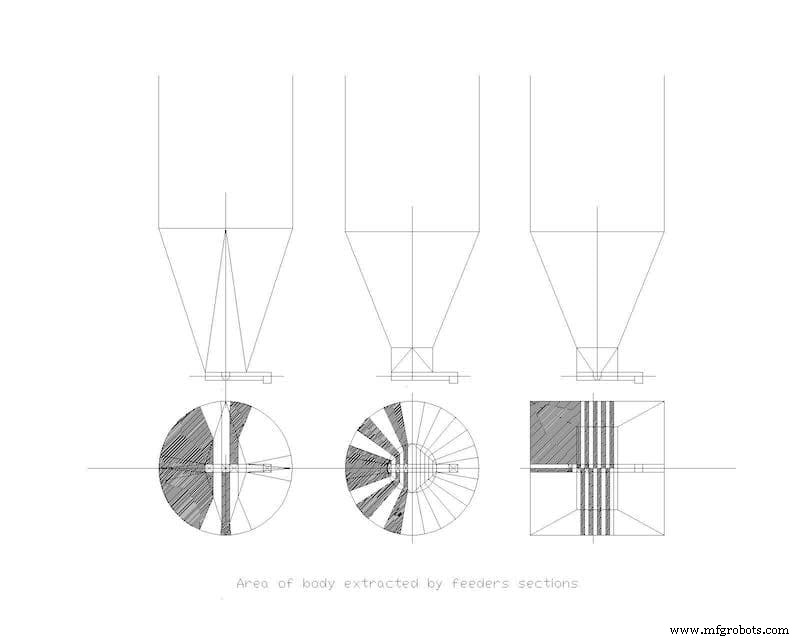
Even extraction refers to proportional removal across the hopper’s cross‑section, not just at the feeder inlet. For example, a 6 m square hopper with a 2 m long feeder will require the first and last 10% of the feeder to extract roughly 11 times the material of the intermediate sections to achieve uniform drawdown.
In contrast, a 2 m long feeder on a 2 m diameter silo must take only a fraction of the material at the ends, increasing sharply towards the centre. These variations underline the importance of tailoring feeder geometry to the hopper layout.
Challenges of Screw Feeder Extraction
Screw feeders typically span less than the hopper’s largest dimension, so flow is a mix of linear and radial paths. The capacity per unit length must align with the screw’s axial transfer efficiency, which depends on pitch, flight geometry, and material friction.
- The first feeder section extracts the full axial capacity; subsequent sections only remove incremental differences.
- Higher pitch does not linearly increase capacity due to reduced axial efficiency.
- Longer outlet sections mean lower extraction rate per unit length.
- Axial efficiency varies with material contact friction, making each application unique.
See the entrainment pattern diagram below for a visual reference.
The figure illustrates that the first and last feeder sections exhibit the greatest variance—often ranging from less than unity to a 10:1 ratio depending on hopper shape and outlet transition.
When to Consult a Specialist
Optimising feeder specifications requires close collaboration between supplier and user. For critical applications, engage a specialist supplier to balance geometry, material properties, and performance requirements.
Reference:
1. Bates, L. "Entrainment pattern of screw hopper dischargers." ASME JIRL Engineering for Industry, May 1969, pp. 215‑302.
Images
Industrial equipment
- Ohm’s Law Explained: A Water‑Pipe Analogy for Clear Intuition
- Sensirion Launches Patient‑Side Flow Sensor for Precise Ventilator Monitoring
- Proactive Pump Care: Detecting Issues Before They Cause Downtime
- Self-Dumping Hopper: The Essential Tool for Efficient Warehouse Operations
- Essential Safety Practices for Forklift-Operated Dumping Hoppers
- SWM Introduces Naltex Flow Media to Reduce Resin Waste in VARTM Processes
- Dual Spindle Solutions for Advanced Flow Profiles & Free-Form Machining
- Innovating Smart Solutions for Gas Flow Devices
- Mastering Aluminum Casting: 5 Proven Techniques for Superior Results
- Choosing the Right Valves for Industrial Fluid Systems: A Practical Guide