



Electromagnetic Induction: The Engine of Modern Electricity
Michael Faraday’s landmark discovery of electromagnetic induction unlocked the practical generation of electricity. He showed that a voltage is produced across a conductor when it experiences a changing magnetic flux that is perpendicular to its length.
One intuitive way to create a varying magnetic field is to move a permanent magnet near a wire or coil. The key rule is that the magnetic field must rise or fall in intensity perpendicular to the conductor; otherwise no voltage will be induced.
Illustration: 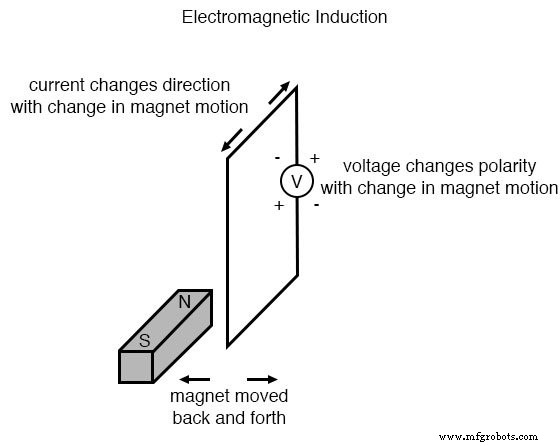
Faraday expressed the relationship mathematically, using the instantaneous voltage symbol “e” to distinguish it from a steady DC voltage:
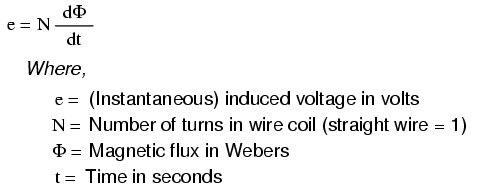
The differential notation “d” indicates the rate of change of magnetic flux over time. The letter “N” counts the turns of wire in a coil, amplifying the induced voltage when the wire is wound into a loop.
This principle underpins all electric generators: mechanical motion drives a magnetic field past coils to create usable voltage. It is also the foundation of transformers, inductors, and many other electrical devices.
When a current‑carrying wire’s current changes, its self‑generated magnetic field changes accordingly. Because this field is perpendicular to the wire, it can induce a voltage along the same conductor—a phenomenon known as self‑induction. Wrapping the wire into a coil or surrounding it with a high‑permeability core strengthens this effect. Devices that exploit self‑induction are called inductors, and they will be explored in the next chapter.
Key Takeaways
- A perpendicular, time‑varying magnetic field induces a voltage along a conductor; the magnitude depends on the rate of flux change and the number of coil turns.
- Faraday’s law:
e = N(dΦ/dt). - A changing current in a wire induces voltage along its length due to self‑induction, a principle that forms the basis of inductors.
Related Worksheets
- Advanced Electromagnetism and Electromagnetic Induction Worksheet
- Intermediate Electromagnetism and Electromagnetic Induction Worksheet
- Basic Electromagnetism and Electromagnetic Induction Worksheet
Industrial Technology
- Mastering Electromagnetic Induction: Build, Measure, and Analyze Magnetic Fields
- Exploring Voltage Addition with Series Battery Connections
- Voltage Divider Lab: Design, Measurement, and Kirchhoff’s Voltage Law Verification
- Thermoelectricity: Understanding Thermocouples and the Seebeck Effect
- Construct a Basic Transformer: Step‑by‑Step Guide
- Build a Permanent Capacitor Split-Phase Induction Motor – Step‑by‑Step Guide
- Build a Large-Scale AC Permanent Split‑Capacitor Induction Motor
- Tachogenerators: Precision Speed Measurement for Industrial Motors and Equipment
- Understanding AC Waveforms: Sine Waves, Frequency, and Oscilloscope Basics
- Understanding Faraday’s Law: How Electromagnetic Induction Generates Power