



Understanding Faraday’s Law: How Electromagnetic Induction Generates Power
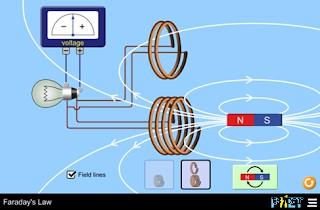
Faraday Law of Electromagnetic induction states that whenever a conductor is placed in a magnetic field such that the flux through it changes an EMF is induced in the conductor.that means that: EMF is directly proportional to the rate of change of flux | Faraday.
There are two types of induced EMFs. Namely Dynamically induced EMF and Statically induced EMF. Dynamically induced EMF: Produced by either the movement of the conductor or the magnet. Statically induced EMF: Produced by the change in current direction.Furthermore, there are two types of statically induced EMFs1) Self-induced EMF 2) Mutually induced EMF Lens’s Law states that a cause always opposes the effect. This law is also used to predict the direction of current flow, and it obeys the conservation law of energy. Generators: These are devices or machines which convert mechanical energy to electrical energy using the concept of “Electro magnetic induction”. A generator, in fact, comprises of two parts, the engine, and the generator. The engine converts the fuel to mechanical energy and the generator converts the mechanical energy to electrical energy. “A generator simply directs the flow of charges already present in a conductor coil” The energy produced from a generator depends upon the following: 1) The strength of the magnetic field 2) The number of turns in the coil 3) Angle at which the conductor cuts the magnetic field In order to find the direction of the current flow you must know the left-hand rule: Left-Hand Rule: 1) Adjust your hand such that your index finger points toward the direction of the magnetic field (From north to south).
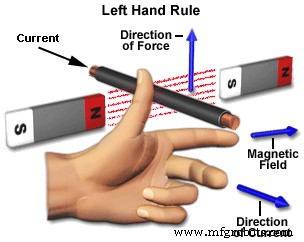 2) Point your thumb towards the direction of the movement of the conductor (it can be left, right, inward, outward).
3) Adjust your middle finger such that it makes an angle of 90 degrees with your index finger and the thumb, in this position the middle finger points towards the direction of the current flow.
2) Point your thumb towards the direction of the movement of the conductor (it can be left, right, inward, outward).
3) Adjust your middle finger such that it makes an angle of 90 degrees with your index finger and the thumb, in this position the middle finger points towards the direction of the current flow.
Understanding Electromagnetism: Key Concepts and Definitions
How AC Generators Work: A Clear, Simple Explanation
Industrial Technology
- Building and Troubleshooting a Basic 6‑V Battery‑Lamp Circuit
- Practical Ohm’s Law Experiment: Measuring Voltage, Current, and Resistance
- Mastering Electromagnetic Induction: Build, Measure, and Analyze Magnetic Fields
- Build a Permanent Capacitor Split-Phase Induction Motor – Step‑by‑Step Guide
- Electromagnetic Induction: The Engine of Modern Electricity
- Series LC Resonance: Zero Impedance and Voltage Peaks Explained
- Best EMF Detectors of 2020 – Accurate, Reliable, and User‑Friendly
- How AC Generators Work: A Clear, Simple Explanation
- Understanding Metal Fabrication: Processes & Applications
- BC547 Transistor: Key Features, Applications & Usage Guide