



Understanding Electromagnetism: Key Concepts and Definitions
Starting off with the definition of a Magnetic material:Any material which has its atoms ordered such that it exhibits the properties of magnetism | phycic
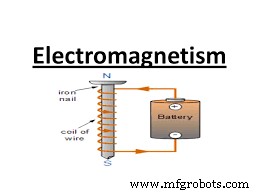
Any metal can be turned into a magnet giving it the characteristics of: Temporary Magnetism: Rub a metal on an already existing magnet in one direction, this process will cause the metal to polarize and inherent magnetic properties. But this will only last for a small while. Permanent Magnetism: If a metal is permanently polarized then it will not lose its magnetic properties. The best way to make a strong magnet is by inducing a magnetic field using an electric current. In order to tell the strength of a magnet the units “Weber” and “Maxwell” are used, these units are defined using the “magnetic flux”, Magnetic flux is the total number of magnetic lines passing through a unit area (denoted by Φ or ΦB). 1 Maxwell (Mx) = 1 magnetic line of force 1 Weber (Wb) = 10^8 Maxwell You cannot tell the strength of a magnet just by the number of magnetic lines of force passing through it, you need to know the relative area of the surfaces in comparison. Simply put it, you need to know the flux density (B). And you need to know the angle which the surface makes with the lines of force, (the angle between the normal of a surface and the flux). Φ=BA —-> NΦ= NBA (for more than one turn) B= Φ/A —-> (Weber/ meter^2) The flux density is measured using the unit “Tesla” 1 Tesla = 1 Weber/ meter^2 similarly 1 Gauss = 1 Mx/ cm^2 1 Wb/m^2 = (10^8)/(100^2) = 10^4 Mx /cm^2 That means: 1 Tesla = 10^4 Gauss
Understanding Space Debris: How Much Junk Is Orbiting Earth?
Understanding Faraday’s Law: How Electromagnetic Induction Generates Power
Industrial Technology
- Understanding 3D Printing Resolution: How Precision Shapes Print Quality
- Electromagnetism: From Oersted’s Discovery to Modern Applications
- The Canary’s Role: A Lifeline in Early Coal Mines
- Understanding 5‑Axis CNC Machining: Advanced Precision for Complex Parts
- Understanding Precision in CNC Machining: Key Concepts Explained
- What Is a Y-Valve in Hydraulics?
- Understanding Milky Hydraulic Fluid: Causes and Significance
- Understanding the Role of G-Force in Hydraulic Systems
- Understanding the CC Acronym in Hydraulics: A Guide for Engineers
- How to Become an Industry Leader: Key Strategies for Success