



What Is a Magnetometer? Fundamentals, Principles, and Real-World Applications
Learn the fundamentals of magnetometers, how they measure magnetic fields, and their wide-ranging applications—from everyday electronics to deep-space probes.
Magnetometers are precision instruments that quantify either the magnitude or direction of a magnetic field. They are ubiquitous in modern electronics: the tiny sensor in your smartphone determines whether the device is upright, while sophisticated units aboard NASA’s Mars rovers chart the planet’s magnetic landscape.
This article delves into the core physics behind magnetometers, their relationship to hysteresis curves, and a snapshot of the technologies you’ll encounter in everyday life and cutting‑edge research.
How Do Magnetometers Work?
Most magnetometers infer the magnetic field by measuring the induced magnetic moment. For a closed current loop with area A and current I, the magnetic moment m is a vector whose magnitude equals I×A. The torque (τ) experienced by the loop in an external field (B) is expressed mathematically as:
$$\overrightarrow{\tau} = \overrightarrow{m} \times \overrightarrow{B}$$
- τ – torque
- m – magnetic moment
- B – external magnetic field
Because the magnetic moment is a vector, a magnetometer’s ability to capture both direction and magnitude is crucial. Vector magnetometers report the full three‑dimensional field, whereas scalar units measure only its strength.
In the International System (SI), magnetic moment is expressed in ampere‑square metres (A·m²). In practice, you may also encounter units like erg/G, where 1 erg = 10⁻⁷ joules.
Magnetometers and Hysteresis Curves
Magnetic materials respond differently to external fields, falling into categories such as paramagnetic, diamagnetic, or ferromagnetic. Their behavior is elegantly captured by a hysteresis curve, which plots magnetic flux density (B) against magnetic field strength (H).
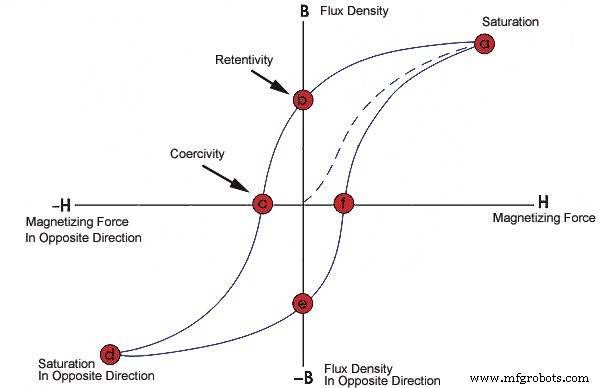
Figure 1. An example hysteresis curve. Image courtesy of NDT Resource Center.
Key features of these curves include retentivity—magnetization that persists after the applied field is removed—and coercivity, the reverse field needed to demagnetize the material. Mastering these properties has driven advances in physics, materials science, and engineering.
High‑Sensitivity Electronics for Magnetometer Readout
Because the signals generated by magnetic sensors are often minuscule and susceptible to noise, the accompanying electronics—filters, amplifiers, and sometimes lock‑in circuits—are critical. Modern designs frequently embed these conditioning stages inside an integrated circuit (IC), reducing error and saving space.
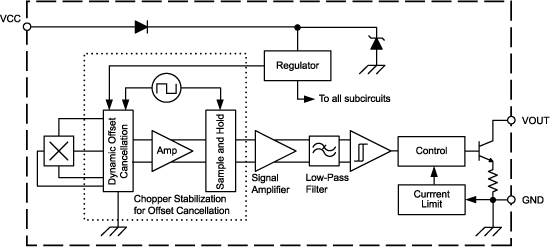
Figure 2. Internal components of a Hall sensor IC. Image courtesy of Allegro.
Discrete solutions remain valuable when bespoke conditioning is required, such as in novel research applications or highly specialized industrial processes.
Magnetometer Applications in Everyday Life and Research
From smartphones to scientific laboratories, magnetometers serve diverse roles:
- Hall effect sensors—used for motion detection and speed control in motor drives.
- MEMS magnetometers—integrated into inertial measurement units (IMUs) to provide orientation data for smartphones and drones.
- High‑end research instruments—vibrating sample magnetometers, SQUIDs, and AGFMs—probe magnetic properties at the atomic scale.
In motor applications, multiple Hall sensors are strategically placed around the shaft. Each passing metallic part induces a square or sinusoidal pulse, enabling precise calculation of rotational speed and position.
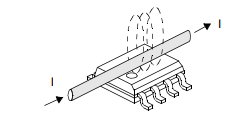
Figure 3. Hall sensor IC. Image courtesy of Microchip.
MEMS e‑compasses from manufacturers like STMicroelectronics are now commonplace in consumer electronics, allowing devices to auto‑rotate displays or navigate based on magnetic field readings.
Curious about a specific type of magnetometer or its application? Drop your questions in the comments below.
Sensor
- Understanding Magnetic Catches: Types, Benefits, and How to Choose the Right One
- What Is a Superconductor? Types, Materials, and Key Properties
- Types of Magnetometers: From Scalar to Advanced Vibrating‑Sample Devices
- Exploring MEMS Sensors: Accelerometers, Gyroscopes, and Magnetometers for Arduino Projects
- Revolutionizing Brain Imaging: The Wearable Metamaterial Explained
- Magnetic Labels: Versatile, Durable Inventory Solutions
- Understanding Electromagnetism: Key Concepts and Definitions
- Magnetic Shielding Explained: Safeguarding Devices from Magnetic Interference
- Understanding Magnetic Clutches: Function, Design, and Applications
- Understanding Magnetic Chip Conveyors: Function, Features, and Applications