



Types of Magnetometers: From Scalar to Advanced Vibrating‑Sample Devices
A comprehensive guide to the most common magnetometer types – scalar, vector, gradient, and advanced vibrating‑sample instruments.
Building on our previous introduction to magnetometers and their key applications, this article delves into the specific technologies that enable precise magnetic field measurement across a wide range of scientific and industrial settings.
Scalar Magnetometers
Scalar instruments deliver a single numerical value of the magnetic field’s magnitude, independent of direction. Their operating principles differ, but all rely on well‑established physical phenomena:
- Hall Effect: Measures the voltage induced across a conductor when exposed to a magnetic field, offering high accuracy and rapid response.
- Proton Precession (PPM): Utilizes nuclear magnetic resonance of protons; the precession frequency induces a voltage in a coil that directly reflects field strength.
- Overhauser: Similar to Hall and PPM, but employs radio‑frequency signals to polarize electron spins, enhancing sensitivity for geophysical surveys.

An Overhauser magnetometer for geophysical applications. Image courtesy of Gem System.
Vector Magnetometers
- Inductive: Determines a sample’s dipole moment by measuring the induced current in detection coils after applying a time‑varying field.
- Fluxgate: Features a magnetic ring core with drive and sense windings, delivering high‑resolution vector components.

Fluxgate magnetometers windings. Image courtesy of Imperial College London.
- Hall Effect: Generates a voltage proportional to both magnitude and direction of the field; favored in sensor applications over material characterization.
- Microelectromechanical Systems (MEMS): Detects motion of a resonant micro‑structure optically, enabling compact, cost‑effective vector sensing.

MEMS magnetometers are cheap and accessible. Image courtesy of Sparkfun Electronics.
Gradient Magnetometers
Gradient devices share common components: a calibrated field source (alternating or constant), an alternating gradient field generator, and a detection system—either electronic or optical—to measure the induced force. All operate resonantly, driving the sample near its natural frequency to maximize signal amplitude.
Orientation plays a key role: for instance, Zijlstra’s design aligns both AC and DC fields vertically, whereas Foner’s configuration vibrates the sample perpendicularly, simplifying the apparatus.
Vibrating Reed Magnetometer
Introduced by Zijlstra in 1970, the vibrating reed was the first alternating‑gradient instrument capable of mapping a material’s full hysteresis loop. A thin wire (the “reed”) holds a minute sample at its tip. Two coils in series opposition create a field gradient, exerting a force that causes the reed to vibrate at its mechanical resonance. The vibration amplitude, observed via a microscope and stroboscope, directly reflects the sample’s magnetic moment.
Its high sensitivity and complete characterization capability require extremely small samples; larger specimens limit the method to measuring remanence or susceptibility rather than the full hysteresis cycle.
Vibrating Sample Magnetometers (VSM)
Invented by Foner in 1959, VSMs pioneered perpendicular sample motion relative to the applied magnetic field, reducing setup complexity by avoiding modifications to the magnet system. Today, VSMs are ubiquitous in research laboratories and are available commercially.
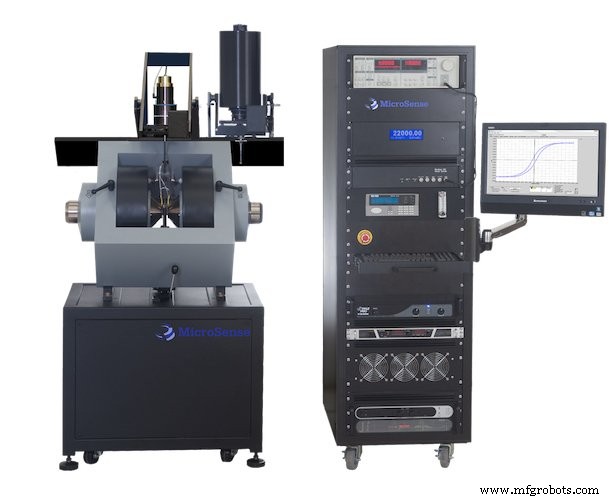
A commercial vibrating sample magnetometer (VSM). Image courtesy of Microsense.
Combined Alternating Field Magnetometers
These hybrid instruments merge features of scalar, vector, and gradient devices by applying two alternating magnetic fields instead of one AC and one DC field. This approach enables simultaneous AC and DC characterization, capturing high‑order harmonics of the magnetic moment.
Unlike conventional gradient magnetometers, which rely on a single resonance frequency, combined systems set one field to 0 Hz, thereby functioning as a traditional gradient device when needed. Developed in 2015 by researchers at the Technical University of Madrid, this technology extends measurement capabilities to complex magnetic materials.
Sensor
- 5 Essential Types of Socket Wrenches for Every Technician
- Resistor Types Explained: From Potentiometers to Thermistors
- Capacitor Types: Polarized, Non-Polarized, and Variable Explained
- Understanding Electrical Switches: Types, Functions, and Applications
- Understanding Relay Construction: From Solenoids to Industrial Applications
- What Is a Superconductor? Types, Materials, and Key Properties
- What Is a Magnetometer? Fundamentals, Principles, and Real-World Applications
- Understanding Variables in C#: Types, Storage, and Usage
- Revolutionizing Brain Imaging: The Wearable Metamaterial Explained
- Sustainable 3D‑Printed Magnets: Eco‑Friendly, Precision‑Shaped Solutions for Modern Electronics