



Understanding Relay Construction: From Solenoids to Industrial Applications
Electricity and Magnetism
When an electric current flows through a conductor, it generates a magnetic field that circles the conductor. If the conductor is wound into a coil, the magnetic field aligns along the coil’s axis. The stronger the current, the stronger the magnetic field, all else equal.
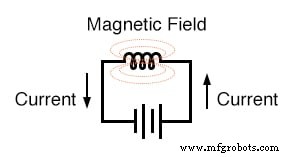
Inductors and Magnetic Fields
Inductors resist changes in current by storing energy in their magnetic field. In a transformer, two inductive coils share a common iron core so that the field from one coil can transfer energy to the other. Beyond transformers, electromagnetic fields can be harnessed for mechanical motion.
Solenoids
When a magnetic field from a current‑carrying coil pulls on a nearby magnetic object—called the armature—a solenoid is formed. The armature can be driven by either DC or AC, and the polarity of the field is irrelevant for attracting ferrous material. Solenoids power door latches, valves, robotic joints, and switch mechanisms. When a solenoid actuates contacts, the device is referred to as a relay.
Relays
Relays are indispensable for controlling large currents or voltages with a modest electrical signal. The coil may draw only a few milliamps, while the contacts can carry hundreds of amps. In effect, a relay amplifies a low‑power control signal into a high‑power action. This property makes relays essential in logic circuits and industrial automation.
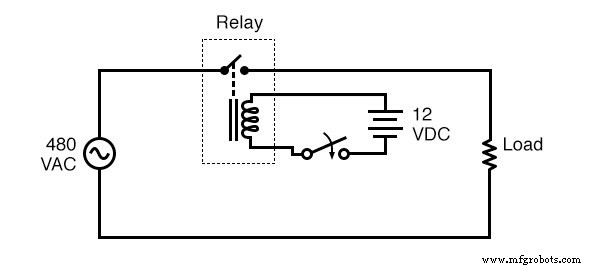
In the schematic above, a 12 VDC coil energizes a single‑pole, single‑throw contact that interrupts a 480 VAC circuit. Typical relay coils draw <1 A, whereas industrial contacts are rated for 10 A or more.
Relay Assembly
One coil/armature assembly can operate multiple contacts—normally open, normally closed, or a mix. The contacts are in their “normal” state when the coil is de‑energized. Contact types include open‑air metal pads, mercury tubes, and magnetic reeds, chosen based on current capacity, corrosion resistance, and spark suppression.
Physical Relay Device Examples
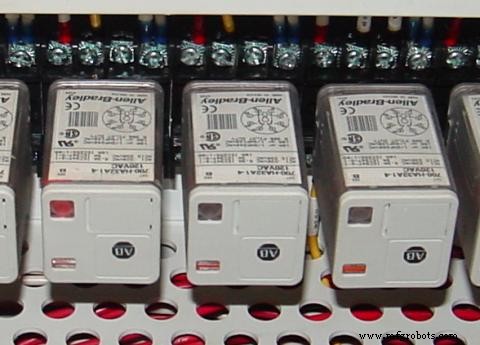
Three small octal‑base relays, each about two inches tall, are mounted on a control panel in a municipal water treatment plant. Octal‑base relays plug into sockets secured by eight metal pins, allowing quick removal and replacement.
Other Benefits of Relays
Relays provide electrical isolation between the coil circuit and the contact circuit, allowing one side to be DC and the other AC, or to operate at vastly different voltage levels. This isolation protects sensitive control electronics from high‑voltage spikes.
Pull‑In Current and Drop‑Out Current
Relays exhibit hysteresis. To actuate, the coil must supply a minimum current—known as the pull‑in current—analogous to a logic gate’s high‑input threshold. Once the armature is in position, a lower current, the drop‑out current, suffices to keep it there. The difference between pull‑in and drop‑out currents creates a Schmitt‑trigger‑like behavior, ensuring clean on/off operation.
Review
- A solenoid produces mechanical motion from an electromagnet coil; its movable part is the armature.
- A relay is a solenoid configured to actuate switch contacts when energized.
- Pull‑in current is the minimum coil current needed to move the armature from its normal state.
- Drop‑out current is the maximum coil current below which the armature returns to its normal state.
Related Worksheets
- Basic Electromagnetic Relays Worksheet
Industrial Technology
- Detecting AC Magnetic Fields with a Coil and Audio Detector
- Solid‑State Relays: Advantages, Limitations, and Practical Insights
- Battery Construction Fundamentals: Cells, Internal Resistance, and Connectivity
- Permanent Magnets: From Ancient Lodestone to Modern Ferromagnetism
- Electromagnetism: From Oersted’s Discovery to Modern Applications
- Magnetic Units of Measurement Explained: Fundamentals, SI, and Practical Equivalents
- The Evolution of Videotape: Revolutionizing Media & Home Entertainment
- Rammed Earth Construction: Sustainable, Durable, and Energy‑Efficient Building
- Magnetic Labels: Versatile, Durable Inventory Solutions
- Professional Ski Lift Tower Construction – Safe, Efficient, Reliable