



Solid‑State Relays: Advantages, Limitations, and Practical Insights
Limitations of Electromechanical Relays
While electromechanical relays are versatile, they come with notable drawbacks. They can be costly to manufacture, have a finite contact cycle life, occupy significant space, and switch at slower speeds compared to modern semiconductor devices. These issues are particularly pronounced in large‑power contactor relays.
Solid‑State Relays
To overcome these challenges, many manufacturers now offer solid‑state relays that employ SCRs, TRIACs, or transistors instead of mechanical contacts to control power. The output device is optically coupled to an internal LED. When the LED receives low‑voltage DC power, the relay activates, providing optical isolation that rivals the best of electromechanical relays.
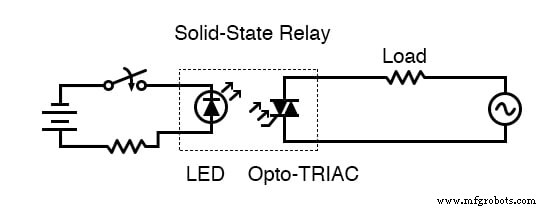
Advantages of Solid‑State Devices
- No moving parts mean virtually no wear and far faster switching than any mechanical armature.
- Eliminates sparking and contact corrosion.
- SCRs and TRIACs naturally interrupt AC circuits at zero load current, a feature known as zero‑crossing switching. This prevents the voltage spikes that can occur when inductive loads are suddenly opened.
- The inherent hysteresis of thyristors keeps the circuit closed until the current drops below the holding threshold, ensuring smooth operation.
Disadvantages of Solid‑State Relays
- They are more prone to fail in a shorted state, whereas electromechanical relays typically fail open. A fail‑open condition is generally safer, which is why electromechanical relays still dominate certain safety‑critical applications.
- Designing for zero‑crossing can add complexity in some circuits.
RELATED WORKSHEETS:
- Thyristor Application Circuits Worksheet
Industrial Technology
- Understanding Relay Construction: From Solenoids to Industrial Applications
- Protective Relays: Safeguarding Industrial Power Systems
- Advances in Solid‑State Nanopore Fabrication and Applications
- Effortlessly Control and Synchronize Hundreds of Relays with IO Expanders
- Testing SSR and Coil Relays: A Step‑by‑Step Guide Using Multimeter and Battery
- Switchgear Relays: Essential Features and Their Impact on Electrical System Reliability
- Choosing the Right Relay: Types, Functions, and Applications
- Voltage Relays Explained: Switching High Currents with Low Control Signals
- Automotive Relays Explained: Purpose, Types, and How They Protect Your Vehicle
- Essential Guide to Relays: Types, Applications, and History