



Key Factors in Designing Contactor Contacts
Factors of Contactor’s Contact Design
The Following factors consider while designing the Contactor’s contacts Current carrying Capacity The ability of current carrying capacity of contacts takes into account while designing contactor’s contacts. The same factor consider while selecting the material for contacts. Hard drawn copper or forged copper is a good option for better result. Pressure between Contacts Pressure between contacts is directly proportional to the current carrying capacity of contactor’s contacts, i.e. when pressure between contacts increase, Current carrying capacity of contacts also increases. But there is a limit and it is not useful to increase the pressure to cross the limit, however, we may increase the pressure to get the desired result. Mass of the contact Heat emission from the contactor’s contacts is directly proportional to the mass of contacts. So the mass of the contact is another factor which is to be considered while designing contacts. Radiation In contact designing, they define the power loss at a given temperature and can increase the available radiation surface for heat emission by the proper sizing of mass. Surface of the Contacts The Contactor’s surface should be clean and seamless without oxide layers. Contactor’s contact surface may get rough, corrugated and black. In this case, contacts may be overhauled or totally replace with new ones. Click image to enlarge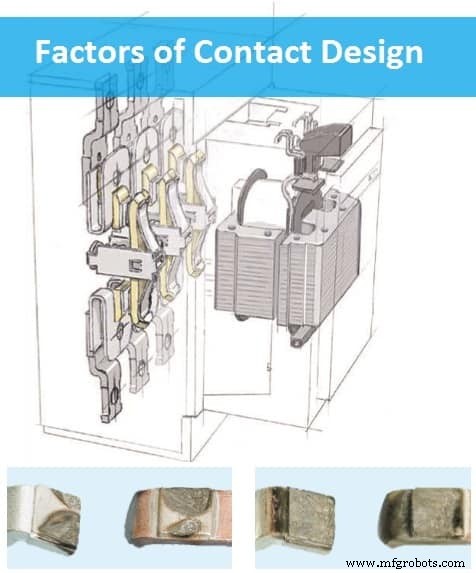 So these were the factor of Contactor’s Contact Design, in next posts, we will discuss about Contactor Designing.
You May also Read:
- Main Difference between contactor and Starter.
- Rated characteristics of Electrical Contactors
- Why We Need to Install a Starter with a Motor?
Understanding Star and Delta Wiring for Multi‑Storey Lighting Systems
Accurate Battery Testing: How to Use a Test Meter Effectively
Industrial Technology
- Why Tungsten Contacts Power Reliable Electrical Appliances
- Designing Reliable Switch Contacts: Materials, Types, and Protection Strategies
- Eliminating Contact Bounce in Mechanical Switches
- Understanding Time-Delay Relays: Types, Applications, and Advanced Features
- Understanding Digital Logic Functions: OR, AND, NOT, and Beyond
- Optimizing Ohmic Contacts on p‑GaAs Nanowires for Low‑Resistance, High‑Reliability Devices
- Contactor vs. Relay: Key Differences Explained for Engineers
- Heat Sink Design Essentials: Key Factors & Calculation Methods
- 7 Essential Factors for Crafting High-Quality PCB Designs
- Key Design Factors Influencing PCB Thickness for Reliable Performance