



How Modern Technology is Transforming Medicine into a New Era of Healing
Modern medicine has come a long way from the days of the town doctor making house calls. In those days, a typical doctor might carry tools that looked more like something out of your garage tool box than today’s modern medical devices. Modern medical devices are truly technological wonders. Today’s surgeries are focused on less invasive techniques utilizing very precise instruments. This drive toward noninvasive surgeries pushes the limits of manufacturing capabilities.
Most medical devices today have a very specific purpose, and they are manufactured with very precise specifications. In order to achieve these tight specifications, highly accurate CNC machines are used. Many medical companies rely upon sophisticated Swiss type CNC machines which can have up to 12-axis simultaneous movements, making complex shapes and features possible. Along with Swiss machines, 5-axis CNC milling machines are also used to produce the wide variety of instruments needed for today’s noninvasive surgeries. In addition to tight tolerances, the materials used in these instruments can be very challenging to machine. These materials have a specific purpose to reduce the chance of infection or rejection. Some examples of these materials include Titanium, 300 and 400 series stainless steel, 17-4 stainless steel and cobalt chrome to name a few. Many of the parts are very small adding to the challenge of machining medical parts. In order to address these challenges, cutting tool manufactures have made great strides from the early days of machining.
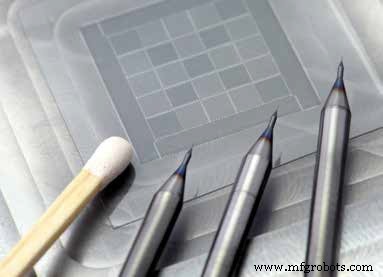
In the early days, HSS was the most common base material for cutting tools. Today, carbide is much more widely used for its wear resistance and ability to withstand higher heat in the cutting zone. Cutting tool manufacturers’ focus has been on producing new tool geometries to effectively cut the difficult to machine materials used in the medical industry. There has also been an emphasis on going smaller to produce very delicate features required on many medical parts. Miniature tools have also played a large role in the capabilities to produce intricately small parts inherent in the medical industry. In addition to new cutting tool geometries, more wear resistant base materials, miniature tools and tool coatings have made a major contribution in today’s modern cutting tool performance.
There are many coatings available today from single layer to multiple layers. They are all applied to extend tool life by adding lubricity and improving heat resistance. Many cutting tool manufactures, like OSG have their own proprietary coatings to maximize their cutting tool performance. Because of these manufacturing advances, the medical industry has made significant breakthroughs, especially around non-invasive surgery. In order to achieve future breakthroughs, medical devices continue to become more complex and specialized, and many more technological advances are likely to occur.
In the end, the big winner is the patient. Modern medical devices have drastically improved many surgical processes, which in turn improves the quality of people’s lives.
Industrial Technology
- New Possible Podcast: fuseproject Leads Medical Design Against COVID-19
- Master Precision Medical Machining: 8 Essential Techniques for Titanium, Cobalt‑Chrome, and Stainless Steel Parts
- How Medical Materials Have Transformed Orthopedic Surgery
- Medical Machining: Expert Guidance on Cutting Tools for Precision & Success
- How Modern Technology is Transforming Medicine into a New Era of Healing
- Tailored Machining Technology for Shops of All Sizes
- Tool Steel Demystified: Composition, Manufacturing, and Industrial Applications
- Laser Turning: A Breakthrough Tool for Complex Medical Parts
- Advanced Turning Centers & CNC Machine Technology
- Precision Swiss-CNC Machining of MP35N® Medical Electrodes for Superior Device Performance