



Boost Manufacturing Efficiency: Proven Measurement & Improvement Strategies
Why is Efficiency Important for Manufacturers?
Improving production efficiency in manufacturing is a key tenet of the industry. Leveraging lean strategies to drive down the costs of production while retaining quality and increasing throughput are a constant challenge. However, with a mindset of continuous improvement, manufacturers see this more as an opportunity than a problem.
After all, manufacturers can only be so efficient, and as long as they are beating out competitors, they are winning. However, as new technology emerges that allows them to use data to make better, faster decisions, there will be a rising tide of what is accepted as “standard” within the industry. For example, despite the number of workers employed in manufacturing declining, output has grown.
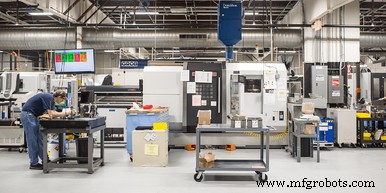
Productivity vs. Efficiency in Manufacturing: Here’s The Difference And Why It Matters
Productivity and efficiency are not synonymous, contrary to popular usage. While they are both worthy paths of optimization, manufacturers should understand each concept and the relationship between them in order to guide these improvements.
Productivity is a Measure of Efficiency, but Not Vice Versa
Product, production, productivity—all words you’ll hear many times a week in any manufacturing facility, all with the same root. This is the easiest way to remember the meaning of productivity.
“Productivity is commonly defined as a ratio between the volume of output and the volume of inputs. In other words, it measures how efficiently production inputs, such as labour and capital, are being used in an economy to produce a given level of output. Broadly, productivity measures can be classified as single factor productivity measures (relating a measure of output to a single measure of input, e.g. labour productivity) or multifactor productivity measures (relating a measure of output to a bundle of inputs, e.g. multifactor productivity). Productivity is considered a key source of economic growth and competitiveness.” – OECM Library
In simpler terms, productivity is the measure of how much you produce compared to how much of whatever resource it took to produce it.
Efficiency is Broader than Productivity
Efficiency takes into consideration more than simply input and output by the numbers. Efficiency includes things like quality and effectiveness of work and can suffer when productivity is overly-prioritized.
Instead, setting efficiency goals helps manufacturers focus on the bigger picture and aims to do work correctly, not just productively. Focusing on efficiency means utilizing resources as optimally as possible and maintaining a high quality of work, minimizing risk and reducing potential losses.
That is not to say productivity should be neglected for the sake of efficiency. If you can’t meet demand, then you still have angry customers (or would-be customers) and, unless you’re intentionally using scarcity tactics to your advantage, you lose out on a lot of potential business and related revenue.
Five Stages for Improving Manufacturing Cycle Efficiency
Manufacturing cycle efficiency begins far before a widget is produced, and continues after production as well.
It’s important for companies to take into consideration all elements of this timeline in order to provide a product that ensures a competitive cycle time.
Each element of the product lifecycle — from innovation, design, and development to testing and, eventually, manufacturing — must be examined in order to remove waste from the overall process.
Below is a shortened version of the full article on improving cycle efficiency.
Concept and Development
Developing new products often leads to a fair amount of waste simply because efficiency is not wrapped into the process.
Ordering Process
Without a streamlined ordering process to account for possible complicating factors, like the currently held amount of stock, volume of sales, or future trends., manufacturing cycle efficiency can be easily hindered.
Production Scheduling
Production should be scheduled in such a way that maximizes a company’s manufacturing facilities, including both available equipment and labor.
Manufacturing
To become leaner and eliminate waste, savvy companies employ machine monitoring software to get real-time visibility into shop floor performance.
Transportation
Cancellations and payment delays, among many other problems, are just two outcomes that can undermine all your efforts at manufacturing cycle efficiency.
 A dashboard from MachineMetrics that analyzes cycles.
How to Calculate Manufacturing Efficiency
Measuring and analyzing your successes, failures, and progress is critical to success in the manufacturing world.
Manufacturing efficiency can be calculated using different sets of numbers relevant to efficiency, but the overall concept remains the same. In order to find your manufacturing efficiency, you simply divide your standard output by your actual output, then express this number in percentage form. There is software that can do this for you automatically, or you can calculate it manually.
Calculate Your Actual Output
Of course, this first requires you to define your outputs. To determine your actual output, divide your total output by your total input. How you express this will depend on which unit you choose to measure productivity in.
We’ll use an overly simplified example:
- You can create 50 widgets for the cost of $100
- As a result, each widget costs $2.
- Input: $100 Worth of Costs
- Output: 50 Widgets
- Actual Output: $100 of Costs / 50 Widgets = $2 per Widget
Calculate Your Standard Output
Standard output can be something you pull from your own historical data or from an industry benchmark which you might find in a report. In this way, you can measure yourself against your past performance, a competitor, or the industry as a whole.
Combined, these two numbers can give you your manufacturing efficiency which can be used to set KPIs in conjunction with other measures of efficiency.
Continuing with the example above, let’s say a competitor, who you would like to compare yourself against, is able to produce 55 widgets at a cost of $100.
- Competitor’s Actual Output: $100 of Costs / 55 Widgets = $1.82 per Widget
- Your Standard Output = $2 per Widget / $1.82 Per Widget = 1.0989
1.0989 suggests that it costs you roughly ten percent (9.98%) more to produce a widget than it does for your competitor. Based on these metrics, you are approximately 10% less efficient than the competitor you are measuring against.
Taking Your Operation to the Next Level with Data
There are a myriad of ways to measure productivity and efficiency in manufacturing, all with the intention of understanding production performance in relation to the profitability of the organization. At the end of the day, stakeholders at every level of the company, from operators to managers to supervisors to corporate, must have a strong understanding of how the shop floor is performing. And this is only possible when the team has complete visibility into accurate, real-time production data and reports in order to make better, faster decisions.
MachineMetrics helps manufacturers easily collect and use production data to boost both productivity and efficiency. Our plug and play solution gives operators and managers the tools they need to act fast, giving them instant visibility and control of the shop floor. In fact, customers see ROI in as few as five days as MachineMetrics can easily highlight major production bottlenecks. Interested in learning how we can help? Set up a demo with out team today.
Industrial Technology
- Mastering Lean Maintenance: Build, Measure, and Sustain a Waste‑Free Strategy
- Maximize Productivity During Manufacturing Downtime: Proven Strategies for Cost Control and Safety
- AI and Robotics Revolutionize Manufacturing: Boosting Quality & Efficiency
- Proven Strategies to Maximize Manufacturing Efficiency and Cut Costs
- Harnessing Automation in Manufacturing: Boost Efficiency & Cut Labor Costs
- Boost Your Manufacturing Efficiency: Proven Strategies to Maximize Productivity
- Enhancing Laboratory Safety and Efficiency Through Optimized Gas Distribution
- Boosting Fiber‑Optic Production: Rosendahl Nextrom’s Customized Solutions for Quality & Efficiency
- Boost Industrial Productivity & Quality: Proven Strategies for Manufacturing Success
- Mastering Tooling & Mold Design: Your Essential Manufacturing Guide