



Industry 4.0 vs. Industrial IoT: Understanding the Key Differences
What is the Difference Between Industry 4.0 and the Industrial Internet of Things (IIoT)?
The Industrial Internet of Things (IIoT) refers to sensor data, machine communications, and automation systems. It is more specific than the broad term Industry 4.0, which encompasses the entire digital change of the industry.
It may help to think of these concepts in a hierarchy format. The Industrial IoT is one of many forms of emerging Industry 4.0 technologies to increasingly be adopted by manufacturers. For reference, whereas the First Industrial Revolution was dominated by basic material like iron and steel as well as fuels such as coal and steam, the Fourth Industrial Revolution is driven by big data, the cloud, artificial intelligence, Industrial IoT, and several other technologies.
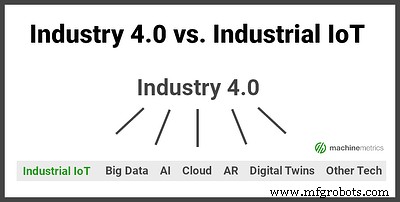
Industrial IoT is one of many technologies that fit under the umbrella of Industry 4.0, which is more of a revolution in industry than it is any one technology solution.
Industry 4.0, as well as IIoT will continue to have a major impact upon manufacturers as well as the world as a whole. These concepts will dominate previously untapped industries that have historically lacked digitization, unlike consumer tech, telecommunications, and other industries, which have adopted many of these technology already.
However, this leaves massive amounts of opportunities for manufacturers, with even simple solutions like machine monitoring creating massive improvements in production.
If you are looking to learn more about Industrial IoT or the various buzzwords and terms surrounding these subjects, you'll get value from "The Industrial IoT Dictionary for Manufacturing" which covers many of the key terms pertaining to the new age of manufacturing.
Industrial Technology
- Securing the Industrial IoT: A Practical Roadmap
- IoT and Industry 4.0: How the Fourth Industrial Revolution Is Shaping Manufacturing
- Industrial IoT: Key Building Blocks Driving Industry 4.0
- Marketing Goals vs. Marketing Strategy: Understanding the Key Differences
- ISO 9000 vs. ISO 9001: Key Differences Explained
- MIG vs. TIG Welding: Choosing the Right Technique for Your Project
- Ferrous vs. Non-Ferrous Metals: Key Differences Explained
- Industry 4.0 vs Industry 5.0: What’s Changing and Why It Matters
- Four Key IoT Solutions Transforming the Compressed Air Industry
- Understanding the Fourth Industrial Revolution: Transforming Modern Manufacturing