



Maximize Cloud Computing for Rapid Reliability Verification in IC Design
In today’s fast-moving industrial and consumer products, integrated circuit (IC) design companies know that getting their designs to market on or ahead of schedule is crucial to maintaining or gaining competitive success. However, they also know that the performance of their products after they hit the market is equally critical. Getting a product to market, only to have it fail to deliver the performance or product life the advertising promised, is the nightmare companies never want to have.
For that reason, reliability verification is now an essential part of the IC design and verification flow. The scope and complexity of reliability issues, such as electrostatic discharge (ESD) and latch-up protection, has grown substantially as designs moved to the most advanced process nodes (figure 1). In response, most foundries now provide some form of reliability design rules, which are enabled by electronic design automation (EDA) companies in the form of automated reliability verification tools and checks [1-3].
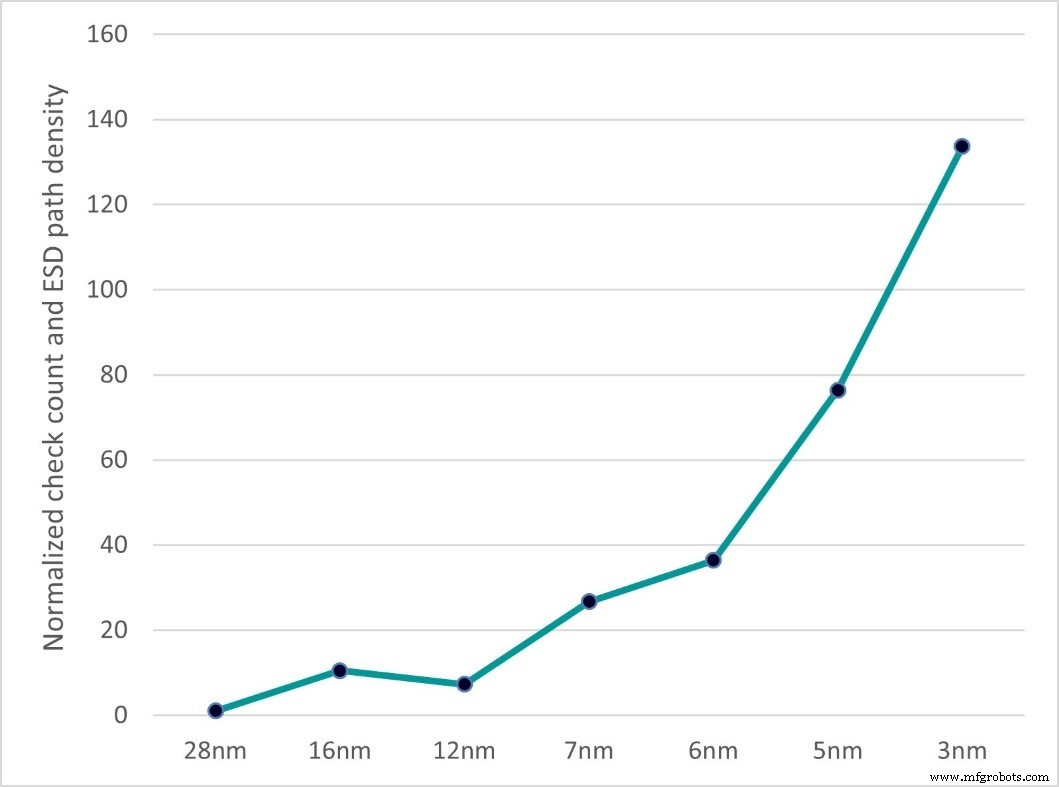
Figure 1. Growth in check count complexity and ESD path density over process nodes.
Of course, like every other form of automated IC design verification, running reliability verification flows requires time and resources…sometimes more than a company has available. Not every company has the ability to acquire and manage enough on-site compute resources to keep reliability verification flows on schedule. Fortunately, now there’s another answer—cloud computing.
Using 3rd-party cloud computing resources to satisfy “peak demand” periods when validating a full chip with foundry rule decks is a scalable and sustainable approach to timely reliability verification. However, companies need a clear understanding of the requirements, limitations, and costs of cloud computing to make intelligent cost/benefit decisions when adopting a cloud technology option.
When using cloud servers, companies are charged based on the number of servers used, the class of the machine, and the total usage time. The optimal number of cloud servers to use and their configurations depend on the types of the reliability verification flows you’re running, the EDA tool you’re using, the size of the design, your tapeout timeline, and how much money your company is willing or able to spend on cloud access [4].
To demonstrate the potential benefits of running reliability verification flows in the cloud, we ran a series of experiments on a full-chip system-on-chip (SoC) design, using the Siemens EDA Calibre PERC reliability verification flows with a major commercial cloud service provider. We ran the same Calibre PERC flow (using the same SoC design and rule decks) a total of three times on different numbers of cloud servers:
- 1 cloud server with 16 physical cores using Calibre multi-threaded (MT) technology
- 5 cloud servers, each with 16 physical cores, using Calibre flexible MT (MTflex) technology. The 5 servers were organized as 1 primary + 4 remotes in the Calibre MTflex configuration.
- 51 cloud servers, each with 16 physical cores, using Calibre MTflex technology. The 51 servers were organized as 1 primary + 50 remotes in the Calibre MTflex configuration.
We recorded the runtime for each flow and compared the results, as shown in figure 2. For 1 server, 5 servers, and 51 servers, the Calibre PERC run completed in 106 hours, 31 hours, and 9.5 hours respectively. In addition, memory for each of the MTflex runs was reduced by 10% compared to the single machine MT run.
Read the article in full: Are you optimizing the benefits of cloud computing for faster reliability verification?
Industrial Technology
- Understanding Cloud Computing: How It Works and Why It Matters
- Essential Cloud Computing Skills for Today’s IT Careers
- 10 Compelling Reasons to Adopt Cloud Computing for Your Business
- Why Cloud Computing Training Elevates Developer Careers
- Hybrid Cloud: The Cornerstone of Modern Edge Computing
- Maximizing ROI and Security with Public Cloud Adoption
- Cloud Maintenance: Unlocking Efficiency, Reliability, and Cost Savings
- Maximizing Robotic Welding Efficiency with Cloud Computing
- Why Small Manufacturers Should Export: Key Benefits & a Practical Starter Guide
- Harnessing Cloud Computing: Transformative Benefits for Manufacturing