



Hot Metal Stamping 101: Fundamentals & Best Practices
Metal stamping transforms sheet metal into usable parts and tools for numerous industries. With almost as many styles as industries that the process serves, recognizing and understanding the complexities of this part formation method becomes a critical aspect of selecting services for part creation.
What Is Metal Stamping?
Generally, metal stamping takes cold metal and places it between dies, though some processes use heated material. Pressing the material forms the metal into the desired shape. Often these shapes create tools or components of larger creations. Occasionally, some in the fabrication industry may refer to metal stamping as pressing.
Stamping dies inside the machines either cut or form the metal. These dies have specific designs for each project. Though making dies takes a while, once finished with the die, the stamping process occurs very quickly.
This process allows for the production of a high volume of identical parts. Stamping may be one step of many in part creation, or it could serve as the only one. Punching, blanking, embossing, flanging, bending and coining are some of the stages a metal may undergo as part of the stamping process.
The versatility of stamping makes it an ideal production method for industries such as the automotive, military, public transportation and manufacturing sectors as well as many others.
Types of Stamping
The type of stamping used depends on the desired finished product. Precision, hot metal and progressive die are some of the most commonly used stamping procedures.
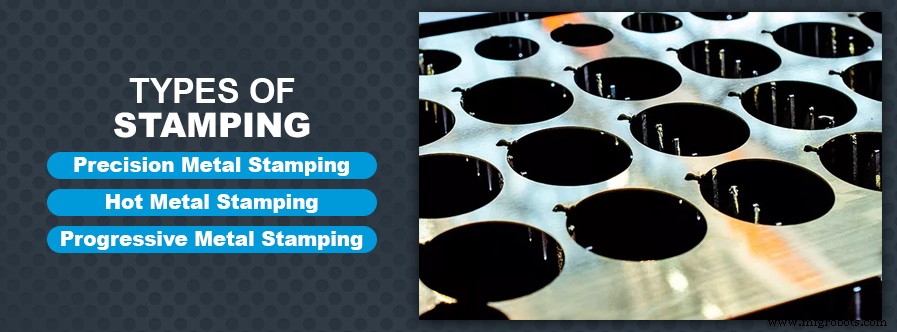
1. Precision Metal Stamping
Precision stamping creates raised images or three-dimensional pieces and results in finished products with tight tolerances. Compared to other forms of stamping, precision stamping involves fewer movements of the material between machines, which makes the process much faster.
The high levels of precision capable with this method of stamping allow the formation of intricate designs that must tightly adhere to their specifications. You can use precision stamping on components with tolerances of 0.001 to 0.002 inches for length and 0.0005 to 0.001 inches for roundness. Aircraft components, engine parts, electronics, telecommunications devices and prototypes all are commonly crafted using precision metal stamping.
A variation of this process is micro-precision stamping. This method creates intricate parts for the electronics or medical industries that measure as thin as 0.002 to 0.005 inches.
2. Hot Metal Stamping
Hot metal stamping is the process of forming metal using extreme heat. The metal, boron steel, is heated to over 1700 degrees Fahrenheit and quenched in the die itself. The result is a high-strength, lightweight steel part.
One of the main advantages of a hot metal stamped part is its high tensile strength, which ranges from about 50 kilopounds per square inch (KSI) to about 200 KSI once the process is complete. Hot stamping also allows you to form complex parts all at once, meaning less welding or other joining measures. Parts produced from this method also do not experience spring-back and warping in the way other high-strength steel formed parts tend to. Unfortunately, the hardened part is difficult to cut, making post-formation trimming and cutting a challenge. You will generally need a powerful laser for these processes.
To perform hot metal stamping, you need several pieces of equipment, including:
- A heating system capable of heating the metal to the necessary temperature
- An adequate cooling system
- An automated handing system, as the completed part will initially be far too hot to touch
- Tooling materials that are highly resistant to thermal shock
- A hydraulic/servo press with dwell capabilities
Your stamping press system obviously must conform to all safety requirements.
3. Progressive Metal Stamping
Progressive stamping, also known as progressive die stamping, takes metal pieces through multiple stations that each perform a separate action on the metal. Throughout these various stages, the metal piece remains attached to a long strip of material. The last machine cuts the finished piece from the metal strip.
When selecting fabrication methods for long-run processes that require high volume, progressive die stamping is an excellent choice. The dies last a long time, and the process produces minimal waste.
When creating larger parts that may need different presses, you will need to use transfer die stamping. This process only differs from progressive stamping in several small ways. The piece is seperated from the metal strip earlier, and a conveyor belt passes the part from machine to machine.
How Metal Stamping Works
Metal stamping refers to the process of forming a piece of sheet metal into a finished piece through punching, blanking, bending and other methods. Let’s take a closer look at how this process works.
What Types of Metal Stamping Materials Do Fabricators Use?
For stamping, fabricators start with a piece of sheet metal. The thinly crafted metal offers strength for the finished products while remaining flexible enough for the stamping process. Most often, the metal has a thickness ranging from 0.001 inches to 0.625 inches.
Despite the thin size of the metal, presses must exert significant pressure to cut and form the material. For example, the force needed to cut a 10-inch circle from 1/8-inch-thick steel is 78.5 tons. In the metal fabrication industry, this force corresponds to a low force. Metal stamping machines can generate from 10 to 50,000 tons —20,000 to 1 million pounds — of pressure.
The type of metal used will determine the force needed to shape and cut it. The most common categories of metals used include the following:
- Ferrous Metals: Iron-based metals, such as stainless steel, cost the least and lower production prices.
- Non-Ferrous Metals: Nickel, bronze, brass and other metals that do not contain iron create this category.
- Non-Standard Alloys: The metals in these alloys depend on the desired properties of the final product.
- Precious Metals: Gold, silver and platinum are expensive but needed for specific applications.
Knowing the types of press forces and processes to use with which materials is part of the expert knowledge that goes into metal stamping. For example, precision stamping tends to use specific alloys or precious metals in strips rather than on coils.
What Happens During Forming?
The formation stage happens when a press bends or otherwise shapes the metal. Several methods shape the metal, depending on the thickness of the metal and what the final part looks like.
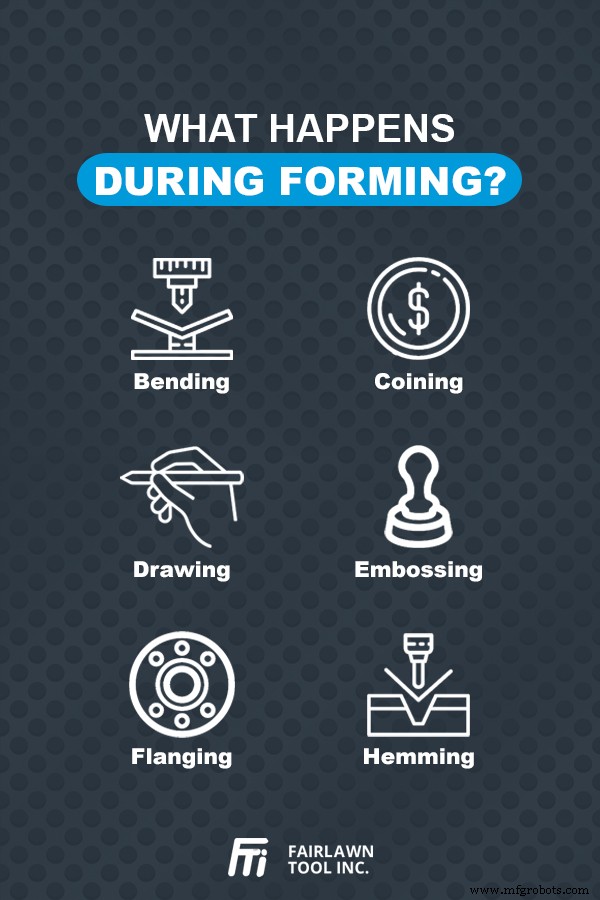
- Bending: Bending folds a metal along a single, straight axis.
- Coining: Coining presses the metal into a finished part with crisp edges.
- Drawing: The drawing process pulls a metal over a form, which stretches the material. Oil pans and metal sinks are examples of products created by drawing.
- Embossing: When a metal needs a design on it, a machine stretches and pulls it onto a depression. Lettering, designs and images require embossing for their creation on metal surfaces.
- Flanging: Similar to bending, flanging folds metal along an axis that curves instead of the straight line that bending creates.
- Hemming: Hemming creates an extra-strong edge with the bottom folded up onto itself.
These formation processes may occur during stamping, though other types of metalworking can also use these same methods.
What Are Cutting Processes?
Cutting the metal may occur before or after formation, depending on the type of stamping process used. For example, progressive die stamping trims the finished product at the end of the process, but transfer die stamping cuts off the metal at the beginning.
The cutting methods used require different cutting dies to achieve the desired result.
- Blanking: A blanking cut removes the basic shape of the material needed, and workers set aside the rest of the metal.
- Lancing: In progressive stamping, the metal may require lancing, which creates small cuts in the metal to allow for greater flexibility of the material as it passes through the presses.
- Punching: Instead of saving the portion cut from the metal, punching takes a hole out of the metal. The material cut from the metal will have another use while the metal surrounding the hole will progress through the stamping process.
- Shearing: Shearing cuts the metal along a straight line, the way scissors cut paper.
- Trimming: Trimming cuts the finished or nearly finished part from the blank. The facility may reuse the leftover metal, sell it for scrap or recycle it.
Metal Stamping Pros and Cons
As with any process, metal stamping has advantages and disadvantages. Some of the main benefits and drawbacks include the following.
Metal Stamping Advantages
The stamping process offers multiple benefits to those who select it for part creation.
After producing the dies, metalworkers can produce large volumes of parts in relatively little time. The use of CNC machining and other forms of automation make production even faster.
When comparing costs, die production for metal stamping has a lower price tag than different types of metal forming. Additionally, if using ferrous metals, the price of the project decreases even more.
One significant advantage of using sheet metal stamping is the material’s recyclability. Any scrap left over after creating the finished parts fabricators can recycle for future products.
Metal Stamping Disadvantages
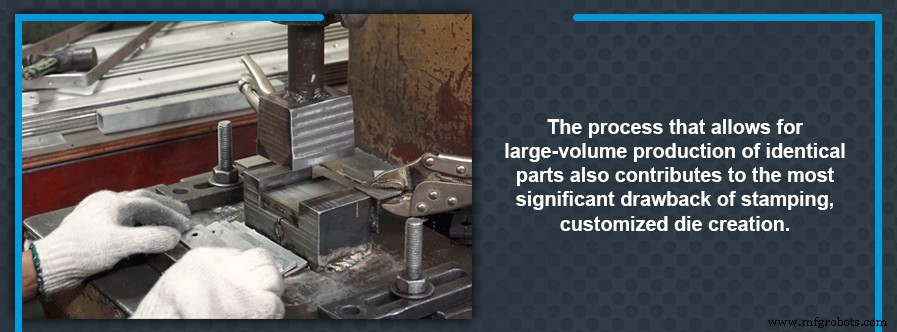
The process that allows for large-volume production of identical parts also contributes to the most significant drawback of stamping, customized die creation.
Making a die to your project’s specifications increases the pre-production time for metal stamping. Additionally, any changes to the die will add to the processing time. In other words, once production with a finished die begins, stopping it becomes expensive and complicated, though not impossible.
While stamping can still produce smaller orders or short-term project runs, the use of the presses may not justify such a smaller order. For small projects, fabrication may provide a more cost-effective alternative. For more information, talk with us about the particulars of your project to see if stamping or fabricating is the right choice.
Metal Stamping Applications
Stamping creates both highly specialized machinery parts and everyday components of consumer goods, industrial equipment and much more.
Applications of metal stamping depend on the industry, but some parts can benefit from either stamping or fabrication. The following qualities of a project may encourage the use of stamping instead of fabricating.
- Tight Tolerances: Precision stamping can create parts made with exact measurements and small margins of error.
- Large Volume: Once a producer manufactures the die, stamping happens quickly and can create a large volume of parts.
- Part Size: For smaller parts, especially micro-precision stamped components, stamping may be a better option than fabrication.
- Part Shape: If you need circular forms, you will need the parts stamped because that process is the only one to create such shapes.
- Later Processes: The stamping process offers greater control over what happens to the parts, which can help ensure the best performance of the component during assembly or welding.
Industries That Use Metal Stamping
Many industries use stamping for some elements of its tools or parts.
- Automotive: Hot metal stamping makes automobile roofs lightweight and crush-resistant in rollover accidents. Many other OEM and aftermarket parts also use stamping for their production.
- Electronics: The smallest metal parts inside electronics may have started as metal fed into a micro-precision stamper.
- Aerospace: Precision stamping can create engine parts and aircraft components in large quantities.
- Home Furnishings and Appliances: Mass-marketed furniture and consumer appliances may have metal components that a metalworker stamped.
Importance of Working With a High-Quality Sheet Metal Stamping Partner
The stamping process requires a high degree of knowledge about metal, how it works and how to work with it. The type of metal and desired outcome both significantly affect how a metal stamping company will approach a project. To accomplish your goals, having the correct equipment is critical. Experienced stamping companies have both the hardware and qualified personnel to get the job done that you need.
For example, some projects will require hot stamping because the finished part must have extra strength. A high-quality metal stamping company will know when to use this process and when to select another form of stamping. Some projects will need procedures beyond stamping alone. These and simpler stamping orders both require a company that can give you a one-stop source for production.
At Fairlawn Tool, Inc., we offer turnkey solutions and have ISO 9001:2015 certification. Our certification demonstrates our ongoing commitment to quality. We undergo regular reviews of our services to keep our certification. With this international backing of our services, you can trust us with your projects.
Your Single-Source Solution for Metal Stamping
If you’re interested in metal stamping parts, Fairlawn Tool can help. We have years of expertise in all types of metal fabrication, including stamping. You can rely on us to get you the high-quality parts you need fast and at a price that fits your budget. Our services include hot stamping, cold stamping, tube bending, CNC turret punching, automated welding and more. We’re your one-stop-shop for all your metal fabrication needs.
To find out more about hot stamping and how it can benefit your business or how Fairlawn Tool can help you with your metal fabrication needs, call us at 410-374-1100 or contact us online today.
Industrial Technology
- How Metal Stamping Works: A Comprehensive Guide for Modern Manufacturing
- Metal 3D Printing 101: How Additive Manufacturing Transforms Production
- Stainless Steel Metal Stamping: Precision & Durability
- Advanced Hot Metal Stamping: Strengthening Cars While Reducing Weight
- Metal Stamping: Emerging Trends & Market Growth Forecast
- Hot vs. Cold Metal Stamping: Choosing the Best Process for Your Parts
- Advanced Metal Fabrication Techniques: Cutting, Stamping, and Beyond
- The Evolution of Metal Stamping: From Ancient Coinage to Modern Innovation
- Precision Sheet Metal Stamping for High-Volume Production
- Mastering Sheet Metal Fabrication: Your Complete Guide