



Metal 3D Printing 101: How Additive Manufacturing Transforms Production
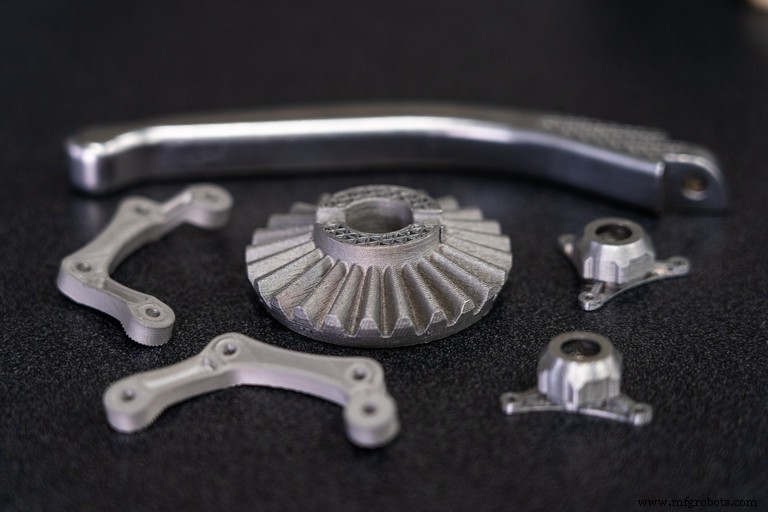
Metal 3D printing once lingered in research labs, but today it is a mainstream production asset that can deliver custom parts at scale and at a fraction of the cost of conventional machining.
Read our Metal Design Guide
Why Choose Metal Additive Manufacturing?
Metal 3D printing offers a set of benefits that traditional manufacturing can’t match:
- Consistent cost per part – Whether you produce a single prototype or a thousand units, the price stays flat, enabling affordable low‑volume runs.
- Zero cost for complexity – Intricate geometries that would require multiple machining setups become a single build, dramatically cutting labor and time.
- Workability of difficult metals – Hard‑to‑machine alloys such as titanium, Inconel, or nickel‑based superalloys can be built layer‑by‑layer without the risks of cutting.
- Design freedom – Additive manufacturing removes many of the geometric constraints of subtractive processes, allowing engineers to tailor components precisely to their function.
How Does Metal Additive Manufacturing Work?
At its core, every metal AM system builds a part one layer at a time. The four most common approaches each have unique strengths and trade‑offs.
1. Powder Bed Fusion
Powder bed fusion spreads a thin layer of metal powder across a build plate and selectively melts it with a laser or electron beam. Popular systems include Selective Laser Melting (SLM), Direct Metal Laser Sintering (DMLS), and Electron Beam Melting (EBM).
Benefits: Ultra‑high resolution for small or precision parts. Drawbacks: Machines exceed $1 M USD, and handling raw powders requires stringent safety protocols.
2. Direct Energy Deposition (DED)
DED machines fuse metal feedstock delivered by a printhead directly onto the part. Examples are Electron Beam Additive Manufacturing (EBAM) and Laser Material Deposition (LMD).
Benefits: Ideal for large components and free from hazardous powders. Drawbacks: Lower resolution and similar capital cost to powder bed systems.
3. Binder Jetting
Binder jetting also lays down metal powder, but a liquid binder links the particles. The green part is then sintered in a furnace, removing the binder and consolidating the metal.
Benefits: Rapid production of multiple parts and high precision. Drawbacks: Like powder bed fusion, it is costly (over $1 M) and requires powder handling precautions.
4. Bound Powder Extrusion
Markforged’s Metal X uses a filament composed of metal powder bound in a waxy polymer. The filament is extruded and then post‑processed—washed to remove the binder and sintered to finish the metal part.
Benefits: Affordable (under $200 k USD), safe (no loose powder), and user‑friendly. Drawbacks: Longer build times due to multi‑step post‑processing.
Metal additive manufacturing continues to diversify, offering capabilities that no other fabrication method can match. As equipment prices fall, metal 3D printers will become a routine tool in high‑value production. Explore our case studies to see businesses already capitalizing on this technology.
3D printing
- 5 Key Advantages of 3D Printing for Modern Manufacturing
- Agile Manufacturing & 3D Printing: A Guide to Rapid, Custom Production
- How 3D Printing Is Revolutionizing Manufacturing: 3 Key Transformations
- 3D Printing: The Future of Manufacturing and Medicine
- Metal 3D Printing Applications: Advanced Use Cases – Part 2
- 3D Printing Trends 2019: Metal Innovation, Binder Jetting Breakthroughs, and Advanced Plastics
- Metal 3D Printing: Revolutionizing Production with Speed, Cost Savings, and Design Freedom
- Top 5 Metal 3D Printing Applications Revolutionizing Manufacturing
- Mastering Metal 3D Printing: A Comprehensive Guide
- Additive Manufacturing vs 3D Printing: Understanding the Difference