



3D Printing Trends 2019: Metal Innovation, Binder Jetting Breakthroughs, and Advanced Plastics
3D Printing Trends 2019: Metal Innovation, Binder Jetting Breakthroughs, and Advanced Plastics
2019 marks a pivotal year for additive manufacturing. After two consecutive years of rapid machine innovation and expanding industrial adoption, 3D printing has proven its capacity to transform traditional manufacturing workflows. As confidence grows, the industry is now focused on the next wave of technologies and how they will reshape production at every scale.
Key Trends Shaping 2019
- Metal 3D printing diverges toward cost‑effective systems and high‑volume production machines.
- A surge in the number of commercial metal printers.
- Initial real‑world trials of Binder Jetting for metal parts.
- Broad acceptance of high‑strength, high‑temperature plastics and composites in production environments.
The Metal Printing Divergence
Until three years ago, the threshold for a metal printer—including purchase, installation, and support—exceeded $1 million. These large, laser‑based machines were confined to R&D labs and limited to prototype or exploratory use. Today, two critical shifts are redefining the market:
- Affordable entry‑level metal printers (costing $100k‑$200k) lower the barrier to adoption, enabling more organizations to experiment with metal additive manufacturing.
- High‑volume production systems, such as GE Additive’s consolidated facilities and HP’s new Binder‑Jetting platform, demonstrate the feasibility of using 3D printing for end‑use parts at industrial scales.
This dual pathway points to a future where metal 3D printing is both ubiquitous for rapid prototyping and fully integrated into production lines.
Proliferation of Metal Printers
According to the Wohlers Report 2018, metal printer sales jumped from 983 units in 2016 to 1,768 in 2017—a 79% year‑over‑year increase. 2019 is expected to continue this trend, with thousands of new machines—including the Metal X—shipping worldwide. The real impact lies not just in numbers but in the rigorous testing and specification that will validate each system’s capabilities.
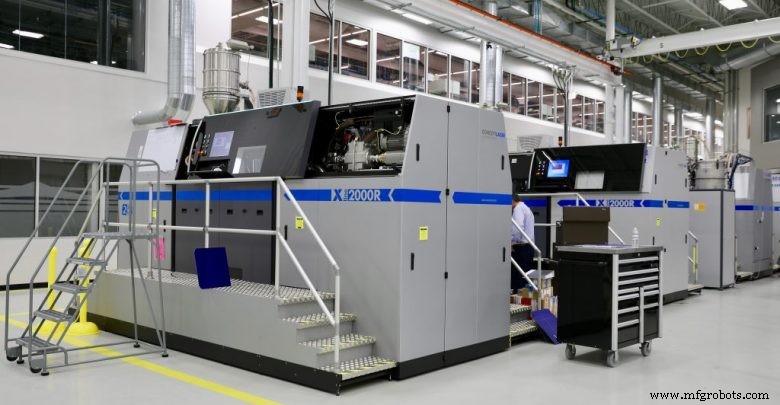
As more printers reach customers, the industry will see a critical differentiation between hype and proven performance. 2019 will be the proving ground where manufacturers validate accuracy, repeatability, and part quality under real production conditions.
Binder Jetting Makes Its First Production‑Scale Trials
Binder Jetting—a process that deposits a polymer binder onto metal powder layers—has long been cited as a potential mass‑production technology. Although it has existed for years, recent advances in sintering, process control, and HP’s entrance into the market suggest it is now ready for large‑scale trials.
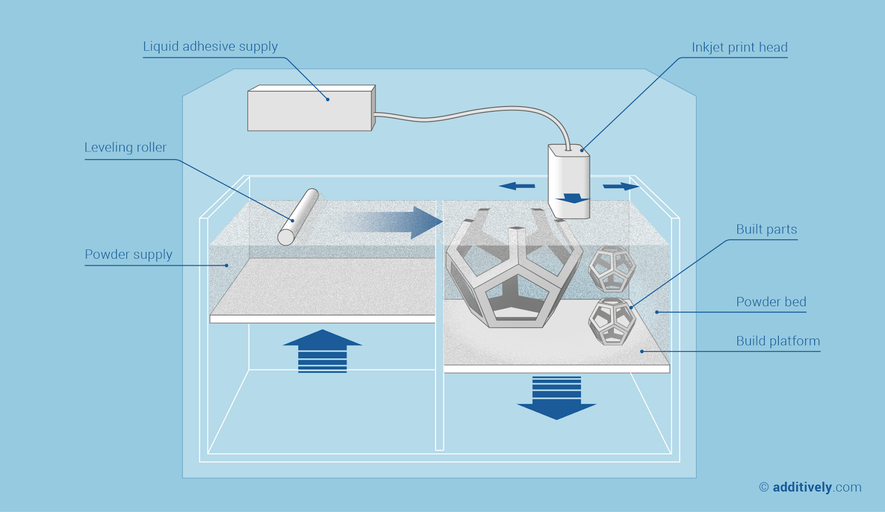
Key advantages of Binder Jetting include:
- Low‑energy, laser‑free fabrication that accelerates build times.
- Batch sintering capability, enabling efficient post‑processing.
- Potential for high throughput and reduced per‑part cost.
Critical questions remain: Can large‑scale sintering maintain dimensional fidelity? What are the limits of part geometry and size? How do reliability and accuracy compare to laser‑based systems? Addressing these will determine whether Binder Jetting can truly meet industrial demands.
High‑Strength Plastics and Composites Gain Widespread Acceptance
Early 2009 saw the advent of inexpensive desktop printers, igniting a hype cycle that peaked around 2014‑2015. During the “Trough of Disillusionment,” many firms reported limited material performance and poor part quality. The past four years, however, have delivered robust, heat‑ and chemically‑resistant polymers and composites—produced on more reliable, precise machines such as the Markforged Mark Two and X7 (formerly Mark X).
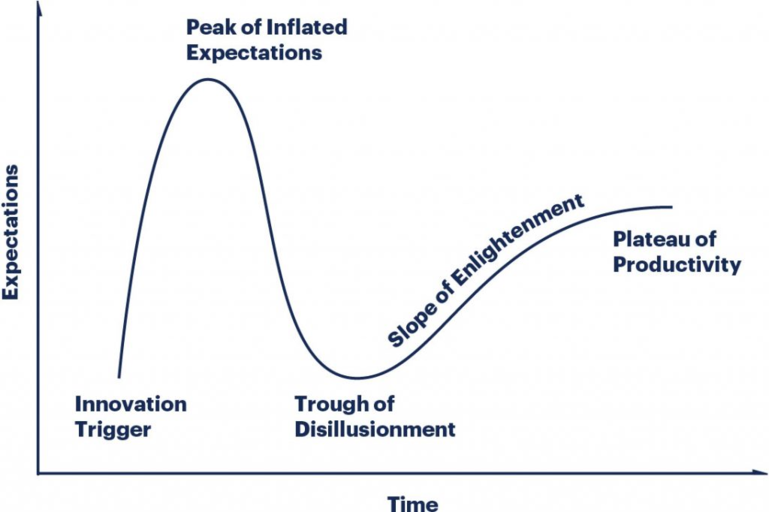
Today, 3D printing is firmly positioned on the “Slope of Enlightenment.” Designers, engineers, and fabricators increasingly rely on additive manufacturing for functional parts. The remaining challenge is to push toward the plateau of productivity—exploring new materials, machine architectures, and applications that will further expand the technology’s role in mainstream production.
Interested in printing in metal? Check out our Metal X for more info.
Request a Metal X Quote
Ready to explore metal additive manufacturing at scale? Request a quote today.
Read Our Metal Design Guide
Download our comprehensive guide to designing for metal 3D printing, covering best practices, material selection, and optimization techniques.
3D printing
- 5 Key 3D Printing Trends Shaping 2019
- Metal 3D Printing 2024: Comprehensive Guide to Technologies, Applications, and Business Benefits
- 5 Key Trends Driving the 3D Printing Materials Market in 2019
- 5 Emerging Trends Shaping 3D Printing Software
- 2019 3D Printing Materials Market: Trends, Growth, and Emerging Opportunities
- Metal 3D Printing: Debunking 7 Common Misconceptions
- Top 3 3D Printing Trends That Defined 2018
- Metal 3D Printing Applications: Advanced Use Cases – Part 2
- Metal 3D Printing 101: How Additive Manufacturing Transforms Production
- Mastering Metal 3D Printing: A Comprehensive Guide