



Six Key Trends Shaping 3D Printing in 2024
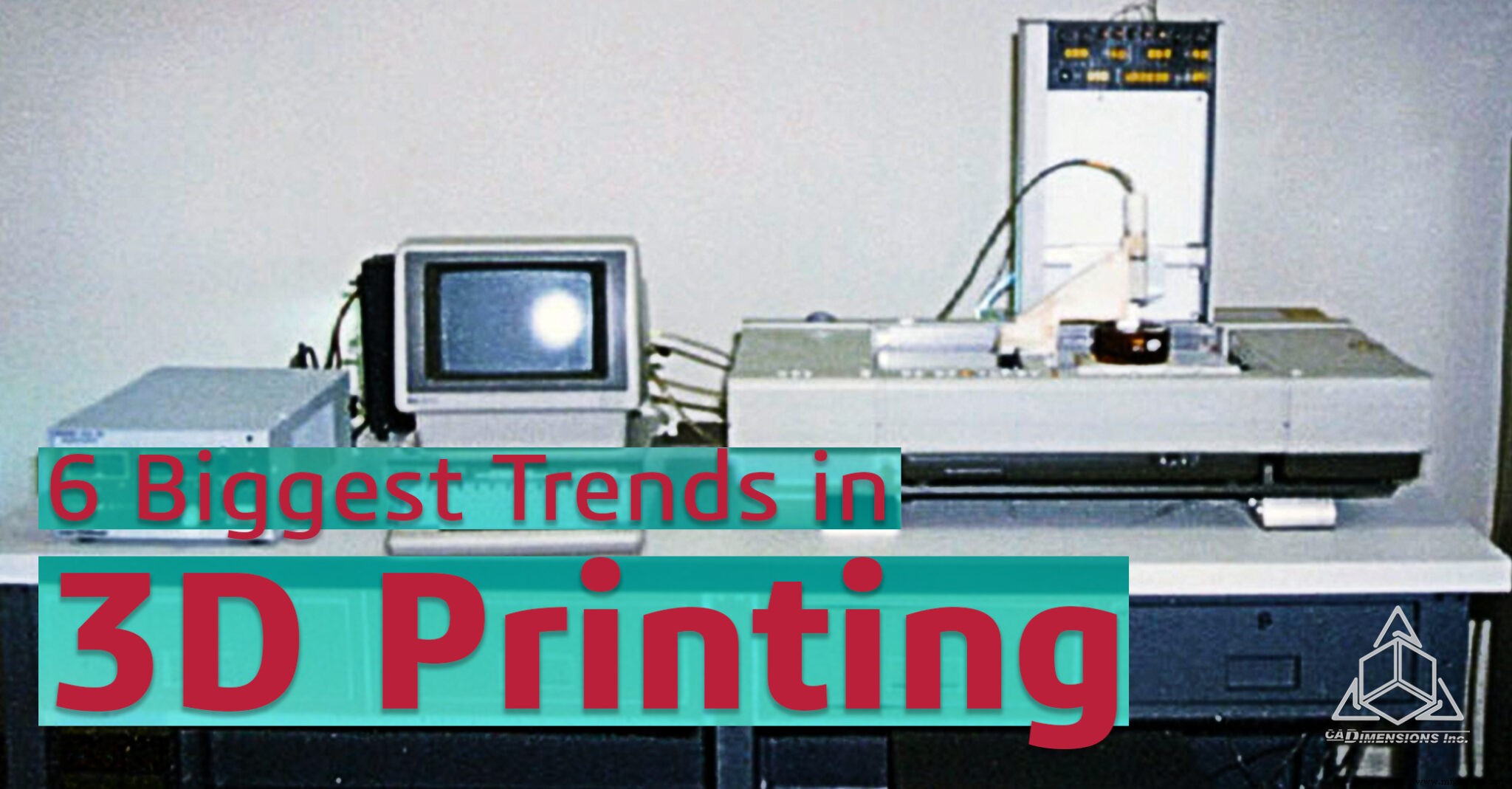
Last week, CADimensions attended the Additive Manufacturing Users Group (AMUG) in St. Louis, Missouri—arguably the premier 3D‑printing conference of the year. To keep our readers abreast of the industry’s latest breakthroughs, we’ll publish a daily recap. This article is the first installment of our “Live from AMUG!” series.

As an engineer immersed in additive manufacturing, the question “What’s next for 3D printing?” surfaces often. The past decade has seen exponential growth in capabilities, making the future feel both thrilling and elusive. Todd Grimm, a 27‑year veteran of the industry now consulting and authoring on additive technology, highlighted six trends that will shape the field today.
1. Hardware – Metal Printheads, OEE, and Cost Evolution
Hardware innovation remains a catalyst for broader adoption. Metal printers are expanding across disruptive and mature processes, while operators increasingly demand metrics such as Overall Equipment Effectiveness (OEE) to justify capital outlays. Manufacturers are now measuring, monitoring, and improving OEE in real time, aligning cost reductions with performance gains. Although prices will continue to fall, premium machines that deliver uncompromised quality, support, and reliability will likely stay in the five‑figure range.
2. China – New Processes, Volume Gains, and Strategic Clones
China’s 3D‑printing ecosystem is thriving, producing both refined copies of FDM and SLA systems and pioneering large‑format machines. Notably, firms are delivering SLA units and SLS systems with build volumes approaching one meter, a leap that opens doors for aerospace and automotive parts manufacturing.
3. Software – From CAD to Predictive Workflows
Software is no longer a bottleneck. Modern slicers now accept native CAD files, eliminating the mesh‑translation step that often introduces errors. Predictive analytics will guide users on printability, orientation, and material selection before a single layer is laid down. Generative design, showcased by solutions such as Desktop Metal’s Live Parts, is unlocking lightweight, topology‑optimized geometries that were impossible to design by hand. Workflow simplification and file‑level security continue to improve, as evidenced by the advances seen in GrabCAD Print.
4. Processes – Continuous Build, Real‑Time Inspection, and Streamlined Post‑Processing
Continuous methods like Carbon’s CLIP are redefining part quality, delivering near‑featureless surfaces and uniform mechanical properties. Additive manufacturers are integrating in‑process inspection to catch defects early, while post‑processing is becoming faster through automated support removal and surface finishing. Each year brings new materials—polymers, composites, ceramics, and emerging metal alloys—further expanding the palette of printable options.
5. Applications – From Mass Production to Targeted Innovation
True additive manufacturing will aim to compete with injection molding and machining in terms of cost and cycle time. Demonstrators from Carbon, HP, and Stratasys illustrate that the gap is narrowing. Meanwhile, firms will sharpen focus on niche markets where custom, complex, or low‑volume parts deliver the greatest value. The future will not be a single all‑purpose printer but a portfolio of specialized machines tuned to specific materials and use cases.
6. Business – Alliances, Brand Entry, and Scaling
Strategic partnerships and acquisitions are accelerating. Big‑name brands—Kodak, Apple, Disney—are increasingly eyeing additive markets, adding credibility and fresh capital. Companies are building internal teams dedicated to integrating 3D printing into production workflows, ensuring the technology delivers measurable ROI.
It’s an exhilarating era for additive manufacturing. These six trends chart a roadmap for the industry’s evolution, enabling businesses across sectors to operate more efficiently and creatively. Stay tuned for our day‑two and day‑three recaps.
Tags: 3D Printing, AMUG, Conference, Hardware, Trends
3D printing
- Seven Key Trends That Shaped 3D Printing in 2018
- 5 Key Trends Driving the 3D Printing Materials Market in 2019
- 2019 3D Printing Materials Market: Trends, Growth, and Emerging Opportunities
- 10 Key 3D Printing Trends Driving 2020 Innovation
- Why Composite 3D Printing Is a Game Changer – Insights from Anisoprint CEO Fedor Antonov
- Top 3 3D Printing Trends That Defined 2018
- Debunking 3D Printing Myths: What the Technology Truly Can Do
- The ABCs of 3D Printing: How Additive Manufacturing is Shaping Modern Industry
- Top Hyperautomation Trends Reshaping Finance: Boost Efficiency, Cut Costs, Reduce Fraud
- 4D Printing: Revolutionizing Additive Manufacturing for Adaptive Solutions