



Why Composite 3D Printing Is a Game Changer – Insights from Anisoprint CEO Fedor Antonov
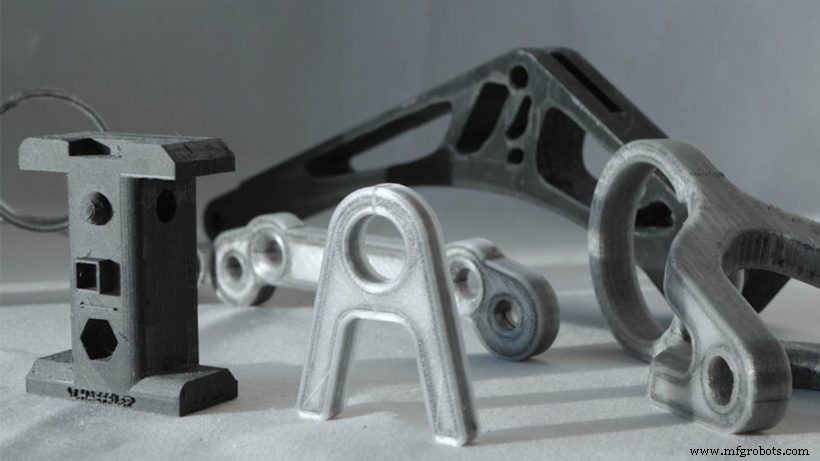
Composite 3D printing, though still a nascent technology, is rapidly advancing, unlocking new possibilities for producing parts that are both robust and lightweight.
Anisoprint, a Russian start‑up, is at the forefront of this evolution. The company has pioneered a material extrusion process called Composite Fiber Co‑extrusion (CFC), which seamlessly integrates continuous composite fibres into plastic during printing, producing exceptionally durable and strong parts.

We spoke with Fedor Antonov, CEO of Anisoprint, to learn more about the benefits of CFC technology, its current applications, and his perspective on the future of the composite 3D printing market.
Can you tell me a bit about Anisoprint?
Anisoprint was founded five years ago by experts in composite material design and optimisation. The company’s mission is to develop a globally demanded, innovative production technology that transforms how aircraft, cars, and spacecraft are built. By enabling lighter, more efficient structures, Anisoprint is contributing to lower resource consumption, reduced fuel use, and ultimately a more sustainable future.
Anisoprint has developed Composite Fiber Co‑extrusion technology (CFC). Could you explain what the technology is and the value it brings to the market?
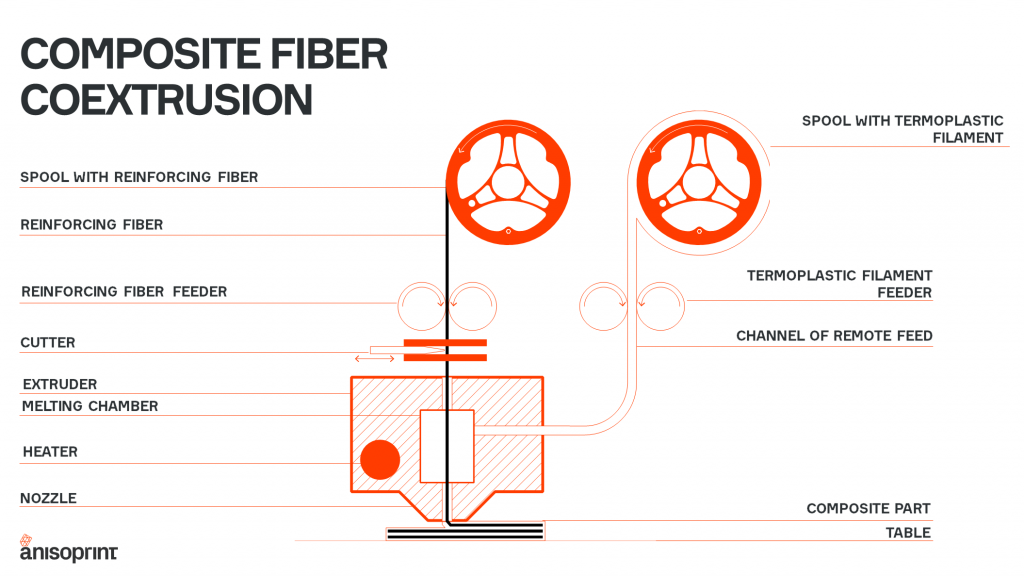
The core objective behind CFC was to introduce the most adaptable composite manufacturing solution available today. The co‑extrusion approach offers unparalleled flexibility: you can choose the matrix material, vary the fibre volume fraction, and design complex reinforcement paths. Pre‑impregnated, continuous fibres provide exceptional strength and stiffness, while the matrix can be tailored to meet specific thermal, chemical, impact, or wear resistance requirements.
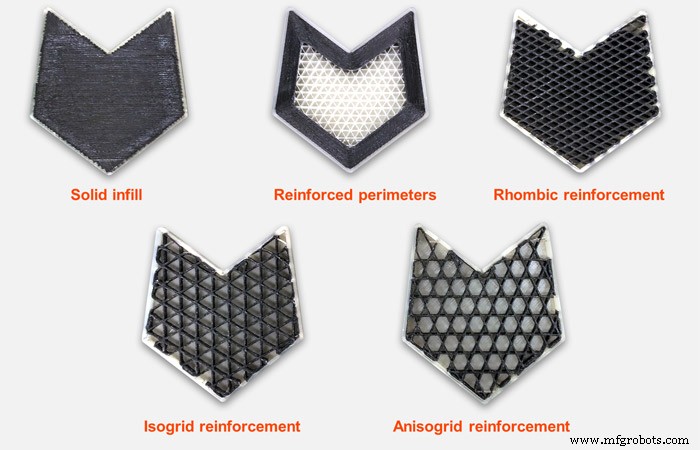
Because fibre volume can be adjusted, CFC enables the printing of composite lattice structures that are dramatically lighter than traditional laminates or sandwich panels. In essence, any complex shape with almost any material combination becomes feasible.
Which industries and applications would be best suited for your technology?
Composite materials excel in lightweight applications, a critical factor for aerospace, high‑performance automotive, sports equipment, and medical devices. Wherever speed, performance, or portability matters, weight reduction is essential.
3D printing brings unprecedented flexibility to composite manufacturing. It supports rapid prototyping, quick design iterations, and the production of lightweight tooling and jigs, all of which can significantly shorten lead times. Lightweight robotic assembly fixtures and welding jigs, for instance, not only move faster but also reduce handling effort, enhancing safety and productivity.
Can you share a success story or two of using your technology?
We’re proud that Anisoprint users are achieving remarkable results. One notable partner, Brightlands Materials Center, has created self‑sensing composite parts capable of monitoring critical structures in aerospace, construction, and healthcare. Traditionally, self‑sensing materials are produced through multi‑step, equipment‑intensive processes. Brightlands combines continuous‑fibre sensing with Anisoprint’s fabrication to streamline and enhance performance.
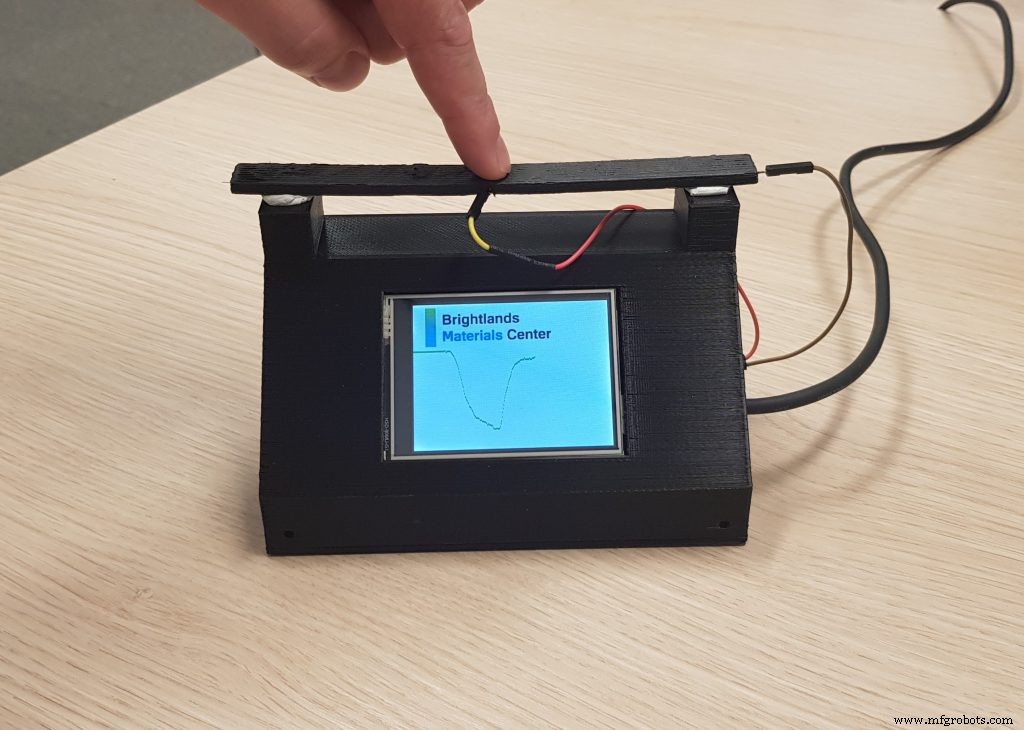
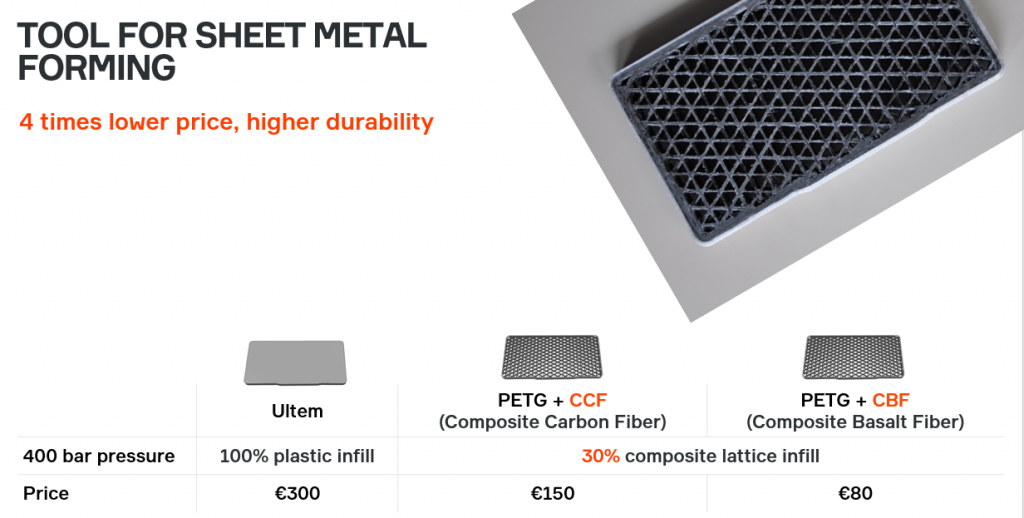
In testing, deformation in a simple bending beam and a scaled pedestrian bridge model was monitored, providing real‑time structural health data. Other compelling use cases include producing tools and fixtures for mass production. Anisoprint helped create a more durable, cost‑effective sheet‑metal forming tool that cut costs by at least 50%.
In one fixture application, our clients extended the life of a clevis by printing it in PETG reinforced with continuous fibres. The material’s resistance to peroxide hydrogen—used in the washing process—further enhanced durability.
These successes stem from CFC’s versatility: arbitrary fibre trajectories, lattice structures for optimal strength‑to‑weight, and any plastic matrix to deliver the exact properties required.
Anisoprint has recently introduced the large continuous fibre composite 3D printer. What was the impetus behind developing this system?
Our long‑term vision has always been an ideal composite manufacturing solution—true Anisoprinting—that delivers autonomous, single‑stage, tool‑less production of large, complex composite structures. Every new product brings us closer to that goal.
The PROM IS 500, our first industrial machine, meets rigorous industrial standards for reliability, tolerance, and safety, thanks to high‑quality industrial components. It is a high‑temperature printer capable of processing high‑performance polymers such as PEEK, PEKK, and PEI. With a build volume of 600 × 420 × 300 mm and high productivity, it is engineered for continuous 24 × 7 production in a factory environment.
What is your view on the current state of composite 3D printing, and how is the technology developing?
We have been in this space for over six years, and the transformation has been remarkable. Composite 3D printing has shifted from a niche, exotic capability to one of the fastest‑growing segments in additive manufacturing. Market studies now recognize it as a distinct technology group with some of the highest growth rates, and the number of players is expanding rapidly.
In the 21st century, composites will dominate—and additive manufacturing will be the enabler that makes it possible.
What does the year ahead hold for Anisoprint?
We have several exciting product announcements on the horizon, covering both desktop and industrial lines. The PROM IS 500 will reach its first customers in early 2021, with an official sales launch slated for the end of the year.
In the desktop segment, new products—including materials, software, and services—will be unveiled later this year. While we can’t reveal specifics yet, they will further expand the flexibility and performance of Anisoprint’s solutions.
To learn more about Anisoprint, visit: anisoprint.com
3D printing
- Digital Alloys CEO Duncan McCallum Discusses Joule Printing and the Future of Metal 3D Manufacturing
- Nanoe CEO Guillaume de Calan Discusses the Future of Ceramic 3D Printing
- Interview with APWORKS CEO Joachim Zettler: Unlocking Business Value in Metal 3D Printing
- Roboze CEO Alessio Lorusso Discusses Cutting‑Edge Composite 3D Printing and Industry Outlook
- Inkbit CEO Davide Marini Discusses the Future of Multi‑Material Inkjet 3D Printing
- Why Post‑Processing Is the Key to Scalable 3D Printing – Insights from AMT CEO Joseph Crabtree
- Interview with Origin CEO Chris Prucha: Advancing Additive Manufacturing through Open Materials
- Six Key Trends Shaping 3D Printing in 2024
- Top 3 3D Printing Trends That Defined 2018
- Debunking 3D Printing Myths: What the Technology Truly Can Do