



Felix Ewald, CEO of DyeMansion, Discusses Innovations in Powder-Based 3D Printing Post-Processing
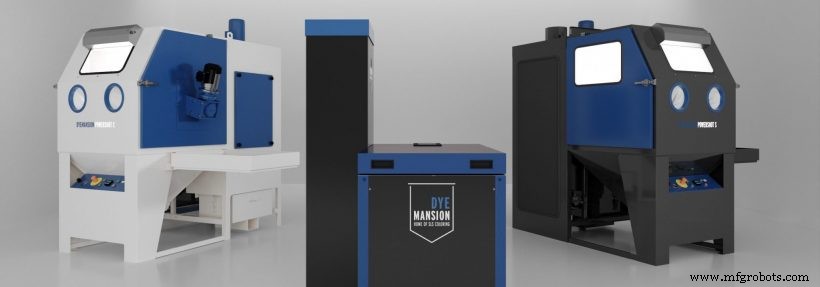
Left to right: DyeMansion’s Powershot C for depowdering, DM60 for colouring, and Powershot S for surface finishing.
At AMFG, we empower users to streamline the post‑processing phase of 3D printing. New technologies that reduce time and improve quality are always on our radar. That’s why DyeMansion’s recent suite of powder‑based finishing solutions has captured our attention.
DyeMansion, headquartered in Munich, specializes exclusively in post‑processing for powder‑based additive manufacturing. Their range of automated systems—especially the DM60 colour‑ing platform and the Powershot series—offers customers finishes that are difficult to achieve in‑house.
We spoke with founder and CEO Felix Ewald about the company’s origins, its rapid growth, and the broader challenges facing the additive‑manufacturing sector.

How did you originally become interested in 3D printing, and specifically in finishing stages?
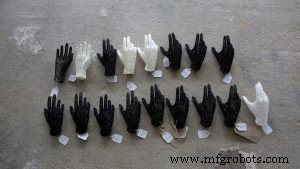
Four years ago, we launched a line of 3D‑printed smartphone cases. The first iterations suffered from poor colour retention and the dye leached onto customers’ clothing. Faced with a choice—pivot away from 3D printing or solve the problem ourselves—we chose the latter.
How did that initial interest evolve into DyeMansion’s current services?
After achieving a durable black finish, we refocused on the colouring solution. In early 2014, investor Arno Held of AM Ventures advised us to leave the phone‑case market and concentrate on our colouring technology, which remained a challenge across the industry. This pivot birthed DyeMansion. Since then we have become the leading post‑processing provider for powder‑based technologies, introducing the world’s first fully automated DM60 dyeing system, a database of over 400 RAL and Pantone colours, and two blasting solutions—Powershot C for depowdering and Powershot S for surface finishing.
What excites you most about powder‑based technologies?
Powder‑based AM is geometry‑independent, eliminating the need for support structures—a major advantage over SLA or FDM. Scalability is also compelling; layer times under five seconds are on the horizon, and HP’s Multi‑Jet Fusion is just the beginning of a rapid‑print era. We believe powder‑based methods will anchor the future of digital manufacturing.
How crucial is automation in 3D printing development?
Rapid prototyping dominated the last two decades, but as volume rises, automation becomes essential. Our customers—once convinced of mass‑production potential—are willing to invest in automated post‑processing. The most significant bottleneck remains post‑processing; we aim to automate every necessary step to deliver consistent, high‑quality finishes.
What recent finishing projects have showcased long‑term industry impact?
High‑volume additive manufacturing is now common in eyewear. Over 500,000 frames are produced annually, with roughly 70 % processed through our systems, in partnership with manufacturers like ic! berlin. We also support on‑demand spare‑part production for automotive firms and are exploring 3D‑printed shoe soles, though cost remains a barrier. A landmark collaboration is with IKEA and Wazp on the OMEDELBAR collection, their first 3D‑printed product line.
Has metal 3D printing shifted perceptions of plastic‑based materials?
Metal printing has amplified overall awareness of additive manufacturing. While it hasn’t directly altered plastic performance, the entry of HP into the market has prompted many to adopt 3D printing. Though HP’s grey parts pose challenges for our dyeing system, we successfully achieve deep black and several greys that complement HP’s raw material, making us pleased with HP’s market impact.
What obstacles remain for effective post‑processing of production parts?
High‑volume manufacturing will soon eliminate post‑processing bottlenecks as automation matures. Nonetheless, consistency, reliability, and inline quality control are critical. We foresee a future where post‑processing is fully automated and tightly integrated into production lines.
How will 3D printing fit into Industry 4.0?
3D printing is a cornerstone of Industry 4.0. Its inherent digital nature—sending a CAD file worldwide and printing on demand within 24 hours—offers unmatched flexibility and geometric freedom. It will play a pivotal role in the digital‑manufacturing ecosystem.
3D printing
- Inside F1 Innovation: Renault’s Additive Manufacturing Lead Pat Warner Shares 19 Years of Evolution
- Interview with Markforged’s Ibraheem Khadar on 3D Printing Innovation at formnext
- Nanoe CEO Guillaume de Calan Discusses the Future of Ceramic 3D Printing
- How PostProcess Technologies CEO Jeff Mize is Removing the Post‑Processing Bottleneck in Additive Manufacturing
- Interview with RIZE CEO Andy Kalambi: Advancing Sustainable, Scalable Industrial 3D Printing
- Roboze CEO Alessio Lorusso Discusses Cutting‑Edge Composite 3D Printing and Industry Outlook
- Fortify CEO Josh Martin Discusses Revolutionary Fluxprint™ Digital Composite Manufacturing
- Inkbit CEO Davide Marini Discusses the Future of Multi‑Material Inkjet 3D Printing
- Lithoz CEO Dr. Johannes Homa Explains the Future of Ceramic 3D Printing
- Expert Interview: nTopology CEO Discusses Advancing Additive Manufacturing with Generative Design Software