



5 Key Trends Driving the 3D Printing Materials Market in 2019

What are the forces shaping the 3D printing materials market as the industry matures?
Materials remain one of the three pillars that underpin 3D printing—alongside hardware and software. The Wohlers Report 2019 noted that the material segment recorded unprecedented growth in 2018, driven by the expanding use of additive manufacturing for serial production. 2019 is set to build on that momentum, thanks to several converging trends that we examine below.
1. Composite 3D printing is taking off

The composite segment presents a high‑value opportunity for additive manufacturing. A SmarTech Analysis report projects the global composite 3D printing market to grow at a CAGR of 22.3% over the next five years—signifying a substantial share of the overall composite manufacturing landscape. In 3D printing, composites typically combine a polymer core (e.g., nylon) with a reinforcing agent such as chopped or continuous fibre. The result is a material that delivers superior strength and stiffness, often rivaling metals like aluminium.
These enhanced properties make composites attractive for tooling and end‑use components across aerospace, automotive, energy, and oil & gas. For example, Shawcor, a Canadian energy services firm, saved approximately US$1.2 million by employing a Markforged composite printer to produce a custom loading machine. Roughly 50% of the 53 printed parts were reinforced with Kevlar, HSHT glass, or carbon fibre, replacing traditional aluminium and sheet‑metal elements.

Arevo’s single‑part composite bike frame demonstrates another breakthrough. Using robotic composite 3D printing, Arevo can produce a complete frame in days rather than months of traditional manufacturing. These examples illustrate the untapped potential of composites and the sector’s growth trajectory.
Material development
Markforged’s recent launch of Onyx FR—the first flame‑retardant composite—highlights continued innovation. The nylon‑based material is reinforced with continuous carbon fibre strands and is self‑extinguishing, meeting stringent fire‑safety standards for automotive, aerospace, and defence applications. Techmer PM has opened a high‑capacity production line for carbon‑fibre‑reinforced polymers, driven by demand from large‑format 3D printer manufacturers. Arkema’s new plant for Kepstan PEKK reflects a similar commitment to meeting the surge in carbon‑fibre composite and 3D printing demand.
2. Materials production is increasing
The industry is expanding its manufacturing footprint. In February, Amastan Technologies acquired AL Solutions, a refined titanium producer, rebranding it as Amastan Additive. The combined use of AL Solutions’ recycling technology and Amastan’s plasma‑based UniMelt® will position the company as a key player in AM titanium powder supply.
Jabil has also launched a dedicated unit—Jabil Engineered Materials—to develop, validate, and commercialise engineered AM materials. The unit currently offers PETg, PETg ESD, TPU 90 A, and TPU 90 A ESD, with additional materials slated for release in the coming months. By offering these internally and to the broader market, Jabil aims to widen material choices and accelerate adoption.
As more companies ramp up production capabilities, the market is poised for a substantial boost, further supporting the growth of 3D printing across sectors.
3. Open materials is an expanding concept
Material innovation often lags behind machine development, largely due to proprietary supply chains. Many printer makers restrict their devices to in‑house materials, driving up prices and stifling innovation.
The open materials model encourages collaboration between material producers and printer manufacturers, delivering two main benefits: a broader selection for users and faster development cycles. Ultimaker’s Material Alliance Program exemplifies this approach, providing a database of print parameters for third‑party filaments. Since its launch in April 2018, the program includes over 80 companies, such as BASF, DSM, Arkema, and Jabil. Arkema’s recent entry of its PVDF‑based FluorX filament expands high‑performance, thermally‑resistant options.
Other players—HP, Origin, Prodways, and even Stratasys—are adopting similar open‑materials strategies. Stratasys acknowledges the need for external partnerships to develop high‑performance materials, signalling a shift toward greater collaboration.
4. Material costs are coming down (slowly)
High material costs have long been a barrier to wider 3D printing adoption. A study indicates that 3D printing raw materials can cost up to ten times more than traditional manufacturing equivalents, depending on the process and material.
Resin prices for SLA printing typically range from US$50 per litre for standard resins to US$500 per litre for professional grades, though some manufacturers offer prices as low as US$10‑20 per litre. The relatively low volume of material shipments and the dominance of proprietary supply chains have kept prices high.
However, increasing serial production volumes and the rise of open‑materials ecosystems promise price reductions. Carbon, for example, lowered its resin prices from US$300 to US$50 per litre between 2016 and 2018, citing high‑volume applications as the catalyst. If other manufacturers follow suit, we can expect a gradual, market‑driven decline in material costs.
5. Global chemical companies are getting more involved
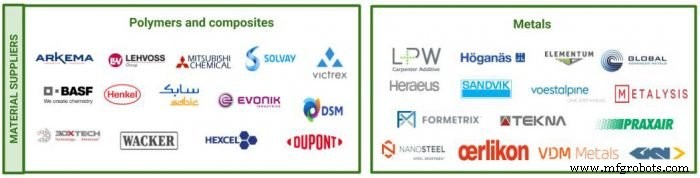
Large chemical firms have recognised the industrial potential of additive manufacturing. Partnerships, new facilities, and material launches are accelerating their entry. Stratasys and Solvay announced a joint roadmap in May, focusing on high‑performance materials such as PEEK and PPSU for Stratasys printers. Victrex is investing millions of euros in Bond 3D to expedite the market entry of PAEK and PEEK parts. BASF’s collaboration with Impossible Objects delivers Polyamide 6 combined with composite technology, targeting automotive and industrial applications.
These alliances underscore a growing trend: chemical giants are investing heavily in AM, validating the technology’s long‑term commercial viability.
Toward a thriving future
The materials market remains critical to the continued evolution of additive manufacturing. The most impactful trend is the surge in material development—driven by market demand for production‑grade parts. Chemical companies are reinforcing their positions through R&D, investment, and strategic partnerships, while printer manufacturers are embracing collaboration to broaden material ecosystems.
As the material portfolio expands and costs decrease, 3D printing’s applicability will broaden, accelerating its adoption across diverse industries.
3D printing
- 5 Key 3D Printing Trends Shaping 2019
- 2019 3D Printing Materials Market: Trends, Growth, and Emerging Opportunities
- 2020 3D Printing Hardware Market: Trends, Key Players, and Evolution
- 10 Key 3D Printing Trends Driving 2020 Innovation
- 5 Key Additive Manufacturing Trends Driving 2021 Innovation
- Six Key Trends Shaping 3D Printing in 2024
- 3D Printing Trends 2019: Metal Innovation, Binder Jetting Breakthroughs, and Advanced Plastics
- CMMS Trends 2019: Customer-Centric Innovations Driving the Industry
- Top 5 Automotive Manufacturing Trends Driving Innovation Today
- Top Flexible Materials for 3D Printing: Performance & Applications