



5 Emerging Trends Shaping 3D Printing Software
For years, software lagged behind hardware and materials in the additive manufacturing (AM) space, but that gap is narrowing fast. Companies are now delivering next‑generation tools that will drive industrial‑scale AM forward.
Below, we explore the key trends reshaping the 3D printing software market.
1. Interoperability: Seamless Toolchains for Faster Design
AM workflows traditionally involve a dozen separate applications—CAD, mesh conversion, support generation, simulation, slicing—each with its own file format. This fragmentation increases cost, complexity, and the risk of data loss.
Increasing software interoperability is the solution. By enabling native data exchange, designers can move a model from CAD to AM without intermediate conversions. Many major vendors are integrating AM functions directly into their CAD suites. For instance, Autodesk’s acquisition of Netfabb in 2015 allowed Fusion 360 users to access full AM preparation tools within a single environment. Hexagon’s purchase of AMendate has added topology‑optimisation capabilities to its MSC Software line. Altair, Dassault‑Systemes, and PTC are following suit.
Although full integration won’t happen overnight, the trend is clear: fewer tools, fewer steps, faster iterations, and ultimately more reliable production.
2. Rethinking STL: The Rise of 3MF and Other Advanced Formats
STL, invented in the 1980s, remains the default format for 3D printing but suffers from several limitations—large file sizes, lack of colour, texture, material, and security metadata, and poor support for complex geometry.
Industry groups are championing more efficient, open‑source alternatives. The 3MF Consortium, established in 2015, has released a modern format that supports multi‑material data, colour, texture, and embedded metadata—all while keeping file sizes manageable. Recent 3MF extensions now cover beam lattices, slicing, and production workflows.
Adoption is gradual, but 3MF’s advantages make it a compelling option for designers who need to prepare production‑ready parts quickly and accurately.
3. Workflow Automation: From Manual Processes to Digital Orchestration
AM operators still spend significant time on manual order handling, build monitoring, and post‑processing verification—inefficiencies that stifle scale. Workflow management platforms such as AMFG are closing that gap by linking order entry, scheduling, build status, and inspection into a single digital ecosystem.
A recent IDtechEx report predicts a decade‑long revenue surge for workflow software, underscoring its growing importance. Automation reduces human error, accelerates throughput, and integrates AM into broader manufacturing IT landscapes.
4. Simulation Software: Predicting Success Before the Print Starts
Accurate simulation is critical as AM moves from prototyping to production. It allows designers to model thermal gradients, residual stresses, and part distortion before a build.
Leading vendors are enhancing their suites: ANSYS added the Additive Prep tool in 2019, offering heat‑map analysis and direct machine export without an STL intermediary. MSC Software’s latest Simufact release automates support optimisation and distortion compensation for metal printing.
These tools are becoming indispensable for reliable, repeatable manufacturing—especially as part complexity and material diversity increase.
5. AI‑Powered Intelligence: Smarter Design, Production, and Operations
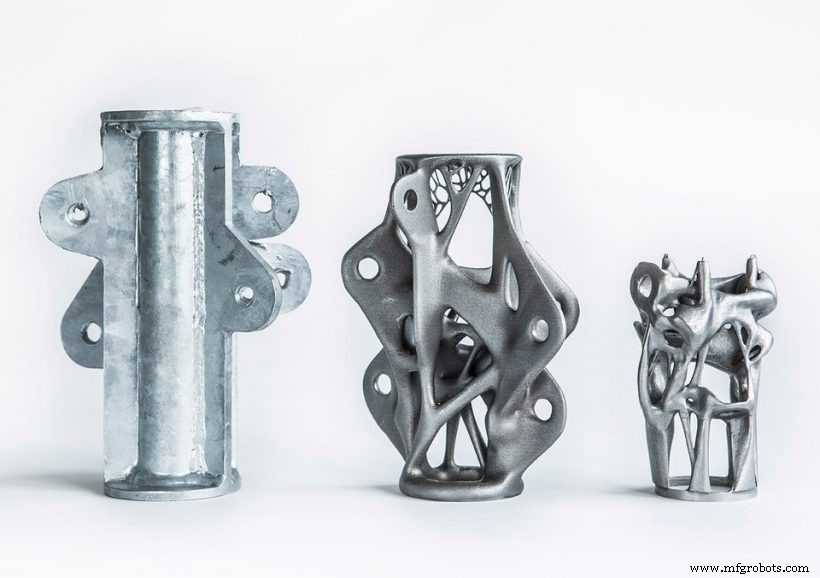
Artificial intelligence is now being woven into every stage of AM. Generative design engines use cloud‑based AI to generate thousands of topology‑optimized models that meet specified constraints—solutions often beyond human imagination.
Manufacturers like Markforged are deploying AI to fine‑tune print parameters on the fly. Their Blacksmith software learns from each part, adjusting slicer settings to improve accuracy and reduce defects.
AI also enhances workflow monitoring. Analytics platforms sift through order, machine, and material data to pinpoint bottlenecks and recommend process improvements, providing unprecedented operational visibility.
Software: The Missing Piece to Industrialize 3D Printing
While hardware and materials have made rapid strides, software has been the final frontier for AM’s industrialisation. The convergence of interoperable tools, advanced file formats, automated workflows, robust simulation, and AI is finally unlocking the full potential of 3D printing as a mainstream manufacturing technology.
3D printing
- Revolutionizing Interior Design: How 3D Printing Brings Spaces to Life
- 4 Key Design Principles for Successful 3D Printing
- 5 Key 3D Printing Trends Shaping 2019
- Software That Solves Four Major Additive Manufacturing Hurdles
- 3D Printing Software: Driving Reliable Digital Production
- Altair’s Ravi Kunju Discusses Simulation-Driven Design & the New Inspire Print3D for 3D Printing
- Top 3 3D Printing Trends That Defined 2018
- 3D Printing Trends 2019: Metal Innovation, Binder Jetting Breakthroughs, and Advanced Plastics
- Discover the 6 Most Innovative 3D Printing Design Trends of 2022
- Optimize Your Polyjet 3D Prints: Design Guidelines for Precision & Multi-Material Success