



Software That Solves Four Major Additive Manufacturing Hurdles
Adopting additive manufacturing is more than just buying a printer; it demands the right software to guide design, simulation, workflow, and security.
The benefits of 3D printing are undeniable, but successful implementation hinges on several critical factors: the design tools chosen, seamless workflow management, and robust data protection.
Fortunately, industry‑leading software now bridges these gaps, turning AM from a prototyping tool into a scalable, digital‑manufacturing powerhouse.
Below we examine how modern software addresses four common challenges that companies face when first integrating additive manufacturing into their operations.
1. Designing for Additive
Advanced design tools such as topological optimisation and generative design unlock possibilities that were once impossible with traditional manufacturing. However, many engineers still struggle to translate these capabilities into practice because they view AM through the lens of conventional manufacturing. Designing for AM requires careful consideration of support structures, part orientation, and build envelope constraints—factors that directly influence print time, material usage, and post‑processing effort. For example, support structures are essential for preventing warping and collapse, especially in metal printing. Reducing the number of supports can cut material costs and shorten removal time, but manual redesign is time‑consuming. Software solutions from Autodesk, Additive Works, and Materialise automate support generation. Materialise’s e‑Stage for Metal, for instance, claims a 90 % reduction in support creation time and a 50 % decrease in post‑process removal effort. Optimal part orientation and nesting further enhance build efficiency. Build‑preparation tools—now integral to many CAD suites—automatically determine the best orientation, set print parameters, and flag design issues before a job is queued. Betatype’s Engine platform takes this a step further by applying optimisation algorithms that maximize machine utilisation. In a recent orthopaedic implant case study, Betatype stacked multiple implants using lattice node supports, enabling full utilisation of the build volume and eliminating manual support removal through sandblasting. These tools transform the design phase into a data‑driven process, ensuring consistent, cost‑efficient production from the outset.
2. Trial‑and‑Error with Metal 3D Printing
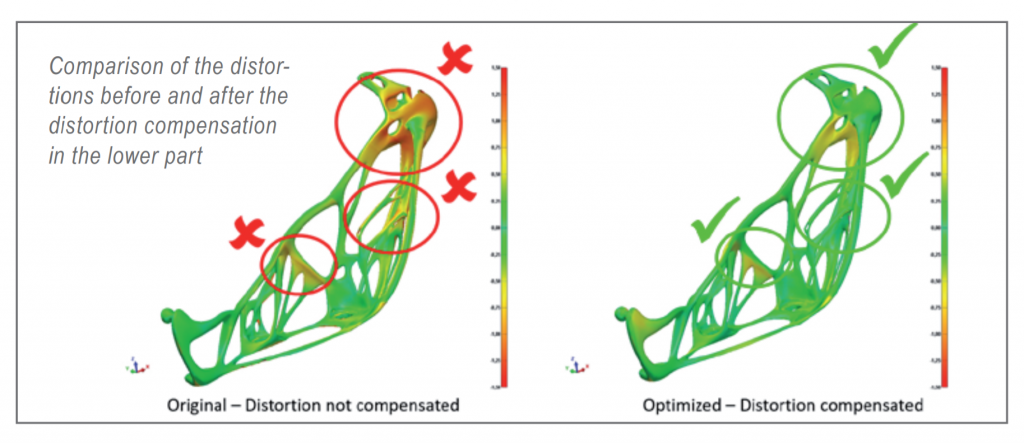
Metal additive manufacturing remains a high‑stakes endeavour. The process is highly sensitive to material quality, layer thickness, laser power, and gas flow, leading to high failure rates if parameters are guessed. Simulation software mitigates this uncertainty by modelling the build from first principles. ANSYS’s Additive Suite, for example, predicts micro‑structure evolution, part distortion, and residual stress, allowing engineers to tweak parameters before a single print. "The arrival of additive manufacturing created a need to simulate both the product and the process itself," says ANSYS’ Dave Conover. Simufact’s virtual‑engineering platform has also proven effective. In a joint project with EDAG and voestalpine, Simufact simulated a hood hinge’s distortion and residual stress, enabling engineers to pre‑emptively compensate for deformation—saving both time and material that would have been lost to trial‑and‑error prints.
3. Managing Workflows
Whether operating as a service bureau or an in‑house manufacturer, organisations must orchestrate complex workflows—from order intake to post‑production inspection. Traditional approaches, such as spreadsheets or generic project‑management tools, offer limited visibility and require manual data entry, stalling production and hampering scalability. Dedicated AM workflow platforms deliver end‑to‑end visibility, automating request capture, build assignment, status monitoring, and machine scheduling. Bowman International’s Bowman Additive Production division now streams orders directly into its platform, automatically assigns parts to builds, and tracks machine availability in real time. This automation has lifted throughput and efficiency, enabling Bowman to grow its production capacity without the bottlenecks that plague legacy systems.
4. Ensuring Data Security
With the proliferation of digital part libraries, protecting intellectual property has become a top priority. 3D printing’s digital thread—where designs can be shipped and printed anywhere—introduces vulnerabilities that traditional manufacturing never faced. AM‑specific security solutions encrypt design files and embed execution controls, such as machine type, material, and print count. LEO Lane’s cloud platform exemplifies this approach, ensuring that only authorised machines can access and print a file, and that each file can be printed only the permitted number of times. By tightening access and preventing unauthorized replication, these tools safeguard revenue streams and maintain product integrity.
AM Software: A Key Element to Production Success
Software is as critical to additive manufacturing as hardware and materials. It drives repeatability, secures the digital thread, and simplifies operations—enabling companies to unlock the full potential of AM. From cutting‑edge design aids to automated workflows and robust security, the right software transforms additive manufacturing from a niche capability into a reliable, cost‑effective production strategy.
3D printing
- Boeing Invests $1 Billion in Dassault Systèmes 3DExperience to Accelerate Global Additive Manufacturing
- Seven Key Trends That Shaped 3D Printing in 2018
- 5 Emerging Trends Shaping 3D Printing Software
- Episode 3: Cutting‑Edge 3D Printing Trends – Replacement Parts, Medical Advances & Air Quality
- Metal 3D Printing: Revolutionizing Production with Speed, Cost Savings, and Design Freedom
- Design for Additive Manufacturing (DfAM): 3D Printing Strategies That Cut Costs and Boost Efficiency
- Unlocking the Future: Challenges and Opportunities in 3D Printing & Additive Manufacturing
- Additive Manufacturing 101: A Beginner’s Guide to 3D Printing
- Additive Manufacturing vs 3D Printing: Understanding the Difference
- How SDKs Accelerate Innovation in Additive Manufacturing