



Carbon Co-Founder Philip DeSimone on Scaling 3D Printing for High‑Volume Production

Since its 2013 founding, Carbon has accelerated from a niche startup to a $1.7 billion+ leader in additive manufacturing. Its proprietary Digital Light Synthesis™ (DLS) technology now powers production for aerospace, automotive, consumer goods and medical sectors. High‑profile customers such as adidas, Ford Motor Company and Lamborghini underscore the company’s ability to translate breakthrough technology into market‑ready solutions.
We spoke with Carbon’s Co‑Founder and VP of Business Development, Philip DeSimone, about the company’s technology, growth strategy and future ambitions.
Reinventing Polymer Production

“Our goal is to reinvent how polymer products are designed, engineered, manufactured and delivered,” says DeSimone. “Digital Light Synthesis is the core of that vision.”
First showcased in 2015 at a TED Talk by CEO Dr. Joseph DeSimone, DLS leverages light and oxygen to cure liquid resin into complex parts. Light is projected through an oxygen‑permeable membrane into a vat of UV‑curable resin, and a programmed post‑cure bath sets the mechanical properties, delivering high‑performance, durable components with excellent surface finish and isotropic strength—all at a lower cost than traditional methods.
DeSimone notes that digital manufacturing offers unprecedented flexibility: mass customization, on‑demand inventory, and designs previously impossible with conventional tooling. “Once a company goes digital, they can never go back,” he says.
“3D printing unlocks new business opportunities—mass customisation, on‑demand inventory, and product designs that were once unfeasible. It fundamentally changes how designers, engineers, and teams collaborate, eliminating conventional constraints.”
From Prototyping to High‑Volume Production
The industry’s focus has shifted from rapid prototyping to scalable production. Hardware makers must deliver speed and accuracy that meet manufacturing standards.
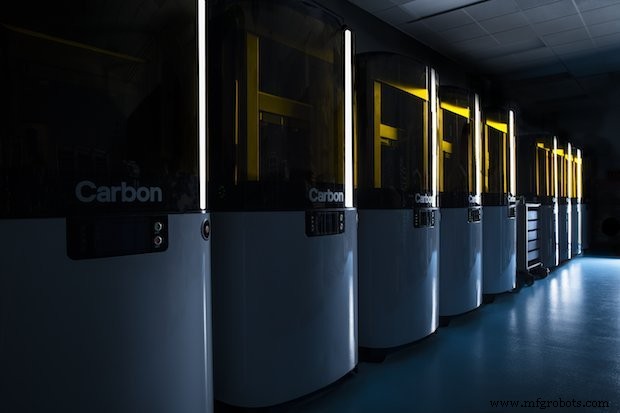
Carbon’s latest L1 printer—its first since the 2017 M2—exemplifies this evolution. Designed for high‑volume manufacturing, the L1’s build area is five times larger than its predecessor, enabling multiple parts per run. Equipment manufacturer Riddell is an early adopter, using the L1 to produce custom 3D‑printed helmet liners for NFL players.
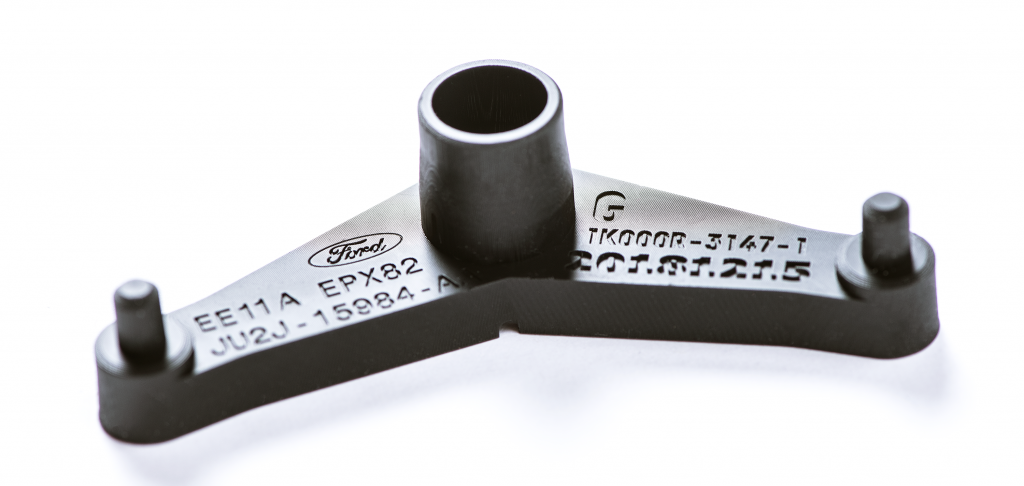
In the automotive sector, the L1’s capabilities were showcased at the 2019 North American International Auto Show, where Carbon and Ford displayed 3D‑printed HVAC lever arms, Raptor auxiliary plugs and Mustang GT500 brake brackets. The collaboration achieved a 60% weight reduction, 50% lead‑time cut and 90% cost savings on the Mustang bracket and HVAC lever arm, respectively.
Perhaps the most visible example of high‑volume potential is the partnership with adidas. Carbon’s DLS technology enabled the production of Futurecraft 4D midsoles, with plans to manufacture 100,000 pairs in 2019 and scale to millions in the coming years. “Mass production is made possible by our L1 printer, built for specialized products at scale,” DeSimone explains.
Strategic Partnerships as a Growth Engine
DeSimone emphasizes that partnerships are central to Carbon’s success. “Every subscription agreement is a partnership that spans the entire production lifecycle,” he says. “We work side‑by‑side, day‑in, day‑out, to turn potential into reality.”
Collaborations span industries—from automotive to consumer goods to medical—allowing Carbon to showcase engineering‑grade parts for end‑use applications and to prove the viability of additive manufacturing at scale.
Materials Innovation
Carbon’s dual approach to material development—validating third‑party innovations and creating proprietary resins—ensures that the DLS platform can meet diverse industry demands. In automotive, the high‑strength Epoxy EPX 82 has been used for Ford parts; in medical, the first medical‑grade resin, Medical Polyurethane 100 (MPU 100), delivers high strength, abrasion resistance, biocompatibility and sterilizability, ideal for single‑use devices, surgical tools and prosthetics.
Looking Ahead
DeSimone believes the next decade will see 3D printing transition from prototyping to full‑scale manufacturing, particularly in the $300 billion polymer injection‑moulding market. He envisions digital manufacturing as a solution that combines software, hardware and materials to make the unmakeable.
“Digital manufacturing will have a profound impact on full‑scale production, especially in the polymer sector. Carbon will demonstrate what’s possible when we integrate innovations across the stack.”
With triple‑digit growth in 2018 and projected again for 2019, Carbon remains focused on expansion, new partnerships and advanced applications.
Learn more about Carbon: https://www.carbon3d.com/
——————————-
Expert Interviews
AMFG’s Expert Interviews series showcases innovative companies shaping the future of additive manufacturing. For more information, contact marketing@amfg.ai.
3D printing
- Inside 3D Printing: Professor Neil Hopkinson on Innovation, Scale, and the Future
- Interview with Philip Cotton, Founder of 3Dfilemarket.com, UK 3D Printing Education Expert
- Dr. Alvaro Goyanes of FabRx on 3D‑Printed Medicines: From Innovation to Personalised Care
- Dr. Bastian Rapp on 3D‑Printed Microfluidics: Advancing Biotech with NeptunLab
- Interview with Sintavia President Doug Hedges: Scaling Serial Production of Metal Parts via 3D Printing
- Inside 3DEO: President Matt Sand Explains How Intelligent Layering Drives High‑Volume Metal 3D Printing
- Ben Batagol on How 3D Printing is Revolutionizing Heat Exchanger Design at Conflux Technology
- Interview with VELO3D’s VP of Technology Partnerships: Advancing Metal 3D Printing Capabilities
- Interview with Photocentric MD Paul Holt: Inside Daylight Polymer Printing and the Future of Affordable 3D Manufacturing
- Interview with BCN3D CTO Eric Pallarés: Unlocking the Power of IDEX 3D Printing Technology