



Inside 3DEO: President Matt Sand Explains How Intelligent Layering Drives High‑Volume Metal 3D Printing

For most manufacturers, the goal of high‑volume metal 3D printing is a benchmark of success. 3DEO, founded in 2016, asserts that its patented Intelligent Layering technology has made that benchmark a reality.
Leveraging its additive process, the Los Angeles‑based firm delivers high‑volume, repeatable, and automated production of metal 3D‑printed parts. We spoke with President Matt Sand about the technology’s advantages and the cost comparison to conventional manufacturing.
Could tell me a bit about 3DEO?
3DEO pioneered Intelligent Layering, a binder‑jetting‑derived technology developed by co‑founders Matt Petros and Payman Toabi, both PhDs in binder‑jetting science. Their expertise enabled the creation of a unique, high‑volume‑oriented process that delivers low‑cost, highly repeatable parts.
After completing their doctoral work, the team engineered Intelligent Layering—a proprietary system expressly engineered for high‑volume production, delivering exceptional repeatability and cost efficiency.
Intelligent Layering operates as a bind‑and‑sinter process, but 3DEO diverges from traditional binder jetting by employing a proprietary spray system instead of inkjet nozzles. This eliminates common inkjet constraints and offers greater flexibility in binder deposition.
How does 3DEO’s Intelligent Layering process work?
Intelligent Layering follows a three‑step workflow:
- A thin layer of standard MIM metal powder is spread across the build platform.
- A binder is sprayed over the entire layer using the proprietary spray system.
- A CNC end‑mill sculpts the part’s geometry with precision at each layer.
This layer‑by‑layer milling approach ensures exceptional dimensional accuracy—currently ±0.002 inches per inch (≈50 µm). 3DEO believes it offers the tightest tolerances among additive manufacturing methods, with future hardware poised to tighten tolerances further.
Repeatability is another key advantage. Because the process has no degrading steps, the ten‑thousandth part matches the first in quality and dimensions.
After mastering component design and accounting for shrinkage during bulk sintering, the process proves robust and repeatable.
Full automation is a strategic priority. By eliminating manual labor for post‑build removal and handling, 3DEO dramatically reduces cost, bringing its price structure in line with conventional manufacturing.
Today, 3DEO’s cost structure for small, complex stainless‑steel components rivals traditional methods. We’ve secured orders in the tens of thousands, with production just starting on a 28,000‑part run.
3DEO stands among the highest‑volume metal additive manufacturers. By next year, the company anticipates orders in the hundreds of thousands.
How has 3DEO managed to automate the production process?
Unlike commercial 3D printers, 3DEO’s in‑house invention grants full control over software, hardware, and materials, enabling seamless integration of automation across the entire workflow.
Was the decision not to sell your printers a deliberate strategic approach? Will that ever change in the future?
The choice not to sell printers is intentional. For end‑use components, the printer accounts for only about 15‑20% of the entire production chain. 3DEO focuses on delivering the complete process, not just the machine.
Thus, 3DEO’s strategy centers on owning the entire value chain. Consequently, the company has no current plans to commercialize its printers.
From which what industries are you seeing the most demand for your technology at the moment?
Small, complex parts are valuable across multiple sectors, and 3DEO serves aerospace, medical, and industrial equipment markets.
What are some of the benefits of metal 3D printing?
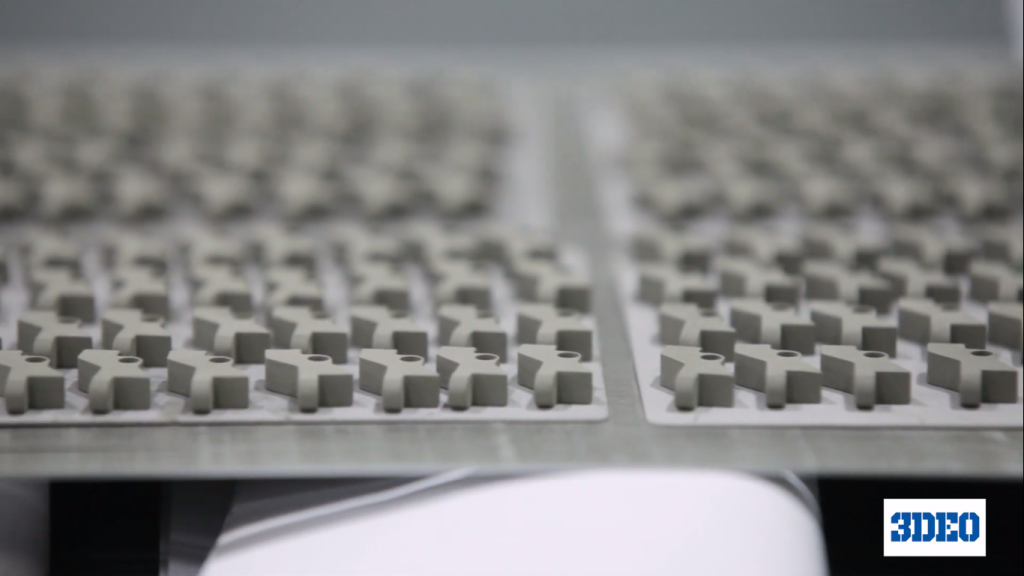
Comparing to metal injection molding (MIM), 3DEO delivers comparable or superior cost and quality. While MIM parts reach 96‑97% density, 3DEO parts exceed 99% density.
MIM tooling can cost six‑digit sums and take 4‑6 months to fabricate, often requiring multiple iterations before a functional mold is achieved—costs incurred before the first part is produced.
In contrast, 3DEO’s process delivers parts in 1‑2 weeks with comparable cost and quality, while granting unparalleled design freedom.
Because prototypes and production parts are fabricated on the same machine, there is no need for process re‑qualification, streamlining validation and reducing time‑to‑market.
What role do you see 3D printing playing alongside traditional manufacturing?
3DEO sees two primary roles for 3D printing relative to conventional methods: 1) Additive‑only designs that cannot be produced by traditional means, and 2) complex, low‑volume parts where additive manufacturing offers cost competitiveness.
Industry leaders like GE are already producing jet‑engine components and heat exchangers using additive techniques, illustrating the potential for complex, high‑performance parts.
For small, highly complex parts—though manufacturable via CNC or MIM—the high tooling costs make additive methods price‑competitive.
While stamping remains unbeatable for mass production, additive, casting, CNC, and MIM remain the primary competitors for intricate components.
For volumes below 50,000 units, additive manufacturing is poised to capture a significant share of the market.
3DEO has announced that it will be increasing its production capacity and introducing new machines. Could you tell us what this means for the company going forward?
With next‑generation hardware now mature, 3DEO is scaling capacity to 20,000 parts per day by year’s end.
Compared to laser melting technologies that output only 200‑300 parts daily, 3DEO’s throughput represents a substantial leap.
How do you see additive manufacturing evolving over the next five years?
AM is steadily moving from hype to mainstream production. The early 2012‑2013 hype cycle laid the groundwork, but true readiness has only recently been achieved.
Advances in technology, quality, and sustained R&D investment are converging, positioning additive manufacturing for broader production adoption.
Metal AM encompasses diverse techniques, from large‑scale laser sintering for jet engines to the one‑inch‑cube scale 3DEO focuses on. The field’s rapid maturation is encouraging.
What is the biggest challenge the industry still needs to overcome?
Quality assurance remains the paramount hurdle. While CNC, MIM, and casting have mature QA frameworks, additive manufacturing’s novel processes demand robust, validated quality protocols.
What does 2019 hold for 3DEO?
In 2019, 3DEO is building its inaugural 13,000‑sq‑ft facility, scalable to 50 machines. Near‑full automation is projected by year‑end, targeting tens of thousands of parts daily. This growth underpins a strategic expansion into Western Europe.
Discover more at 3deo.co.
3D printing
- Digital Alloys CEO Duncan McCallum Discusses Joule Printing and the Future of Metal 3D Manufacturing
- John Kawola on Ultimaker’s Transition to Enterprise 3D Printing
- Interview with Sintavia President Doug Hedges: Scaling Serial Production of Metal Parts via 3D Printing
- Carbon Co-Founder Philip DeSimone on Scaling 3D Printing for High‑Volume Production
- Metal 3D Printing Today: From Prototype to Production
- Interview with ANSYS Chief Technologist on Driving Metal 3D Printing Success Through Simulation
- Ben Batagol on How 3D Printing is Revolutionizing Heat Exchanger Design at Conflux Technology
- Interview with VELO3D’s VP of Technology Partnerships: Advancing Metal 3D Printing Capabilities
- Neil van Es on Driving 3D Printing into Production – Parts on Demand Founder
- Interview with BCN3D CTO Eric Pallarés: Unlocking the Power of IDEX 3D Printing Technology