



John Kawola on Ultimaker’s Transition to Enterprise 3D Printing
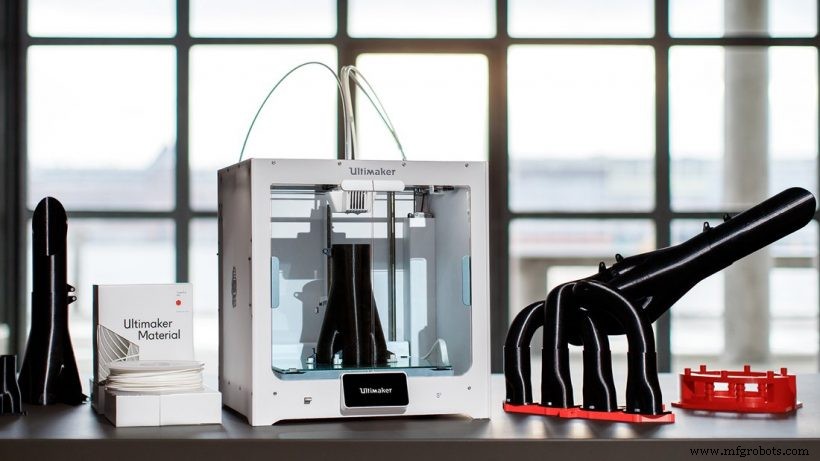
 Since its founding in 2011, Ultimaker has become one of the most trusted names in desktop 3D printing. With a clear mission to democratize additive manufacturing, the company delivers open‑source printers, high‑quality materials and user‑friendly software. 2018 marked a pivotal year: in April, Ultimaker launched the S5 and announced strategic alliances with leading material suppliers.
We spoke with John Kawola, President of Ultimaker North America, about the firm’s shift toward enterprise solutions, the expanding role of desktop printers in manufacturing, and his vision for the future of 3D printing.
How did you first get involved in additive manufacturing?

I’ve worked in additive manufacturing for two decades, beginning with Z Corporation, which was acquired in 2016. I joined Ultimaker the same year. Over the years, I’ve seen 3D printing evolve through three distinct waves: the 1990s’ bulky, high‑cost machines; the 2000s’ cheaper, high‑end printers; and the last decade’s proliferation of affordable desktop units, metal printers, and corporate adoption.
Ultimaker was founded amid the 2012‑2013 consumer hype. How did you succeed where others didn’t?
Unlike many start‑ups, Ultimaker never bought into the fleeting consumer hype. We focused on true hobbyists and professional makers who already had the necessary skill set. While the market later realized that 3D printing was not a household appliance, we continued to refine our products for serious users. In 2018, we pivoted toward enterprise and professional applications, while still serving makers and educators.
Was the move to enterprise deliberate or opportunistic?
It was a combination. As printers became more robust, reliable, and offered a broader material palette, they began to meet the rigorous demands of industrial users. Seeing this alignment, we decided to double‑down on the enterprise market.
What role will desktop systems play in industry? Are they complementary to larger machines?
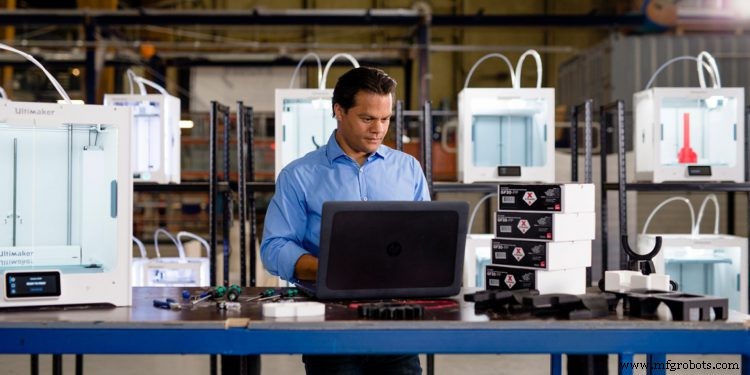
Desktop printers are now capable of competing with high‑end industrial machines for design, prototyping, and even short‑run production. Their lower cost, safety features, and ease of use make them attractive for widespread deployment—think a printer on every engineer’s desk or a small cluster in a lab. While large industrial printers still dominate high‑volume manufacturing, desktops are increasingly filling the gap for tools, fixtures, and low‑run parts.
Do you expect desktop 3D printing to expand further?
Absolutely. Improvements are twofold: user experience—from data input to finished part—and material performance, including accuracy, surface finish, and mechanical properties. Ultimaker’s open‑source philosophy attracts major plastics companies to develop compatible filaments, accelerating progress.
Why partner with chemical companies, and what’s next for materials?
Large manufacturers want prototype materials that match their production grades. By collaborating with plastics suppliers, Ultimaker ensures that filaments align chemically with industrial plastics, easing certification and quality control. As 3D‑printed parts become a larger share of production—projected to rise from <1% to 5–10%—the demand for production‑grade materials will grow.
What inspired the S5, and how does it differ from earlier models?
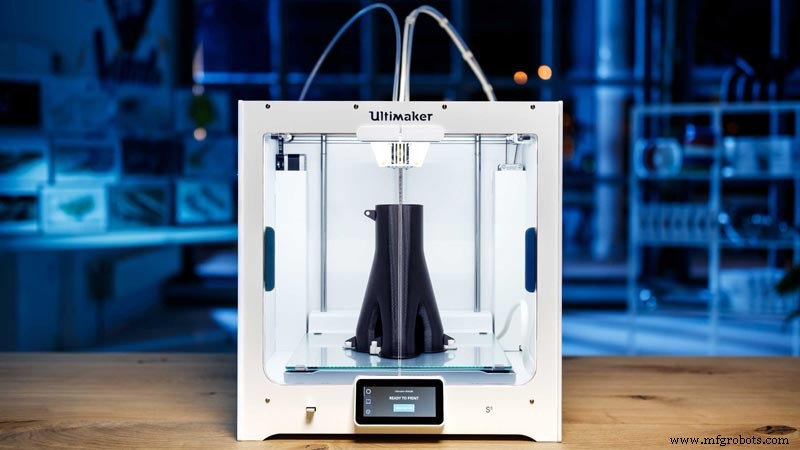
The S5 builds on Ultimaker’s evolution from the 2+ to the 3. It offers a larger build volume, advanced automation, and the ability to print composite materials like glass‑filled or carbon‑filled filaments. These enhancements position the S5 as a true industrial‑grade solution.
Future product roadmap?
Our roadmap focuses on two tracks: a “carpet floor” of user‑friendly prototyping machines, and a “concrete” line of high‑repeatability industrial printers. Upcoming developments will enhance consistency, expand material libraries, and reduce cost disparities between 3D printing and traditional manufacturing.
Core industry challenges?
Education remains a barrier—understanding when and how to use AM for production versus prototyping. For production, parts must match the strength, finish, and precision of injection‑molded components while remaining cost‑effective. Current success stories are in high‑value, low‑volume sectors such as aerospace and medical devices.
Where will additive manufacturing go in the next five years?
We anticipate a shift toward purpose‑built production systems, with companies like HP and Carbon focusing on manufacturing rather than prototyping. Material costs will continue to decline as competition increases, narrowing the gap between 3D printing and conventional processes.
Next steps for Ultimaker?
We aim to streamline the entire office experience—from software to post‑processing—and to launch a new line of printers that deliver higher repeatability and a broader material range suitable for short‑run production.
To learn more about Ultimaker, visit https://ultimaker.com/.
3D printing
- Digital Alloys CEO Duncan McCallum Discusses Joule Printing and the Future of Metal 3D Manufacturing
- Nanoe CEO Guillaume de Calan Discusses the Future of Ceramic 3D Printing
- Jabil’s Rush LaSelle Explains How Additive Manufacturing is Revolutionizing Global Production
- Interview with VELO3D’s VP of Technology Partnerships: Advancing Metal 3D Printing Capabilities
- John Barnes, Founder of The Barnes Group Advisors, Discusses Additive Manufacturing’s Future and Workforce Development
- Interview with Petar Stefanov, Founder & CTO of Spectroplast AG: The Advantages of Silicone 3D Printing
- How 3D Printing Is Transforming Manufacturing, Healthcare, Aerospace, and Education
- How 3D Printing Will Transform Manufacturing in the Next Decade
- How 3D Printing is Revolutionizing Modern Manufacturing
- 4D Printing: Revolutionizing Additive Manufacturing for Adaptive Solutions