



Interview with Petar Stefanov, Founder & CTO of Spectroplast AG: The Advantages of Silicone 3D Printing
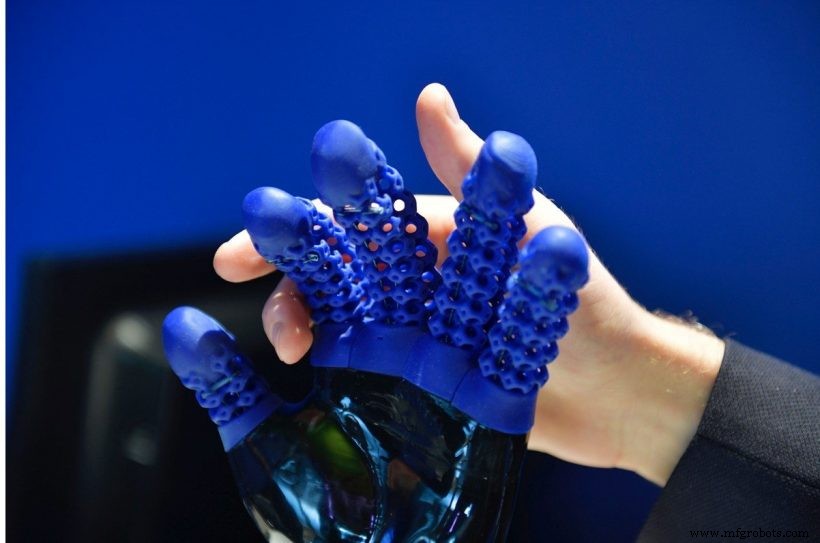
Material science in additive manufacturing is advancing at a breakneck pace, and silicone 3D printing has emerged as a game‑changing technology. This elastomeric material is prized for its biocompatibility, thermal conductivity and heat resistance.
Based in Switzerland, Spectroplast is at the forefront of silicone 3D printing. After extensive research at ETH Zurich, the company launched its commercial service bureau in September 2023.
In this week’s Expert Interview, we sit down with Spectroplast’s founder and CTO, Petar Stefanov, to explore the distinct advantages of silicone 3D printing, its most promising applications, and the operational realities of a service bureau.
Could you describe Spectroplast and the company’s mission?
 Spectroplast emerged from a multi‑year research program led by ETH Zurich PhDs—one of the world’s premier technology universities. Our mission is to commercialise that research, turning cutting‑edge material science into tangible products.
At the heart of Spectroplast is material chemistry: we have engineered a formulation that allows pure silicone to be printed directly with 3D‑printing technology.
Beyond chemistry, we have advanced the entire manufacturing chain—from raw‑material synthesis and process development to custom hardware—ensuring seamless delivery of finished silicone parts.
What are the benefits of using 3D printing to produce silicone parts as opposed to traditional methods?
Traditional silicone parts are typically produced by injection moulding, a process that excels at high‑volume, standardised production but carries substantial upfront costs and inflexibility.
Creating a mould requires specialised design, tooling and validation, with lead times of 8–12 weeks and upfront costs that can exceed $100 000. Any design change forces a costly re‑mould, adding both expense and time.
Injection moulding also suffers from high scrap rates—often 40–50 %—and limited shape complexity. In contrast, Spectroplast’s additive‑manufacturing (AM) workflow eliminates the need for costly tooling, reduces scrap to near zero, and cuts energy consumption.
Our process is ideal for low‑ to mid‑volume runs (50 000–100 000 units) and for parts that demand intricate geometries, where traditional moulding would be prohibitive or impossible.
What are some of the possible applications with silicone 3D printing?
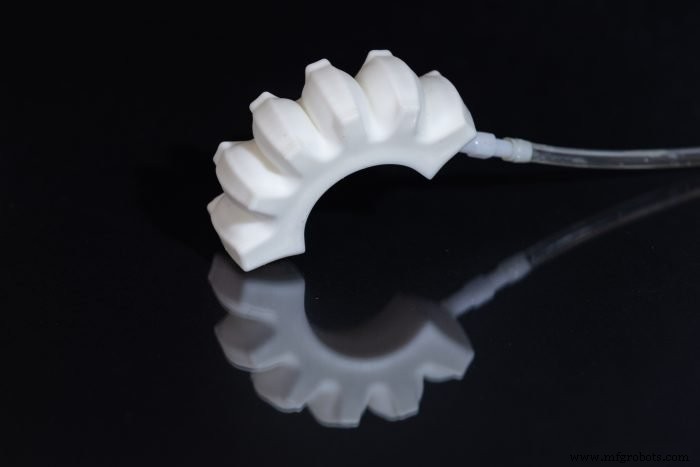
Silicone’s elastomeric, non‑toxic, biocompatible, heat‑resistant, UV‑stable and gas‑permeable properties make it indispensable across many sectors.
While everyday office equipment contains silicone components, Spectroplast focuses on high‑value healthcare solutions—custom hearing aids, protective ear devices, specialised headphones, and beyond.
Other medical applications include masks, prosthetic liners, shoe insoles, and fully customisable implants such as tracheal stents and heart valves, all of which benefit from the material’s softness and tailorability.
You mentioned that you’re specifically focusing on healthcare applications at the moment. Could you explain the reason for that?
We see the greatest impact of silicone 3D printing in healthcare, where customised solutions can directly improve patient outcomes.
For instance, we’re excited about bespoke breast prostheses for post‑mastectomy patients. Conventional prostheses come in a limited range of sizes and shapes, often leaving patients with asymmetry and discomfort.
By leveraging AM, we can fabricate a prosthesis that matches the patient’s anatomy precisely, restoring symmetry and enhancing well‑being.
Can you highlight specific examples of how you’ve helped your customers?
We recently partnered with the University Hospital of Zurich, which now recommends our service to patients in need—providing us with invaluable clinical feedback.
Beyond healthcare, we serve a portfolio of automotive, aerospace and other industries that demand rapid, custom, non‑certified silicone parts.
What are some of the challenges associated with 3D printing silicone specifically, since it’s very different from metal or polymer 3D printing?
Printing silicone poses unique challenges because of its high viscosity. Conventional extrusion‑based methods—such as robocasting or drop‑on‑demand—can only achieve limited resolution, and the material behaves like honey, constraining nozzle design.
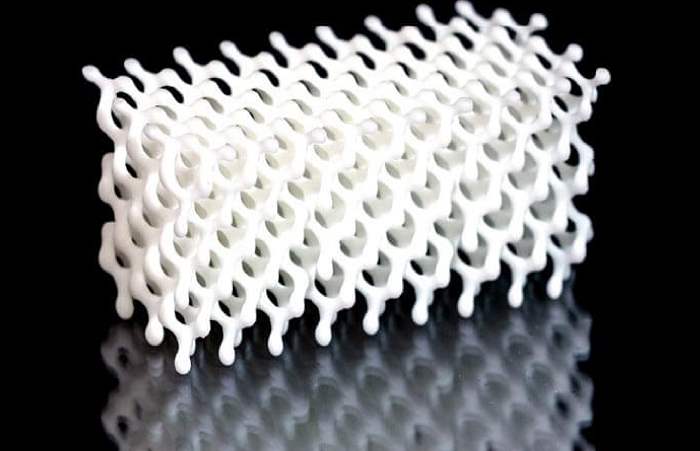
Spectroplast overcame these limitations by adapting silicone chemistry for a stereolithography‑compatible process, specifically digital light processing (DLP). This innovation improves resolution by a factor of 20, dropping tolerance from millimetre‑scale to 50 µm, and delivering superior surface finish.
We also increased throughput by at least tenfold compared to standard silicone 3D‑printing techniques, making our solution industrially scalable.
What is it like to run a service bureau as a business? What are the day‑to‑day challenges?
Running a service bureau is exhilarating. Since incorporation in September 2023, we’ve served over 150 B2B customers across diverse sectors.
Every day presents new challenges and learning opportunities, as clients push the boundaries of what our technology can achieve. This constant interaction guides our R&D, ensuring we develop solutions that meet real‑world demands rather than chasing trends.
However, the breadth of applications also demands rapid adaptation and flexible resource allocation, which can strain operations.
How would you describe the current status of 3D printing? And how do you see it evolving in the next few years?
We are at a tipping point where additive manufacturing is moving from niche prototyping to viable serial production.
While AM already supports moderate‑volume runs, high‑volume production remains outside its current domain. Instead, it occupies a complementary niche, delivering cost‑effective, custom parts for the evolving market.
Are there specific trends that you’re seeing?
Yes. Order volumes are shifting from simple prototypes and tooling toward finished parts, reflecting a broader industry move toward short product life‑cycles and diversified design portfolios.
With fewer units per design, AM’s strengths—rapid iteration and custom geometry—are increasingly valuable.
Spectroplast recently received 1.4 million CHF in seed funding. What does this investment mean for your company going forward?
Our growing customer base—over 150 clients—drives the need for expanded capacity. The 1.4 million CHF seed round will fund additional machinery, talent, and the next generation of materials.
We aim to raise the quality of our service to match the standards of injection moulding, ensuring that clients receive reliable, high‑performance parts at competitive cost.
To learn more about Spectroplast, visit spectroplast.com
3D printing
- Interview with Philip Cotton, Founder of 3Dfilemarket.com, UK 3D Printing Education Expert
- Dr. Alvaro Goyanes of FabRx on 3D‑Printed Medicines: From Innovation to Personalised Care
- Nanoe CEO Guillaume de Calan Discusses the Future of Ceramic 3D Printing
- John Kawola on Ultimaker’s Transition to Enterprise 3D Printing
- Expert Interview: Simon Fried, Co‑Founder of Nano Dimension, on 3D Printing’s Future in Electronics
- Interview with VELO3D’s VP of Technology Partnerships: Advancing Metal 3D Printing Capabilities
- John Barnes, Founder of The Barnes Group Advisors, Discusses Additive Manufacturing’s Future and Workforce Development
- Neil van Es on Driving 3D Printing into Production – Parts on Demand Founder
- Inkbit CEO Davide Marini Discusses the Future of Multi‑Material Inkjet 3D Printing
- Interview with BCN3D CTO Eric Pallarés: Unlocking the Power of IDEX 3D Printing Technology