



Interview with Spencer Wright of pencerw.com and nTopology: Expert Insights on Metal Additive Manufacturing
Almost every professional in manufacturing has visited Spencer Wright’s blog or newsletter. As the head of research & partnerships at nTopology, Spencer brings decades of experience in metal additive manufacturing (AM) and conventional processes. He shared his journey, current workflow solutions, and future vision with RP Platform.
How did you originally get interested in 3D printing?
I became interested in metal printing simply because it sounded cool!

My background is in traditional manufacturing—project management, product design, and custom bicycle frame construction. After a stint in a prototyping shop focused on electromechanical assemblies, I moved to New York in 2012 to reassess my career focus. The city’s Makerbot and Shapeways scene sparked my curiosity about metal printing, especially as GE’s acquisition of Morris was redefining the industry.
Through a strategic role at Undercurrent, I learned about metal powder‑bed fusion. I was skeptical of the hype and asked: how does this compare with the multi‑billion‑dollar CNC, forging, and casting sectors? I discovered that the printers cost roughly $1 million and fit on a breadbox‑sized build platform. The challenge was identifying high‑value, lightweight parts that fit within that space. I settled on bicycle components—luxury riders are willing to pay a premium for reduced weight or unique geometry.
My design expertise, supply‑chain knowledge, and a blog that filled a niche allowed me to experiment with printing, publish results, and attract inquiries from industry leaders such as Siemens and Philips. That exposure cemented my pivot to a full‑time focus on manufacturing workflows, leading to my current role at nTopology, where I align our design software with the broader toolchain.
It seems like your background in traditional manufacturing means you’re approaching 3D printing in a much more organic way than many people do: starting with a problem and identifying 3D printing as the right tool to fix it. Would you agree with that?
Absolutely. I always start with the problem and then evaluate the best technology—whether that’s CNC, 3D printing, or another process. The key question I ask clients is: why do you want to print this part?
The media often hype the novelty of printing without addressing tangible benefits. Ultimately, customers care about performance, cost, and availability—not whether a part was printed. For most components, printing is not the optimal solution; it shines when weight reduction, internal lattices, or simplified assembly are needed.
I focus on identifying those high‑impact applications and developing heuristics to evaluate an industry’s suitability for AM.
What would be some good examples of those recently?
Our portfolio spans aerospace, medical implants, and consumer technology. In aerospace—rockets, satellites, and hypersonic vehicles—regulatory scrutiny is the toughest, so succeeding here often opens doors elsewhere. Medical implants demand stringent biocompatibility and mechanical precision. In consumer tech, we design lattice structures that absorb impact in footwear or sports equipment, replacing conventional foam with energy‑dissipating geometries.
Do you find that there’s much of a learning curve in terms of companies’ workflows, especially when multiple software platforms are involved?
Yes, it’s complex. Engineers run $50,000‑plus software suites simultaneously—several CAD packages, analysis tools, and manufacturing software. Despite the variety, core requirements—traceability, documentation, regulatory compliance—remain consistent across industries.
Manufacturing tools like Autodesk Netfabb and Materialise Magics evolve rapidly, and file formats change frequently, adding another layer of complexity.
What do you see as the answer in terms of streamlining all this?
We focus on creating a smooth experience within our flagship product, Element. Currently, most AM workflows rely on STL, which is inefficient for lattice structures. For a million beams, STL can generate files of many gigabytes, making transfer and rendering burdensome.
Element uses a graph‑based representation: nodes with coordinates and radii connected by beams. This reduces file size dramatically and aligns with an open‑source spec that works with any slicer or orientation tool. We are integrating this approach into the 3MF standard to simplify communication and improve CPU performance during slicing and FEA integration.
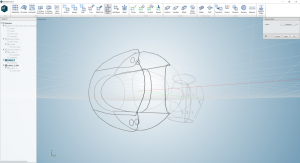
By exporting to a streamlined format, engineers can email files quickly and render them efficiently, while still enabling beam‑level analysis.
How do you see the uptake of this new file format?
We’ve seen mixed adoption with previous file standards. However, the clear advantages—reduced size, faster transfer, and simplified geometry—should drive rapid uptake. Unlike traditional triangle‑based files, our representation fits neatly into the 3MF framework, offering the best of both worlds.
Do you see customisation for clients’ specific needs as a key factor in successful software for AM?
Customization is a double‑edged sword. A consistent interaction model is essential; adding disparate context menus or command structures creates a fragmented user experience. We prioritize a unified interface while listening closely to customer requirements. Our new file format is designed to be easy for anyone to manipulate, ensuring flexibility without compromising clarity.
What about streamlining AM workflows? What ways have you found of making the overall processes tighter and reducing any disconnects?
Streamlining is challenging, especially for aerospace clients juggling multiple part revisions. We enable multiple design versions within a single file, allowing engineers to branch without fragmentation. Interoperability remains a bigger hurdle; instead of building plug‑ins for each CAD kernel, we keep most work inside Element, guaranteeing a coherent user experience.
In wider terms, how do you see all this evolving?
Metal printing has matured over a century of metalworking, but AM lacks repeatability. Different manufacturers can produce varying results from the same file. The goal is maturity—consistent, reliable builds. We’re building design constraints into our software, providing real‑time feedback on manufacturability, and pushing for machine manufacturers to expose APIs that surface printability insights.
In the next five years, I anticipate tighter integration between machine manufacturers and part designers, more open APIs, and a workflow that encourages cross‑disciplinary collaboration—turning disparate teams into a cohesive engineering ecosystem.
www.pencerw.com
3D printing
- Inside 3D Printing: Professor Neil Hopkinson on Innovation, Scale, and the Future
- Interview with Philip Cotton, Founder of 3Dfilemarket.com, UK 3D Printing Education Expert
- Dr. Alvaro Goyanes of FabRx on 3D‑Printed Medicines: From Innovation to Personalised Care
- Carbon Performance: Revannth Murugesan on Racing Innovation, 3D Printing, and AI‑Driven Components
- Interview with RIZE CEO Andy Kalambi: Advancing Sustainable, Scalable Industrial 3D Printing
- How Graphite AM’s Jonathan Warbrick Drives Success in Industrial 3D Printing
- Ben Batagol on How 3D Printing is Revolutionizing Heat Exchanger Design at Conflux Technology
- Roboze CEO Alessio Lorusso Discusses Cutting‑Edge Composite 3D Printing and Industry Outlook
- Dunlop Systems Accelerates Tooling Production with 3D Printing – Insights from Mark Statham
- Expert Interview: nTopology CEO Discusses Advancing Additive Manufacturing with Generative Design Software