



Expert Interview: Scott Dunham on Metal 3D Printing, Service Bureaus, and the AM Materials Market – Part 2

This is Part 2 of our two‑part interview with Scott Dunham. Check out the first part here.
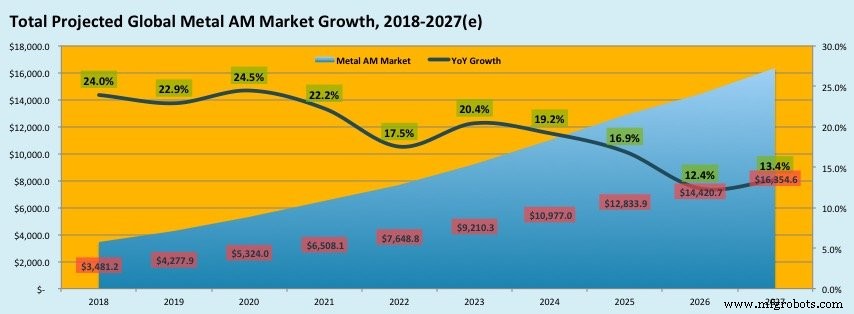
Metal 3D printing has been a hot topic in recent years, with many companies entering the space. How much more growth will the market see in the future?
When we look at the metal additive manufacturing (AM) ecosystem, the biggest leap lies in hardware. The market can be broken down into four value‑chain segments that SmarTech focuses on: hardware, materials, production services, and software. The relative size of each segment tells us how mature the technology is.
Hardware dominance signals an early‑stage technology. Companies are eager to acquire the latest machines and emerging metal processes to understand true capabilities and avoid being locked into an inferior solution. As the industry matures, emphasis shifts toward materials and production services, reflecting higher utilization rates and serial production demand. Yet, one‑off and low‑volume parts remain highly valuable, especially for niche applications.
Even though traditional subtractive technologies like machining are also digitally controlled, additive manufacturing offers unique benefits that are still largely untapped. For example, compare the number of mills sold worldwide to the number of AM systems—AM is still a minor player, but that underlines tremendous growth potential on the metal side.
Service bureaus: Will they become essential as more companies adopt in‑house metal 3D printing?

From a metallurgical standpoint, powder‑bed fusion is complex and hard to optimise for repeatability. This complexity creates a clear niche for service bureaus to offer outsourced expertise in metal AM. Companies that have invested five years or more in‑house are still refining post‑processing and certification processes. For others, the barrier to entry remains high—they prefer a plug‑and‑play solution rather than building internal capabilities.
Even as firms bring printers in‑house, they often leave post‑processing, certification, and qualification to partners. Service bureaus can fill that gap, saving non‑power users time and capital while accelerating adoption. On the polymer side, this outsourced expertise is less critical, but it may grow as new applications emerge.
New users will come from diverse industries. Aerospace, for instance, has rapidly integrated service bureaus for high‑volume parts. However, many metal processes remain under‑developed, offering service providers a window to specialize and deliver value.
Non‑AM companies are entering the market—will this trend continue? Xerox’s acquisition of Vader Systems is an example.
While Xerox’s move is noteworthy, it may not be a perfect blueprint for success. Still, we expect the trend of large technology firms exploring additive manufacturing to continue. Canon, Epson, and others have shown interest in AM over the past eight years. Acquisitions will likely keep happening, but not every entrant will succeed. The key will be finding a niche where their core strengths align with AM capabilities.
Key insights into the AM materials market
Open‑materials initiatives are often portrayed as the panacea for AM challenges. However, the reality is more nuanced. Allowing customers to tweak printer parameters does not automatically yield optimal materials; the process is costly and complex. A successful material‑development strategy requires a deep understanding of both the printer and the target application.
When an organization needs a specific material for a particular use case, the most efficient path is to use a pre‑qualified material that the machine manufacturer has already validated. This hands‑off approach delivers repeatable results without the burden of proprietary development.
Ultimately, the scope of printable materials is constrained by the hardware. Each printer defines the allowable temperature range, feed rate, and other parameters. Therefore, hardware innovation remains the most critical driver for expanding material options.
The evolving role of software in 3D printing
Software has long been a pain point in AM, especially as the industry transitions from rapid prototyping to full‑scale manufacturing. Two critical software needs are automation and design optimization.
- Automation: Beyond robotic integration, software must streamline end‑to‑end workflows—from build planning to post‑processing—to improve productivity.
- Generative design: This technology enables engineers to create lightweight, high‑performance parts that exploit the unique strengths of additive manufacturing.
- Simulation & in‑situ monitoring: Coupling design with real‑time process data enhances quality assurance, a key requirement for certification in many sectors.
Collectively, these software advances will lower the barrier to entry and make AM a viable manufacturing alternative across industries.
What to expect in the next five years?
We foresee two major shifts:
- Competitive consolidation: Mergers, acquisitions, and strategic partnerships will reshape the market. Companies that cannot keep pace with automation, quality assurance, and consultative services risk being left behind.
- Machine specialization: We will see more machines tailored to specific materials or applications—akin to EOS’s custom‑system division—though flexible solutions will still coexist.
These trends will drive innovation and redefine how metal AM is integrated into manufacturing ecosystems.
To learn more about SmarTech Analysis, visit: https://www.smartechanalysis.com/
3D printing
- Digital Alloys CEO Duncan McCallum Discusses Joule Printing and the Future of Metal 3D Manufacturing
- Nanoe CEO Guillaume de Calan Discusses the Future of Ceramic 3D Printing
- John Kawola on Ultimaker’s Transition to Enterprise 3D Printing
- Expert Interview: SmarTech Analysis VP Scott Dunham on Additive Manufacturing Trends (Part One)
- Interview with APWORKS CEO Joachim Zettler: Unlocking Business Value in Metal 3D Printing
- 5 Key Trends Driving the 3D Printing Materials Market in 2019
- Roboze CEO Alessio Lorusso Discusses Cutting‑Edge Composite 3D Printing and Industry Outlook
- Interview with VELO3D’s VP of Technology Partnerships: Advancing Metal 3D Printing Capabilities
- Scaling 3D Printing: Makelab CEO Christina Perla Shares Insights on Building a Resilient Service Bureau
- 2019 3D Printing Materials Market: Trends, Growth, and Emerging Opportunities