



Support Structures in 3D Printing: Expert Guide to Design, Use, and Optimization
Support structures are the backbone of reliable 3D prints. While 3‑D printing unlocks free‑form geometry, it relies on supports to keep parts from warping, collapsing, or losing dimensional fidelity.
In this comprehensive guide we examine what supports are, why they’re essential across printing technologies, and proven strategies to minimise their use while preserving part quality.
What Are Support Structures?
Support structures act like scaffolding: they temporarily brace a print, anchor it to the build plate, and absorb heat during fabrication. After the part is finished, they are removed.
Complex features—overhangs, bridges, and deep cavities—are particularly vulnerable. Without support, they can sag or fracture. In metal AM, supports also serve as heat sinks, mitigating residual stresses that would otherwise cause cracking or warping.
When Do You Need Supports?
Most additive processes require some level of support. The table below summarises the requirement by technology and material.
| Technology | Material | Support Needed? |
|---|---|---|
| Stereolithography (SLA) | Photopolymers | Yes |
| Fused Deposition Modelling (FDM) | Thermoplastics | Yes |
| Selective Laser Melting / DMLS / DED / EBM | Metals | Yes |
| Material Jetting | Powder | Yes |
| Binder Jetting | Powder | No |
| Selective Laser Sintering (SLS) | Powder | No |
Metal 3D Printing
Powder Bed Fusion (SLM, DMLS, EBM)
These systems enclose the part in loose powder, but the part still needs support to secure it to the build plate and to drain heat. Supporting the contact area between the part’s base and the plate reduces residual stress, thereby preventing cracking, warping, or delamination.
For more on metal‑printing pitfalls, see our guide to common issues faced in metal 3D printing.
Direct Energy Deposition (DED)
DED builds by fusing material on a substrate. Like powder bed fusion, supports are essential for complex geometry, stability, and heat dissipation.
Design Considerations
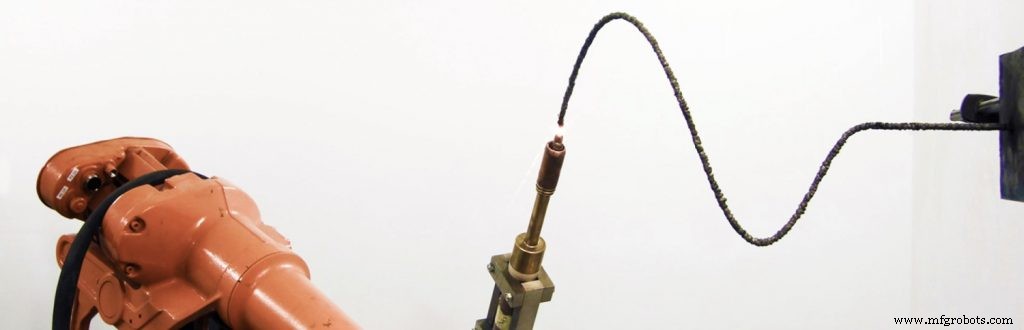
Metal supports are typically lattice structures that act as heat sinks while keeping material usage low. However, excessive support can increase build time and cost, and complicate post‑processing. Some companies, such as Dutch firm MX3D, have introduced robotic arm‑based welding that eliminates the need for supports entirely.
Support Removal
Metal supports usually require cutting tools. After removal, sanding or polishing is often needed to achieve a smooth surface.
Stereolithography (SLA)
SLA solidifies liquid resin with light. Supports in SLA are slender and only lightly touch the part, making manual removal simple. However, they can leave micro‑marks that typically require sanding.
Design Tips
SLA excels when a high‑quality surface is required—visual prototypes, molds, hearing aids. Positioning the part so that critical surfaces avoid support contact can eliminate visible marks. For example, orient a tubular part vertically rather than horizontally to minimise supports.
Fused Deposition Modelling (FDM)
FDM builds by extruding heated filament layer by layer. Features up to 45° can be printed without support, but steeper overhangs or long bridges (>5 mm) need assistance.
Support Types
Supports are often lattice or tree‑like structures. Tree‑style supports reduce material usage by up to 75 % compared to straight columns.
Support Removal
Industrial FDM printers frequently use dissolvable supports. Polyvinyl alcohol (PVA) dissolves in water, while High‑Impact Polystyrene (HIPS) dissolves in limonene. Dissolution removes the need for sanding but adds post‑processing time.
Material Jetting
Supports are mandatory for overhangs but are printed in a separate, water‑soluble material that can be removed with pressurised water or ultrasonic baths.
Selective Laser Sintering & Binder Jetting
Both powder‑based processes encapsulate the part in loose powder, eliminating the need for additional supports.
Drawbacks of Supports
- Material cost: Supports consume extra material that is typically discarded.
- Design constraints: Accessible removal must be considered, limiting geometry.
- Time: Generating and post‑processing supports adds hours to a build.
- Surface damage: Incorrect placement can damage fine features.
Four Ways to Minimise Supports
- Optimise part orientation: Reorienting the model can reduce overhangs. For example, rotating a “T” shape so the horizontal arms align with the build plate eliminates the need for supports.
- Optimise support geometry: Use topology‑optimised lattices or tree‑like structures. Autodesk Meshmixer can generate tree supports for FDM, SLA, and DMLS.
- Employ fillets and chamfers: Adding a 45° chamfer or a rounded fillet converts steep angles into printable ones, eliminating the need for supports.
- Split complex parts: Printing sub‑assemblies separately can drastically reduce support volume and build time. Ensure consistent orientation for proper fit.
Supports: A Necessary Evil? The Future is Bright
Innovations are turning supports from a nuisance into a streamlined process. Desktop Metal’s patented “separable supports” use a ceramic powder interface that dissolves post‑sintering, enabling easy hand removal. PostProcess Technologies offers automated, hands‑free removal systems for FDM, SLA, PolyJet, and CLIP.
Velo3D’s Intelligent Fusion technology simulates part behaviour to print with up to five times fewer supports, achieving near‑zero support requirements in many cases.
While the industry continues to evolve, expertise and proper workflow design remain crucial for harnessing these advancements.
We hope this guide empowers you to treat support structures as allies, not adversaries.
3D printing
- Mastering 3D Printing Support Structures: Essential Strategies for Every Process
- Simplifying Metal 3D Printing: Expert Tips for Managing Support Structures
- Silicone 3D Printing Explained: A Beginner’s Guide to Cutting‑Edge Production
- Material Jetting 3D Printing: The Ultimate Guide to Precision, Colour, and Innovation
- Master TPU 3D Printing: Your Complete Guide to Flexible, Durable Parts
- Metal 3D Printing 2024: Comprehensive Guide to Technologies, Applications, and Business Benefits
- Your Definitive Guide to 3D Printing: From Basics to Advanced Techniques
- Ultimate Guide to Ender 3 (Pro & V2) Support Settings – Optimize Print Quality
- Expert Guide to Choosing 3D Printing Materials for SLS, MJF, FDM, SLA & DLS™
- Enhancing 3D Printing: Mastering Support Structures for Complex Builds