



Standards for 3D Printing (2020 Update): Current Landscape and Road Ahead
Standardisation is the bedrock of any mature industry. For the rapidly evolving world of additive manufacturing, it is not a luxury but a necessity.
According to a recent EY survey, 46 % of companies plan to use 3D printing for end‑part production by 2022. As the technology pivots from prototyping to production, the urgency for common standards has never been higher.
The Value of Standardisation for 3D Printing
Standards—best practices, regulations, and benchmarks—create a shared foundation that promotes wider adoption and ensures consistent quality. In additive manufacturing, they play a dual role:
- Consistency. Additive processes involve a complex web of variables—raw materials, design optimisation, and machine parameters—each demanding rigorous control. Standards delineate the parameters for every stage, enabling companies to compare their output against objective criteria and eliminate costly trial‑and‑error cycles.
- Regulatory Compliance. Industries such as medical, automotive, aerospace, and defence require stringent certification. Because AM parts can exhibit properties that differ from traditionally manufactured parts, clear qualification and certification guidelines are essential for regulatory approval.
Current Challenges in Standardising Additive Manufacturing
While several standards exist, many critical ones remain under development. Key gaps include:
- Materials. Metal AM materials dominate aerospace and medical markets, yet standardized mechanical data for these powders is scarce. Existing conventional material standards cannot always be transferred directly because AM parts can behave differently.
- Process Control. Proprietary data on process variables—thermal history, microstructure, defect formation—limits the ability to benchmark performance. Open, collaborative data sharing is crucial to advance this area.
- Certification. Current QA relies on post‑production testing, which is time‑consuming and resource‑heavy. Industry needs robust, real‑time certification pathways that account for the unique characteristics of AM parts.
Building a Global Standards Framework
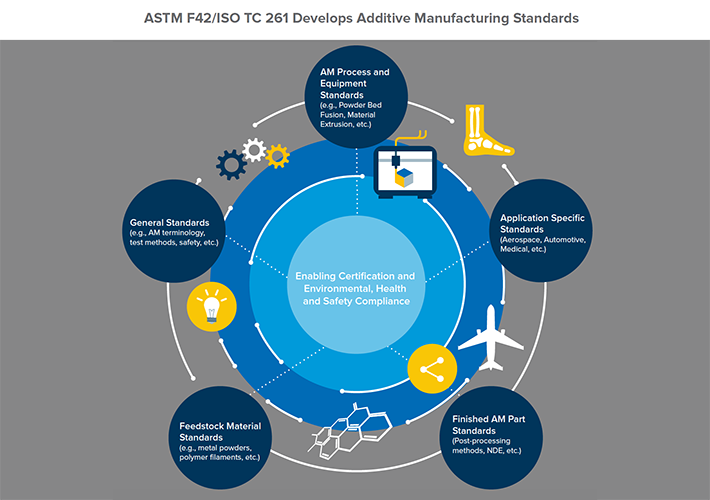
Global consensus has yet to be reached, but momentum is growing. ISO and ASTM International have established joint working groups to harmonise AM standards under the Additive Manufacturing Standards Structure, covering materials, processes, equipment, and finished part treatment.
- As of May 2020, ASTM Committee F42 had approved 22 standards, and ISO/TC 261 had published 15 with 30 in development.
- ASTM has funded research initiatives, including a 2019 grant to the National Additive Manufacturing Innovation Cluster (NAMIC) in Singapore.
Metal Powder Bed Fusion Standards
ASTM’s F3303, released in 2018, sets qualification criteria for SLM, EBM, and DMLS technologies used in medical, aerospace, and other high‑performance sectors. The Metal Powder Industries Federation (MPIF) has issued nine test methods to characterise metal AM powders, reinforcing the sector’s focus on material reliability.
Aerospace‑Specific Standards
SAE International’s new PBF standards—AMS suite—cover nickel‑alloy materials and process requirements for aircraft and spacecraft components. The AMS7100 polymer specification, introduced last year, ensures reproducibility for FDM and other extrusion processes. ASTM’s F42 is also developing four additional standards addressing feedstock, finished part properties, system performance, and qualification principles.
The Additive Manufacturing Standardisation Collaborative (AMSC)
Formed by America Makes, the Additive Manufacturing Innovation Institute, and ANSI, AMSC’s roadmap identifies 93 gaps—18 of which are high priority—across the AM landscape. Their online portal launched in 2019 tracks standardisation activity and accelerates gap closure.
Collaboration Drives Progress
Industry alliances are essential to advance AM standards. Examples include:
- SLM Solutions partnering with DIN to accelerate metal 3D printing adoption.
- Oerlikon and Boeing collaborating on titanium powder‑based AM standards for aerospace and defence.
- ASTM’s $300,000 investment in research at the Additive Manufacturing Center of Excellence, focusing on feedstock, process qualification, post‑processing, and testing.
- The Center of Excellence, co‑founded by ASTM, Auburn University, NASA, EWI, and the UK’s MTC, aims to bridge R&D and standardisation gaps across material evaluation, laser‑based machine specs, surface quality metrics, and mechanical testing guidelines.
Standardisation: Shaping the Future of 3D Printing
“Better, universally accepted standards would enable companies to compare apples to apples and make informed decisions across a coherent ecosystem of suppliers, manufacturers, and users.”
Avi Reichental, Founder of XponentialWorks
While mainstream adoption of 3D printing is still challenged by quality, consistency, and certification hurdles, robust standards will unlock the technology’s full potential. Establishing clear, actionable guidelines will drive production‑grade usage, foster industry‑wide trust, and accelerate the transition from niche to mainstream.
3D printing
- Designing Object Models for 3D Printing: CAD, Scanning, and Photogrammetry Explained
- Is 3D Printing Ready for the Construction Industry? 2020 Update
- Metal 3D Printing Today: From Prototype to Production
- Stereolithography & Digital Light Processing: Current Landscape & Future Outlook
- FDM 3D Printing Today: Current State, Milestones, and Future Outlook
- 2021 State of 3D Printing in Healthcare – Market Growth & Emerging Applications
- 2020 3D Printing Forecast: 20 Industry Leaders Outline the Future
- How 3D Printing and Software Drive Digital Transformation in Manufacturing
- 3D Printing and Mass Customisation: Current Landscape and Future Opportunities
- CRN Awards Markforged X7 Turbo Print as 2020’s Best 3D Printing Innovation