



Comprehensive PPE Checklist for Oil & Gas: Head, Face & Eye Safety Essentials
What specific head, face and eye protection is needed in the oil and gas industry? Our PPE checklist will help you outfit your workers’ specific needs.
The dangerous work in the oil and gas field makes the chance of injury or fatality one of the highest of any industry.
In fact, from 2008 through 2017, “1,566 workers died from injuries in the oil and gas drilling industry and related fields, according to data from the U.S. Department of Labor’s Bureau of Labor Statistics,” notes this article by The Center for Public Integrity.
Vehicle incidents and struck-by hazards result in the most fatalities for upstream workers involved in oil and gas extraction, according to the Occupational Safety and Health Administration. Downstream at refineries and processing plants, the potential for coming into contact with chemicals and fumes increases.
The hazards in jobs across this industry make personal protective equipment for the head, face and eyes a paramount safety focus.
What about protective gear for flash fires and explosions? Find out why oil and gas workers require flame-resistant clothing in this Better MRO article.
Oil and Gas Safety Equipment: Head Protection
“Hard hats are worn in nearly every upstream application to protect workers from head injuries ranging from minor bumps to concussions and even severe trauma which can result in death,” says Industrial Safety & Hygiene News.
What to look for in a hard hat:
- ANSI Type II/CSA Type 2 protection to reduce lateral and crown impact.
- High-density polyethylene to provide chemical resistance.
- Multiple suspension points to improve comfort while ensuring a snug fit.
- Lightweight.
Never forgo comfort. “Studies prove that uncomfortable caps are not worn consistently, leaving workers vulnerable to injury,” adds the ISHN article.
Also, make your workers aware that they must regularly inspect their hats because chemical exposure, high temperatures and the ultraviolet rays of the sun can break down hat material and suspensions over time, reducing a hat’s protective value.
“A good rule of thumb is to replace the suspension every year and the shell every five years,” ISHN points out.
 Want to compare different types of hard hats? Use our safety product selector.
Oil and Gas Safety Equipment: Face Protection
Again, the potential for flying debris and splashing chemicals makes the use of face shields a smart option for workers in this industry.
“These shields extend from the eyebrows to below the chin and across the width of the employee’s head,” explains Princeton University’s environmental health and safety documentation.
What to look for in a face shield:
- Compliance with ANSI Z87.1 to provide chemical or UV protection (avoid fluid-resistant shields as they can’t withstand chemical splashes).
- Specific chemical resistance for hazards unique to your worksite.
- A blast shield for work involving highly explosive materials.
- Anti-fog and anti-scratch coatings.
Oil and Gas Safety Equipment: Eye Protection
A face shield is not enough.
“When worn alone, face shields do not protect employees from impact hazards,” notes OSHA’s Eye and Face Protection eTool. “Use face shields in combination with safety spectacles or goggles, even in the absence of dust or potential splashes, for additional protection beyond that offered by spectacles or goggles alone.”
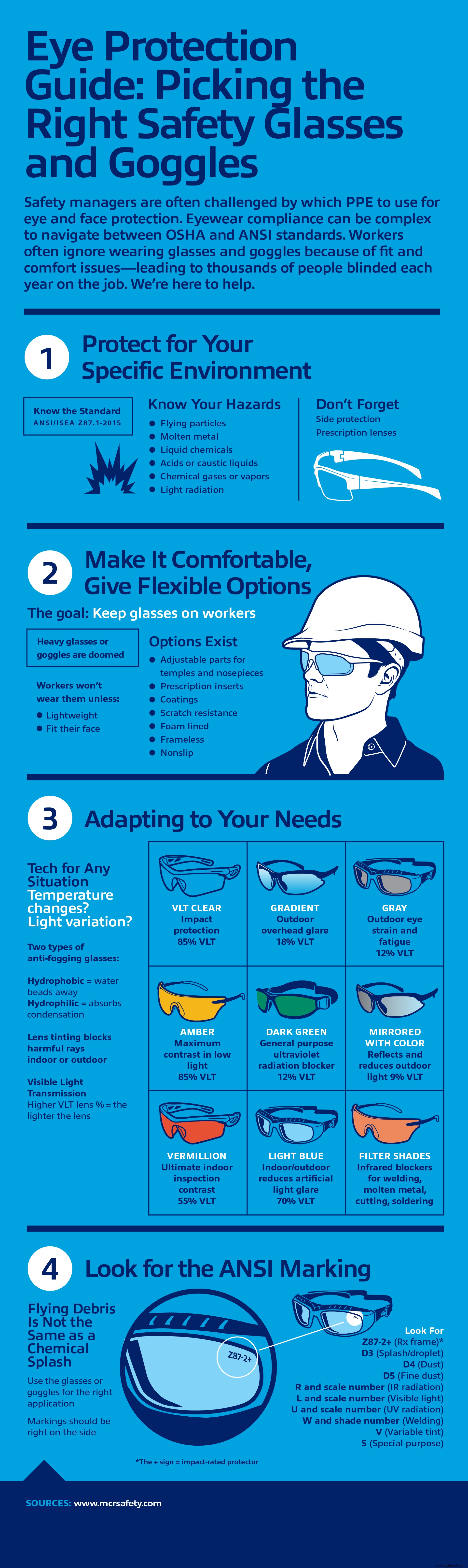
What to look for in safety glasses and goggles:
- Specialized lens tints for specific lighting levels since many in this industry work outside.
- Transitional lenses for workers who must go between indoor to outdoor locations often.
- Customizable eyewear for personal fit adjustments
- Anti-fog and anti-scratch coatings.
- Goggles or wrap-around glasses to protect from all angles.
“Ensuring that safety eyewear fits every worker properly—and comfortably—is a tall order, but a vital one,” writes Wanda Sanchez-Miller of Honeywell Safety and Productivity Solutions in OH&S magazine. As with hard hats, workers simply won’t use protective eyewear if the fit is poor, but also if the eyewear is unattractive, she adds.
Ensure Compatibility of Oil and Gas PPE
Clearly, if workers don goggles, face shields, hard hats—and potentially earplugs or earmuffs too—a key factor during product selection must be compatibility. Will the PPE gear mesh together well and be comfortable once workers don all the pieces?
“Together, head and face protection should provide a comfortable, secure and reliable fit,” says the ISHN article. “Convenience features that allow the user to quickly and easily switch between types of face protection save time, while easy adjustability features eliminate worker frustration and help ensure that PPE stays on—even while making adjustments.”
What challenges have your workers faced if they must work outdoors with head, face and eyewear protection?
Industrial Technology
- Building Resilient Oil & Gas Supply Chains: A Strategic Roadmap for Post-Crisis Stability
- Navigating Digital Transformation: How IIoT Empowers Oil & Gas OEMs
- 4 Proven Asset Management Strategies for Oil & Gas Companies
- Comprehensive Guide to Face Protection: Balaclavas, Neck Gaiters & Masks
- How to Properly Clean and Sanitize Safety Eyewear for Optimal Protection
- Enhancing Laboratory Safety and Efficiency Through Optimized Gas Distribution
- Enhance Safety & Efficiency in Gas Distribution Systems
- Oil & Gas Safety Checklist: Secure Your Industrial Fluid Systems
- Expert Guide: Material Selection for Sour Oil & Gas Field Operations
- Training as a Key to Reducing Risk on Oil and Gas Platforms