



Photo Relays Explained: A Beginner’s Comprehensive Guide
Relays are a critical part of any design, especially those that require high current to power some of their sections. However, a dilemma typically ensues when choosing between mechanical relays and contactless relays, but that will no longer be the case with the onset of photo relays.
Thus, below you learn about photo relays, what makes them unique, and why they are preferred to mechanical relays.
Read on to find out more.
What are Photo Relays?
To understand what photo relays are, it is essential you first have a clear understanding of what relays are.
Put simply. Relays are switches used to provide both high power and low power outputs in electrical circuits.
Relay models are into two groups;
Semiconductor relays, also known as contactless relays.
Electromagnetic relays. Primarily known as mechanical relays.
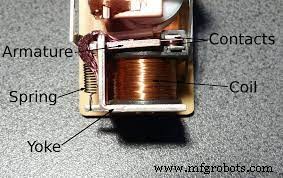
Mechanical Relay
Source: Wikipedia
Now Photo relays are a type of contact-less relays that use light as the impulse signal. Meaning that, unlike the mechanical relays, they do not require contact to switch current to a load.
Photo relays work by releasing light once the current goes through the LED.
The released light then falls across the isolation boundary onto the PDA chip light sensor, which powers a connected MOSFET pair.
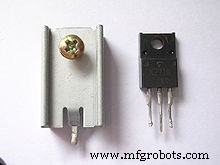
MOSFET
Source: Wikipedia
Once the MOSFET pair is turned on, AC/DC flows through its power terminals.
Photo Relays versus Mechanical relays
In the table below, features of photo relays are compared against those of mechanical relays.
| Photo Relay | Mechanical relay |
| Uses Light | Uses movable contacts |
| Fast and quiet switching | Slow switching and produces a loud clicking sound |
| Long-lasting as there are no contact parts | Shorter lifespan due to pressure resulting from the movable contacts |
| Low input power consumption | High input power consumption |
Benefits of Photo Relays
- Longer lifespan, since they do not have mechanical parts hence slower degradation enhancing their reliability.
- Photo relays have reduced power consumption. Relay photo relays require as little as 3 to 5mA level current. To give you a clear perspective; contact relays consume about 100 mW, whereas photo relays consume 0.5mW
- Smaller due to their package style.
- Faster switching speeds.
- Affordable as they don’t require mechanical relay replacements.
- Enhance device functionality.
How to make a portable photo relay
Items you will need to make a portable photo relay.
- Transformer
- NE-2 Neon Lamp
- Plastic Case preferably 12cm*8cm *3cm
- Light-dependent resistor
- A receptacle
- 7555 CMOS timer
- A solid-state relay; item model 2 Amp
- Tip Jack
- Bottle top
- Silicone rubber Sealant
- Tip Jack
- LED mounting Sleeve
Procedure
Place the SS relay, LDR leads, and the transformer onto the plastic case. Using silicone rubber sealant, secure them on the plastic.
Place the small parts such as the diode, capacitor, and integrated circuit onto the circuit board.
Circuit Board
After which, mount the circuit board onto the plastic case. Place the circuit board between the SS relay and the transformer next to the LDR leads.
Now connect the 2 pin header onto the LDR.
Wire the SS relay to connect to the circuit board, and then wire the transformer to connect to the circuit board.
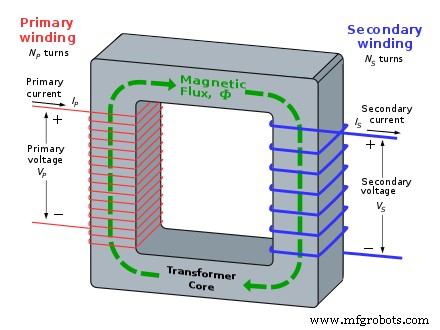
Circuit Transformer
Source: Wikipedia
Place the output receptacle onto the SS relay while installing the transformer wiring and inputting the line cord.
Finally, install the neon lamp and ground terminal connecting it to the transformer. Your portable transformer is now complete.
Below is a circuit diagram to provide direction:
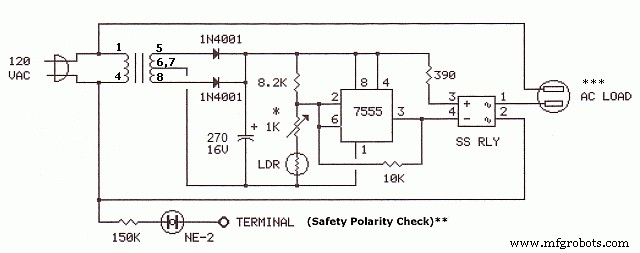
Photo relay Circuit
Source: Maxim Carter
It is worth noting that there are three variations of a photo relay, and they include:
- 240 VAC single pole version
- Weatherproof version
- High current Version
Let’s have a closer look at each and learn how you can make them.
240 VAC single Pole Version
Making the 240 VAC single pole versions is relatively easy. All you have to do is use a 230V/6v×2 transformer in place of the 240VAC and remove the neon lamp and resistor (150k)
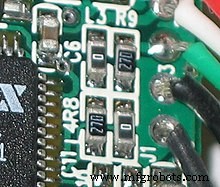
Resistors
Weather Proof Version
By removing the light sensor using low voltage wiring, you will have created a weatherproof Photo relay version.
However, you will need to enclose part of the Light sensor in a translucent waterproof tin to place the remaining circuit parts in a covered location. As shown by the circuit diagram below
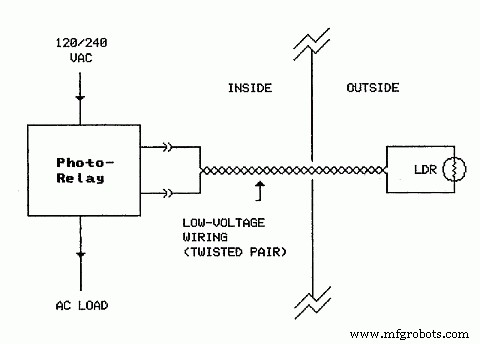
Weatherproof Photo Relay Circuit Diagram
Source: Wikimedia commons
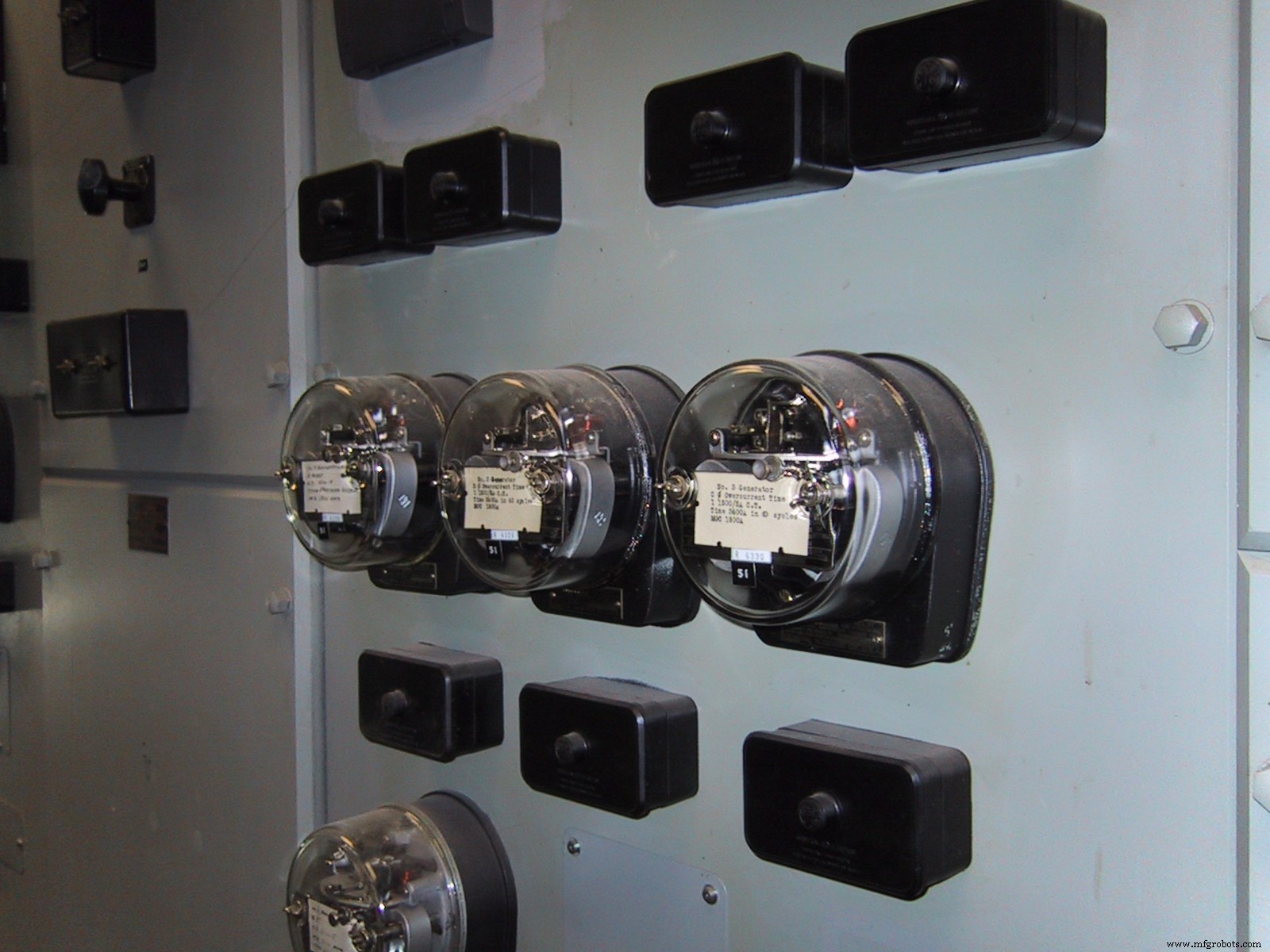
Enclosed Relay
Source: Wikipedia
High Current Photo relay Version
For a high current photo relay version, you will need to replace the original resistors. That you used when making the initial photo relay with more powerful resistors to handle the high current.
This system is preferred as it provides enhanced nighttime security.
Similarly, you can follow the circuit diagram as shown below to pilot a 240VC relay.
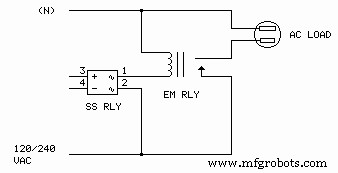
High current Photo relay
Source: Wikimedia commons
Safety Precautions to follow when making a portable photo relay
Whenever dealing with any digital device, you must adhere to safety regulations to prevent you and the electronic item from harm or damage.
Some of the precautions include:
1. Work on a dry surface and environment to avoid electric shocks.
2. Ensure you have turned off any power source linked to the device before working on it. You should also disconnect all the wiring attached to the photo relay.
3. Conduct a polarity check to ensure all the conductors are de-energized. A polarity test will also prevent your device from short-circuiting and also improve your device functionality
4. Only use a voltage that the system can handle as a higher voltage may lead to an explosion once you connect the photo relay to power.
5. Double-check the wiring on your digital device to ascertain you linked it correctly before connecting the photo relay to a power source.

Double-check the wiring
Source:
Summary
With the continuous advancement of technology, designers are looking for ways to develop quality relay systems.
Relay systems that can handle their tasks with ease, be durable, and be cost-effective.
Thus they are moving away from mechanical relays.
Given the popularity and stellar reputation that photo relays enjoy, it is safe to say that they are the future.
Well, that concludes the article, don’t hesitate to contact us for any inquiries you might have, as we are more than happy to help.
Industrial Technology
- Protective Relays: Safeguarding Industrial Power Systems
- Laser Cleaning 101: A Comprehensive Beginner’s Guide
- How to Select the Right Logistics Provider: A Beginner’s Guide
- Heavy-Duty Mechanic Career Guide: Pathways, Skills, and Opportunities for Beginners
- Embedded Systems 101: A Beginner's Quick Reference
- Wi‑Fi Explained: How Wireless Internet Works for Beginners
- Ultiboard: Comprehensive Beginner’s Guide to PCB Design
- TRIAC Symbols Explained: A Beginner's Guide to Power Switching Components
- Electronic Circuits Demystified: The Complete Beginner’s Guide
- AMS1117 Pinout & Wiring Guide: A Complete Beginner’s Tutorial