



Wi‑Fi Explained: How Wireless Internet Works for Beginners
What Does it mean for Wi-Fi?
Wi-Fi is a technology for wireless local area network with devices based on the IEEE(Institute of Electrical and Electronics Engineering) 802.11 standards. This technology allows computers, devices, mobile phones, iPods, game consoles and other devices to communicate over a wireless signal. Much the same way a radio can tune into a radio station signal over the airwaves, your device can pick up a signal that connects it to the internet through the air. In general, we can say that the Wi-Fi is a high-frequency radio signal.
The inventor of Wi-Fi?
If we look back so Vic Hayes has been called the “father of Wi-Fi” because he chaired the IEEE committee that created the 802.11 standards in 1997. Before the public even heard of Wi-Fi, Hayes established the standards that would make Wi-Fi feasible. The 802.11 standard was established in 1997. Subsequently, improvements to the network bandwidth were added to the 802.11 standards. These include 802.11a, 802.11b, 802.11g, 802.11n and more. That’s what the appended letters represent. As a consumer, the most important thing you should know is that the latest version is the best version in terms of performance and is the version you would want all your new equipment to be compatible with.
How does Wi-Fi work?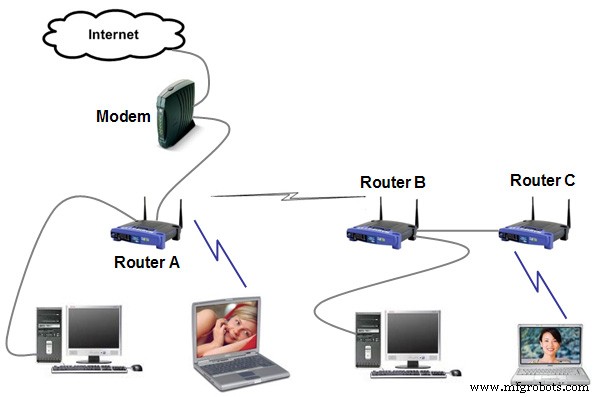
We can’t have a Wi-Fi signal without a router. Only the router is physically connected to the internet by an ethernet cable. So, the router then broadcasts the high-frequency radio signal, which carries data to and from the internet.
The adapter in whichever device you are using both picks up and reads the signal from the router and sends data back to your router and onto the internet. These transmissions are called upstream and downstream activity.
- Wi-Fi mainly uses a so-called “Industrial, Scientific and Medical” frequency band, ISM, from 2.4 to 4835 GHz, shared with other types of use, which can lead to interference problems. interference caused by microwave ovens, home transmitters, relays, telemetry, telemedicine, remote identification, wireless cameras, Bluetooth, television broadcasts (amateur TV or ATV), etc. . Conversely, some systems such as technical RFID begin to merge with Wi-Fi to take advantage of the infrastructure already in place .
In Wi-Fi, it is recommended not to use the same frequency as that used by the immediate neighbors (collisions) and not to use a frequency too close (interference).

This Article has been Written by Mr.Youssef AIT ALI, he is part of our team kindly Click Here if you want to Read His Biography.
Industrial Technology
- Transfer Molding Explained: Process, Benefits, and Variants
- Understanding Vehicle Transmissions: Types, Functions, and How They Operate
- 3D Printing Explained: Types, Processes, and How It Works
- Understanding Arc Welding: Types, How It Works, and Key Benefits
- Understanding CNC Boring Mills: How They Operate and Their Key Benefits
- Bionic Eye Technology: How It Works and Its Benefits
- Understanding Industrial Clutches: Definition, Function, and Applications
- Understanding Welding: Processes, Techniques, and Industrial Applications
- Wire EDM Explained: How It Works & Why It Matters
- Underwater Welding Explained: How It Works and Why It Requires Specialized Training