



CNC Machining Explained: How Computers Shape Precision Parts
Manufacturers and machine shops often use Computer Numerical Control, or CNC, machines to control their diverse array of machine tools. The concept of CNC machining emerged in the 1940s and 1950s. At the time, analog data storage such as punched tape technology was used. Today, CNC production relies on sophisticated Computer Aided Manufacturing (CAM) or Computer Aided Design (CAD) software to deliver design instructions to machines that produce parts and product prototypes.
A subtractive manufacturing process, CNC machining allows for a greater degree of complexity. It’s now feasible for low-, medium-, and high-volume production runs requiring high precision and accuracy.
The CNC machines manufacturers use can mill, grind, drill, and perform various other operations. Some systems are capable of finishing as well. Electro-mechanical devices used in CNC machine work vary in sophistication and in the tools they can manipulate. They can function in anywhere from three to five axes, each axis being a specific dimension the tool can move in.
- Lateral movement (up or down, left or right) is enabled by x and y axes.
- Longitudinal movement is typically controlled on the z axis.
- Rotation and additional motions are enabled with additional axes.
The more axes a machine has, the more freedom of movement there is for cutting and precision.
CNC Machining Materials
Most CNC machines are quite versatile. They are commonly used for milling metal, as a production machine is capable of cutting steel, aluminum, copper, brass, and titanium. Other machinable materials include various types of plastic, including polypropylene, and different forms of wood, fiberglass, or foam.
How Is CNC Machining Different from Other Computer Systems?
The computer used to control a CNC machine is not like your average home or business computer. Code is written by experienced programmers and requires a high degree of computational capacity. This code can also be revised over time so that pre-existing programs can be modified and updated. That makes CNC machine programming an ever-evolving automated process. Yet, it’s used in virtually all manufacturing sectors that depend on the software to control speed, position, and repetition and predictability without the intervention of human operators.
How Does CNC Production Work?
The process generally starts with unprocessed stock material. A block of plastic, for example, may be placed in the machine before the material removal process begins. Digital instructions from a software program are sent to the machine, not unlike with 3D printing. Instructions from these digital instructions, also called G-code, are converted to instructions for how to cut the parts.
A process that was once highly technical and labor intensive is now faster and more accurate. Prototype parts can be
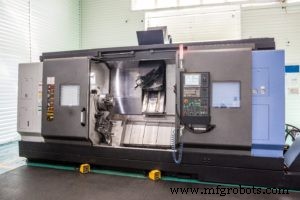
made with a high degree of productivity. Over the course of the machining process, multiple tools may be used. For example, the machine can draw from an inventory of drill bit sizes. Lateral movement in the x or y axis, longitudinal movement in the z axis, and even rotational motion may be possible.
With a multi-axis machine, parts can be flipped over and positioned automatically, without human intervention. There’s no need to stop the process to manually move parts. Once the part is automatically positioned, additional cuts are made, and so on.
A CNC machine is highly accurate. Measurements are calculated in thousands of an inch, meaning a fine machining process can have tolerances of around ±0.001”. If a machine is used for polishing, this number might be as tight as ±0.00005”. The thickness of a human hair is about .00069, for comparison.1 That’s quite accurate, considering how intricate and repeatable the process is.
The typical stages of CNC production include:
- Design of the CAD model: Designers may create a 2D vector or 3D solid part CAD design while incorporating all applicable dimensions, geometries, and other technical specifications. Part properties are limited by the capabilities of the machine. Most CNC tooling can create only curved corners, restricting part geometries, while each machine’s mini
- mum part thickness, maximum part size, and ability to produce complex internal features must be considered as well.
- File conversion: Once a CAD file is run through CAM software, the part geometry is extracted. The digital programming code is then generated and is used to control the machine and its tooling. Geometric code, or G-code, tells the machine when, where, and how to move, while miscellaneous function code, or M-code, controls the removal/replacement of machine covers and other auxiliary functions.
- Machine setup: After CNC machine programming, the system must be prepared. Workers must take initial steps such as placing the workpiece in the machine or onto a spindle or vise. Work-holding equipment must be secured before the tools are activated. In some cases, drill bits and end mills must be attached to the proper components before the machine can start running the program.
- Execution: The operator initiates the program to prompt the machine to begin the process. Commands are then issued by the CNC program and instruct the computer inside the machine to proceed with operating and manipulating its tooling. The program does the rest, guiding the system in executing ea
ch operation until a custom-designed part or product is completed.
Types of CNC Machines and Processes
Modern CNC systems combine conventional and novel machining technologies, making them highly versatile in a wide range of applications. The more conventional types of equipment include:
- Mills: Milling machines are flexible systems, with rotary cutting tools, which can be programmed with G-code or a proprietary language developed by a manufacturer. The most basic units have three axes, but newer ones can have up to three more.
- Drills: A drilling tool spins a bit, sized according to the specific operation, which does the cutting on
- contact with a stationary piece of material. Drills are highly efficient at cutting and improving the productivity of an operation.
- Lathes: A lathe operates by spinning a block of material against a drill bit, rather than the other way around. Capable of producing complex designs, lathes usually operate in the x and z axes and laterally move a material to make a progressive cut.
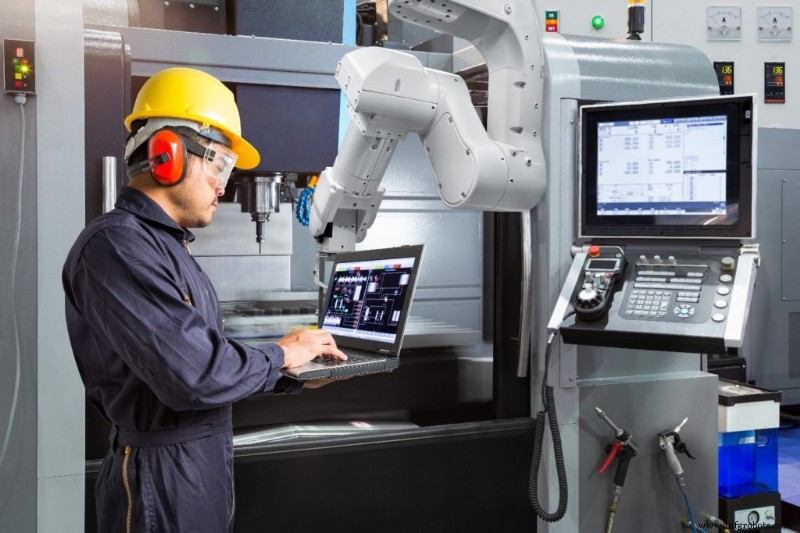
The more novel technologies used today include electric-discharge machining (EDM), in which electrical sparks are used to remove sections of workpieces, molding them according to the digital design. Electrical discharges are triggered by reducing the space between electrodes, which intensifies the electric field. Two common forms include wire EDM, in which a wire is used to essentially burn (or erode) pieces away, and sinker EDM, in which the workpiece and electrode are soaked in a dielectric fluid.
Plasma cutting involves the use of a torch to cut metal. Compressed-air gas and electrical arcs are combined to generate plasma. However, a more familiar medium, water, may be used for CNC machining. Water jet cutters use high-pressure, concentrated streams of water to cut metal, granite, and other hard materials. In some cases, sand or other strong, abrasive substances may be mixed to enhance the effect. Waterjet cutting is often employed with less heat-tolerant materials.
CNC Production Machining with Laszeray Technology
Laszeray Technology, LLC has a wide range of design and manufacturing capabilities and can partner with you to meet any production requirement, regardless of size or complexity. We employ 4- and 5-axis milling centers, turning machines, and large-capacity wire EDM systems. Our team can ensure efficiency and accuracy while providing customers with access to low-cost machining.
For more information about our CNC machining services and for help with product development, rapid prototyping, and other manufacturing steps, contact our CNC production team, submit your request online, or call 440-582-8430 today.
CNC Machine
- Abrasive Jet Machining: How It Works, Benefits, and Practical Applications
- Transfer Molding Explained: Process, Benefits, and Variants
- CNC Machines Explained: How They Operate and Drive Modern Manufacturing
- Understanding CNC Boring Mills: How They Operate and Their Key Benefits
- CNC Milling Explained: Process, Benefits, and Industrial Applications
- CNC Machines Explained: How They Operate and Why They’re Essential
- CNC Milling Machines Explained: How They Work and Their Key Types
- Understanding 4-Axis CNC Machines: Benefits and Comparison to 3-Axis Systems
- Wire EDM Explained: How It Works & Why It Matters
- Understanding 5‑Axis CNC Machines: Function, Benefits, and How They Operate