



Understanding Stamping: The Key Process Behind Coke Can Production
Some people like Coke, some people like Coca-Cola, and some people like Pepsi, but do you know how Coke cans are produced? Stamping is the most typical manufacturing process in the machining industry, do you know it? This article will use the simplest words to let you understand the production process of cans in 5 minutes.
What is stamping?
Stamping is a forming and processing method that applies external force to sheets, strips, pipes and profiles by means of presses and dies to cause plastic deformation or separation to obtain workpieces (stampings) of desired shape and size.
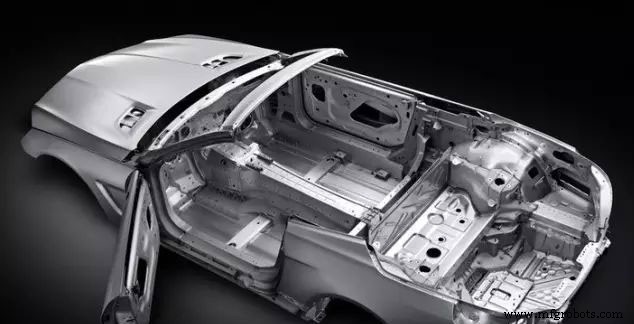
The body, chassis, fuel tank, radiator sheet of the car, the steam drum of the boiler, the shell of the container, the iron core silicon steel sheet of the motor and the electrical appliance are all stamped. There are also a large number of stamping parts in instruments, household appliances, bicycles, office machinery, living utensils and other products.
According to the stamping temperature, it is divided into hot stamping and cold stamping. The former is suitable for sheet metal processing with high deformation resistance and poor plasticity; the latter is performed at room temperature and is a commonly used stamping method for thin sheets.
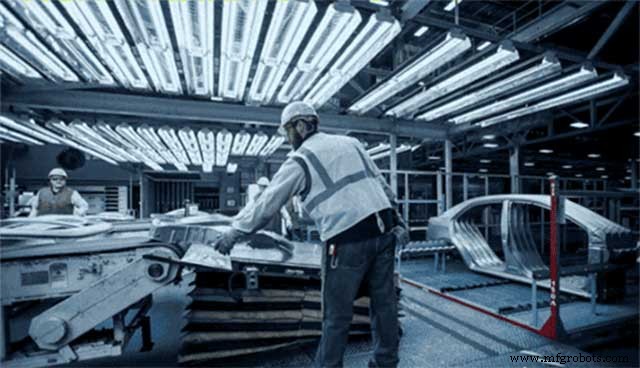
What are the 3 elements of sheet metal processing?
Sheet metal, mold, and equipment are the 3 elements of stamping processing.
- Sheet
The surface and intrinsic properties of the sheet metal used for stamping have a great influence on the quality of the stamped product. 6 points for stamping material requirements:
① The thickness is precise and uniform.
② Smooth surface, no spots, no scars, no scratches, no surface cracks, etc. Prevent waste generation.
③ The yield strength is uniform and has no obvious directionality. To reduce the production of defective or waste products
④ High uniform elongation. To prevent uneven deformation.
⑤ The yield strength ratio is low. To improve the accuracy of bending parts.
⑥ Low work hardening. To prevent deformation later.
- Mold
The precision and structure of the die directly affect the forming and precision of the stamping parts. Mold manufacturing cost and life are important factors that affect the cost and quality of stamping parts.
- Equipment
According to the transmission structure: manual punching machine, mechanical punching machine, hydraulic punching machine, pneumatic punching machine, high-speed mechanical punching machine, CNC punching machine
According to machining accuracy: ordinary punch, precision punch
According to the scope of use: ordinary punch, special punch
Processing characteristics
1. The production efficiency of stamping processing is high, and the operation is convenient, and it is easy to realize mechanization and automation.
2. The quality of stamping is stable, the interchangeability is good, and it has the characteristics of “the same”.
3. The strength and stiffness of stamping are high.
4. The cost of stamping parts is lower.
What is the stamping process like?
In the modern part manufacturing process, stamping is fully automated production, and its production method is shown in the figure below:
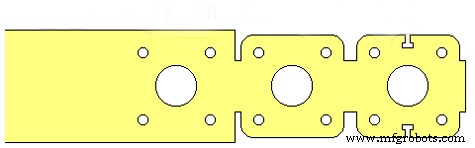
But it’s actually so fast!
In the stretching process, in order to prevent the processing material from being damaged, it must be broken down into multiple steps to complete a die casting process.
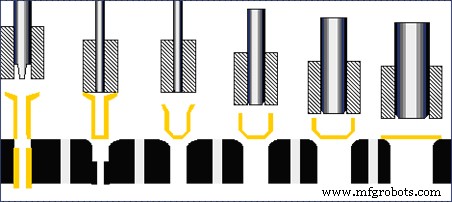
It is to use the production method of die casting to transform one by one from aluminum wafers into complete aluminum cans. Isn’t this amazing? Such a simple, fast and efficient production method is due to the continuous development of modern technology.
Industrial Technology
- Metal Additive Manufacturing: Key Insights for Modern Production
- Unlock Your Business’s True Value: A Guide for Small and Mid‑Sized Manufacturers
- Polyurethane Foam: From WWII Innovation to Everyday Essentials
- Essential Guide to CNC Production Machining: What You Need to Know
- Uncover Hidden Causes of Production Downtime: Boost Efficiency with Smart Analytics
- SCR Demystified: How Silicon Control Rectifiers Power Modern Electronics
- D880 Transistor Explained: Features, Specs, and Use Cases
- 4‑Layer PCBs Explained: Key Insights for Advanced Circuit Design
- Understanding CNC Fixtures: Types, Uses, and Production Benefits
- Exploring EDM: How Electrical Discharge Machining Works & Why It Matters