



Enhance Injection-Molded Parts with Tunnel Gates: Expert Design Tips
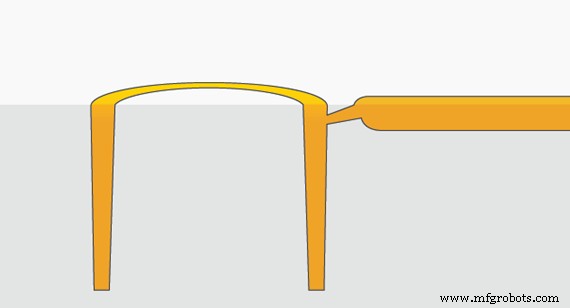 Tunnel gates, also known as pin or post gates, deliver resin to the mold cavity. They are machined at an angle and below the parting line.
When designing parts for injection molding, key elements of the mold that you will need to work out are the gates, which control the flow of the melted resin (plastic) into the mold cavity. Gates are the connections where the runners—the system that delivers the resin to the mold—meet the mold cavity.
Gates come in a variety of shapes and sizes and can maneuver the plastic into the cavity in various ways. Gating options include, among others, tab gates, which are most common, hot tip gates, and tunnel gates (also called pin or post gates), which this blog post focuses on.
At Protolabs, we offer the capability of designing and machining tunnel gates into customer molds. The end result is often a more cosmetically pleasing, and consistent, gate vestige on finished parts. This result is in comparison to other traditional gating options mentioned, which require manual trimming of the part by an operator. These other methodologies have variability because of the manual trimming process and are also typically larger and more cosmetically noticeable.
Tunnel Gates Defined
So, what actually is a tunnel gate? It is a type of molding gate that is machined at an angle and below the parting line of the mold, such that the part is automatically sheared from the runner (which, as mentioned, delivers resin to the mold cavity) at the time of part ejection. Accordingly, because the runner is cut from the part as part of the ejection process, there is no need to manually trim the gating system from the part itself.
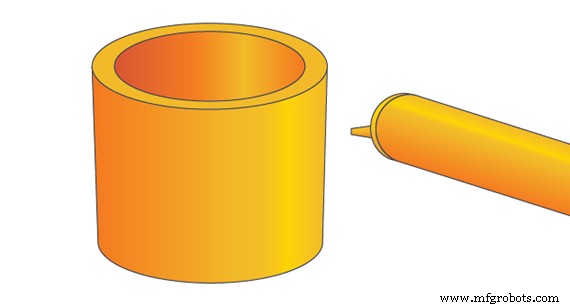 Compared to other gating methods, tunnel gates result in a more cosmetic and consistent gate vestige.
Compatible Materials for Tunnel Gates
Tunnel gates can’t be used with every material available for injection molding. That’s because a tunnel gate relies on the ability of the material to shear on the tunnel gate edge as the part is ejected. If a material is too flexible, a proper shearing action isn’t achievable. Additionally, if a material is too brittle, the tunnel and runner may not be flexible enough to be ejected, causing processing issues. Also, materials that are highly abrasive can quickly wear down the shearing edge, which requires sharpness, resulting in a drastic reduction of gate longevity.
Materials that are compatible for tunnel gates are:
- ABS
- PP
- ABS/PC
- HPDE
- PC
- LDPE
Our Materials Comparison Guide offers more detail on each specific plastic. In addition, our pocket-sized material selector is a quick reference guide to help you identify the right material for your molding project.
Getting Your Part Quoted with a Tunnel Gate
At Protolabs, we actively look for good tunnel gate candidates during the quoting process. If your injection molding part seems to fit the criteria laid out above, and is an On-Demand-Manufacturing (ODM) mold, it will likely be flagged and quoted as a tunnel gate mold. To ensure vetting for tunnel gate compatibility, you can add a note within the quoting process that you have a preference for tunnel gating, and it will be looked at for review.
Other Injection Molding Design Resources
Ultimately, many variables can affect how an injection-molded part is crafted: part geometry, material selection, and the mold design, among other factors. With this in mind, beyond this post, you can read about contending with parting lines in injection molding, and enhancing cosmetic appearance of your molded parts. Still more design tips can be found here. You can also order our second edition of Injection Molding Design for Dummies.
Industrial Technology
- Augmented Reality: Transforming Manufacturing with Real‑Time Insights and Remote Expertise
- Transform Warehouse Operations with CMMS: Boost Efficiency and Reduce Downtime
- Enhancing Manufacturing Efficiency with Voice Recognition Technology
- Enhancing Parts with 3D Printed Lattice Structures
- Galvanization Explained: How Zinc Coatings Extend the Life of Metal Parts
- Elevate Production: Mastering Machine Operator Efficiency Measurement & Improvement
- Enhancing Machine Accuracy for Precise Manufacturing
- Boosting Workpiece Accuracy: Expert CNC Machining Strategies
- Elevate Your 3D Prints: Proven Techniques for Superior Surface Finish
- Mastering Surface Finishing: Techniques to Enhance Machined Part Quality