



3D Lattice Structures: Design Principles and Mechanical Behavior for Advanced Additive Manufacturing
Published on May 3, 2022
 Originally published on fastradius.com on May 3, 2022
 Lattice structures are periodic frameworks that assemble into intricate three‑dimensional geometries. In additive manufacturing, compliant lattices unlock unprecedented design freedom, allowing engineers to produce shapes that were previously unattainable.
When fabricated from elastomers, these lattices exhibit remarkable deformability. By tailoring the architecture, designers can fine‑tune stiffness, buckling behavior, and energy absorption to meet the demands of a wide range of industries.
Creating compliant 3‑D lattices requires both manufacturing expertise and advanced design tools. At SyBridge, we have engineered and validated a comprehensive library of elastomeric lattices across numerous product categories, supported by extensive simulation data that correlates structure to mechanical performance.
Choosing the right lattice architecture hinges on understanding how each design variable influences the part’s mechanical response. The following guide distills the essential design elements and presents four representative lattice types from our catalog.
Key Design Elements for Elastomer 3D Lattice Structures
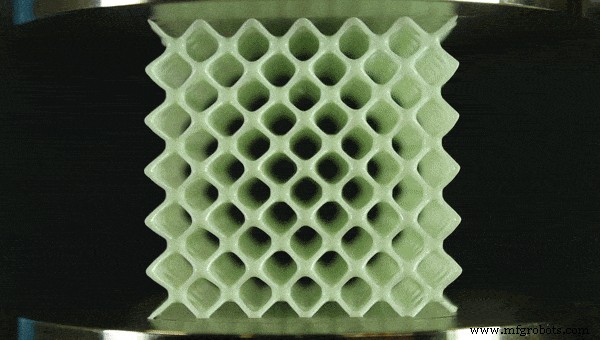
Elastomer lattice projects typically evaluate the following core elements:
- Geometry: The spatial configuration of struts and nodes—including unit‑cell size, shape, and overall topology—directly governs load paths and deformation modes.
- Stiffness / Modulus: Defined for small, elastic deformations, this metric indicates the force required to achieve a given strain and is critical for load‑bearing applications.
- Buckling Response: The propensity of lattice elements to buckle under compressive loads determines whether the structure behaves elastically, exhibits a stress plateau, or collapses progressively.
- Energy Dissipation: The ability to absorb and dissipate mechanical energy during loading and unloading cycles makes certain lattices ideal for impact mitigation or vibration isolation.
Example Types of 3D‑Printed Lattice Structure
Simple Cubic Lattice
This lattice features a 7.5 mm unit cell and 2 mm truss width, yielding a modulus of 0.72 MPa.
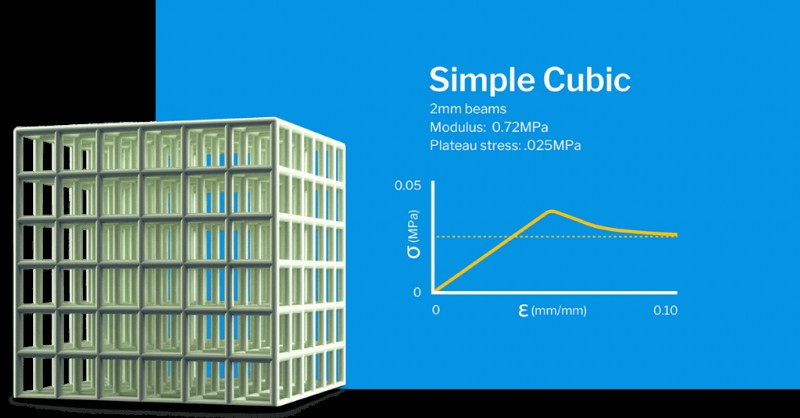
Buckling response: Exhibits a clear buckling instability; after a strain of ~0.05, the stress plateaus at 25 kPa, and further deformation does not increase the modulus.
Energy dissipation: The inelastic buckling behavior produces a hysteresis loop, making it suitable for applications requiring impact absorption.
Applications: Ideal for personal protective equipment and as a sacrificial layer that protects sensitive components, this lattice can also fill inter‑component gaps in assemblies.
Kelvin Cell Lattice
Unit cell size of 10 mm, truss width 2 mm, modulus 0.44 MPa.
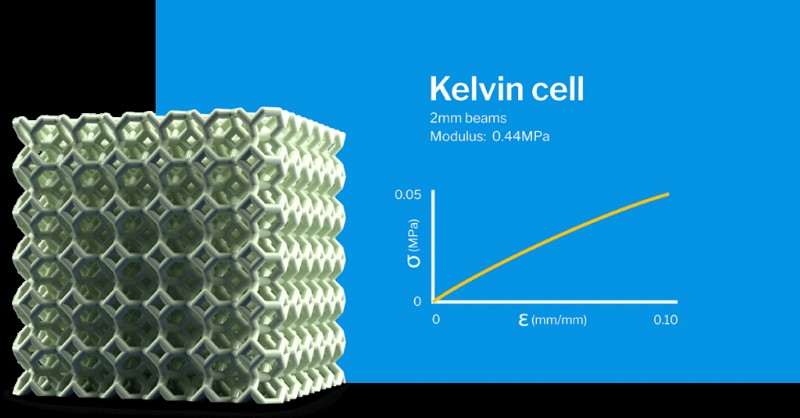
Buckling response: Lacks a distinct plateau; the beams elongate elastically until full compaction, providing a smooth compression curve.
Energy dissipation: Stores energy elastically and returns to its original shape quickly—behaving like a resilient spring.
Applications: Suitable as a foam substitute in static‑compression products such as seat cushions and body pads, and its hexagonal geometry offers aesthetic appeal for fashion‑centric designs.
Body‑Centered Lattice
Unit cell size 10 mm, truss width 2 mm, modulus 0.07 MPa.
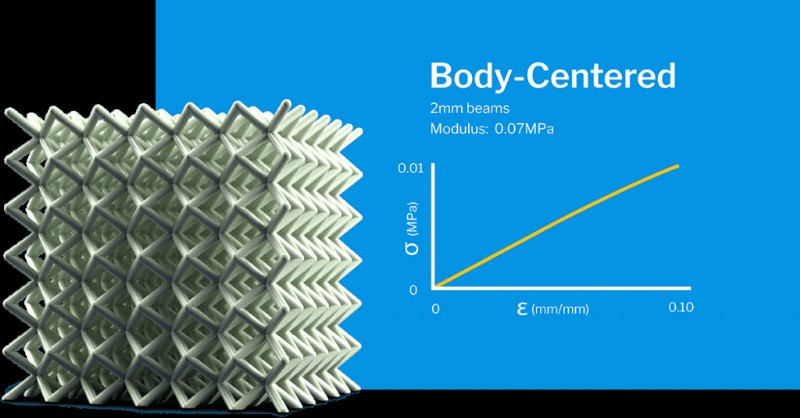
Buckling response: Demonstrates a progressive, stretching behavior with increasing force per displacement until full compaction; no stress plateau is observed.
Energy dissipation: Similar to the Kelvin unit, it behaves like a spring, returning to shape after loading.
Applications: The high‑strain, elastic response makes it ideal for static‑compression foam replacement, while the angled struts deliver uniform mechanical performance.
Body‑Centered Cubic (BCC) Lattice
This hybrid structure combines body‑centered and simple cubic topologies, with a 7.5 mm unit cell and 1 mm truss width. The resulting modulus is 0.23 MPa—higher than the simple cubic and body‑centered lattices alone.
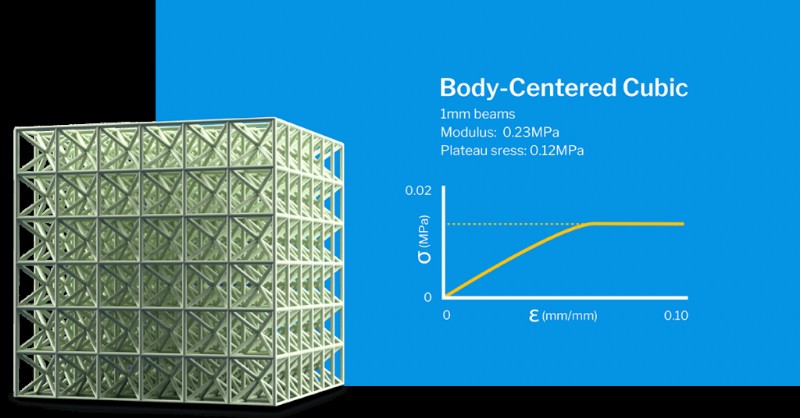
Buckling response: The BCC lattice inherits buckling from the simple cubic component, showing a plateau at 0.12 MPa, yet its post‑buckling behavior is more stable.
Energy dissipation: By blending elastic and buckling modes, the BCC lattice allows precise tuning of energy storage and release for specific use cases.
Applications: Ideal for products that require a tailored combination of elastic resilience and controlled energy dissipation, offering a more predictable response than pure buckling lattices.
Make New Things Possible with SyBridge
The four lattices highlighted above only scratch the surface of what elastomeric 3‑D lattice design can achieve. If you’re ready to embark on a 3‑D printing project, contact us today and make your next project possible.
Industrial Technology
- How Automation Is Transforming the Fabrication & Welding Industry
- Energy‑Efficient Lighting: Benefits, Technologies, and Implementation Strategies
- Essential Insights into Metal Casting: Techniques, Applications, and Advantages
- Master HP Multi‑Jet Fusion: Exclusive On‑Demand Webinar for 3D Printing Innovators
- How Polyurethane Molecular Formula Drives Product Development
- 1‑2‑3 Blocks Explained: Essential Tools for Precision Machining
- Electropolishing Explained: Benefits, Applications & Junying's Expert Metal Finishing Services
- Practical Strategies to Reduce Transportation Emissions in Your Supply Chain
- Reverse Engineering Explained: When and Why to Use It in Mechanical Design
- Craftsmen Industries Accelerates Growth with ISO 9001:2015 Certification