



Optimizing Blast Furnace Cast House Operations for Efficiency and Reliability
Blast Furnace Cast House and its Operation
The blast furnace (BF) cast house is the working area where hot metal and liquid slag are tapped from the blast furnace and either poured into ladles (torpedo car or open top ladle) or led off for solidification (pig casting and slag granulation) or treatment (cast house desulphurization).
A good trouble free cast house operation is an important requirement in a high productivity blast furnace for low cost operation. The cast house functional design, operational practice, refractory technology, automation and environmental requirements are important issues which are required to be looked into to meet the demands for greater reliability and output from the cast house. In any blast furnace cast house is the most labour intensive area in the entire BF operation. Its design must be fully integrated with the expected hot metal production, hearth volume, and tapping practice whilst minimizing use of labour, maintenance, materials and improving working environment. The prime objective is to remove the liquid iron from the blast furnace at a casting rate and through a number of casts per day that is determined by the smelting rate, effective hearth volume, and the desire to maintain the hearth in a ‘dry’ condition rather than by the availability of the cast house troughs, runners and cast house equipment. Typical lay out of a BF cast house is shown in Fig 1
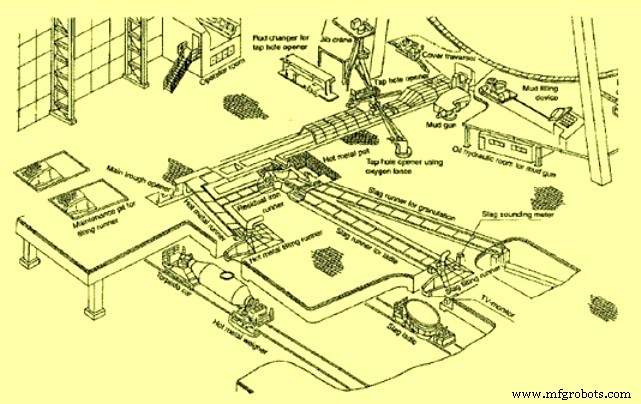
Fig 1 Typical layout of a BF cast house
The design and operation of the cast house must improve the efficiency of BF operation with respect to the following parameters.
- Improvement in the working conditions for workmen engaged in tapping of the hot metal and liquid slag
- Reduction in the losses of heat from the hot metal by maintaining its temperature
- Reduction in the amount of hot metal lost with the liquid slag
- Significantly reduce the volume of pollutants created during tapping
Cast house must have a certain number of entrances, passages and exits through which workmen can evacuate the area in emergencies. It must be designed and located in such a way that it is always possible for workmen to escape from any area of the cast house without passing in front of tap holes or stepping over runners.
The size of the cast house depends on the production capacity of the furnace, but it is also important that there should be enough space to accommodate both the workmen and the equipment. In particular, there must be as much free space as possible next to the furnace and on each side of the taphole. Ideally the layout should be such that the runners are kept as short as possible. With tilting or swinging runners and high capacity hot metal ladles, working conditions in the cast house can be improved, and tapping can be made easier. Further careful taphole opening and closing is a key success factor for a blast furnace.
For efficient dust and fume extraction in the cast house, the iron runners should be covered. However, the tapping process and taphole maintenance require unobstructed access to the front area of the runner. Various designs of trough cover manipulators provide flexible solutions in a cast house.
The cast house floors on the metal and slag sides must have smooth surfaces, and be slightly sloping in certain parts. The angle of slope should not be selected simply for easy removal of slag and hot metal. If the slope is too steep, work in the cast house will be unnecessarily tiring and the risk of falls will be greater.
The depth of the runners should be large enough to accommodate the maximum possible flow of hot metal after allowing for the presence of the refractory lining.
Particular care need to be taken in selecting the system used to link the taphole with the main runner, so that there is no break between the blast furnace and the tapping floor.
Openings in the tapping floor, for evacuation of tapped liquid matter and slag is required to be shielded so that workmen cannot fall through them.
The explosion of a slag ladle is rare but not impossible occurrence and, for each type of installation, the most suitable measures should be taken to protect workmen from splashes of slag.
Another danger is spillage or leakage of hot metal from the metal ladles onto the rails and the surrounding area. If the ground is wet an explosion can occur. Appropriate measures must be taken to prevent water (ground water, rain water or water from the blast furnace) from seeping or draining into the area. There must be facilities for drainage of any water which could collect between the rails.
The cast house should be designed and equipped to enable workmen to supervise filling of hot metal and slag ladles without any danger of accident.
Care should be taken in the selection and location of slag granulation plant, so that there is no possibility of steam from cooling water being blown into the cast house. Some system must be installed to protect workers and equipment from the explosions which can occur when hot metal is accidentally tapped with slag.
Transport and handling machinery used in the cast house must be carefully chosen, as manual handling must be kept to an absolute minimum and every part of the tapping floor must be accessible. Machinery should include one or more overhead travelling cranes or other lifting devices and forklifts and other handling trucks. An access ramp and maneuvering space on the tapping floor must be provided for handling trucks.
The hazards to which cast house workmen are exposed during tapping operations are given below.
- High temperature of materials and heat radiated by hot metal and molten slag
- Explosions and splashes of hot metal and slag
- Overflow and spillage
- Furnace breakout
- Fumes, dust, gas and steam
- Use of oxygen for lancing of the tap holes
- Use of machinery such as taphole guns and drills, pneumatic, hydraulic and electric equipment etc.
- Use of hand tools
- Handling of materials, and waste etc.
- Use of combustible gas for drying runners
- Use of rice husk for heat preservation and sand
- Noise.
Modern blast furnaces have the following equipments, tools and consumables in the cast house
- Taphole drill
- Drill rod changer
- Taphole clay gun
- Taphole clay gun loader
- Trough cover and trough cover manipulator
- Level measuring system for torpedo cars
- Tilting runner
- Jack dam drill
- Control cabins
- Temperature measurement and sampling
- Refractory consumables
- Other consumables like sand, rice husk, lancing pipe, and piercing rod etc.
- Oxygen for lancing and fuel gas for runner drying
Some of these are described in detail below.
Taphole drills
Economic tapping requires a high performance taphole channel. In addition to the choice of appropriate taphole clay and the optimum opening strategy, optimal adjustments of the tapping parameters as well as their reproducibility are important. Taphole drills must combine maximum flexibility with well proven high capacity drill hammers to ensure effective drilling. The basic design and installation requirements for taphole drills are as follows.
- The drill should be sufficiently powerful and rigid for accurate drilling of the taphole
- It should be possible to lock the drill in certain positions
- All the movements and manoeuvres of the drill should be remote controlled
- It must be possible to stop these at any given time
- The machine must be fitted with a warning siren or buzzer which should operate automatically before the drill is set in motion
- The drill should be installed in such a way that when it is not in use, workers can move freely around it and carry out repairs on it. There should be enough room for one person to pass between the machine and any obstacle
- Suitable means of protection must be provided for the personnel working round the machine, and it too should be protected
- Power lines should be protected against heat and break outs and they should have good mechanical strength
- If electricity is used, it is advisable to have supplies via at least two independent circuits, one of which should be a safety circuit
- If control is hydraulic or pneumatic a suitably sized accumulator should be installed.
Taphole clay guns
Closing a furnace under any condition is a key safety requirement. This demands extremely high reliability and robustness from taphole clay guns. The basic design and installation requirements for taphole guns are as follows.
- The gun must be powerful enough to extrude the taphole clay into the taphole against the full force of internal pressure of the blast furnace, even when the pressure rises above normal
- The machine must be capable of placing the mouth of the gun correctly in the taphole in spite of any obstruction by slags or other material
- The machine must be designed to extrude all the clay required for the plug
- It should be possible to lock the gun in various positions
- All the movements and manoeuvres of the gun should be remote-controlled; it must be possible to stop these at any given time
- The machine must be fitted with a warning siren or buzzer which should operate automatically before the gun is set in motion
- The gun must be installed in such a way that when it is not in use, workmen can move freely around it and carry out repairs on it ; there should be enough room for one person to pass between the machine and any obstacle
- Suitable means of protection must be provided for the personnel working around the machine, and it too should be protected
- Power lines should be protected against heat and break-outs and they should have good mechanical strength
- If electricity is used, it is advisable to have supplies via at least two independent circuits, one of which should be a safety circuit
- If control is hydraulic, a suitably sized accumulator should be installed
Control cabins
Control cabins for the taphole guns and drills should be located, protected and equipped in such a way as to permit operation even in emergencies. Accordingly, they should have the following basic features.
- The location of the control cabin should be such that the personnel are fully protected from the risk of break outs or explosions and can observe operations in a perfect manner
- No combustible material is to be used in its construction
- At least two different and independent entrances must be provided, one of which must afford access to an emergency evacuation platform on the outside, which must be kept clear at all times
- There should not be any doors leading from the cabins to the runners
- The observation window overlooking the tapping area must (i) be as small as possible but give the operator a complete view of the area of operations and location of the gun and/or drill, (ii) be fitted with ‘Triplex’ glass panels on a frame which opens outwards, protected by a grille, (iii) The controls should be located next to the windows so that the operator can easily work them while following the progress of operations. Precautions should be taken to prevent accidental operation of controls, and (iv) Communication between the cabin and other places where work connected with the operation of the blast furnace is done must be provided by at least two separate systems of oral communication (internal telephone, intercom, and radio telephone etc.).
- The cabin should be provided with a ventilation system which draws air from an area not polluted by smoke or gas.
- If the cabin cannot be located in an area protected from possible splashing or explosions, the safety measures must be intensified. In particular, the doors must be set so that any explosion will tend to close rather than open them, and the walls, doors and roof must be covered with flame and heat-resistant materials.
Taphole piercing with oxygen
The equipment for taphole piercing consists of flexible piping for oxygen supply, a lance holder, and oxygen lances. Oxygen lances consist of one or more steel tubes. It is important to ensure that the operator is always far enough away from the taphole to avoid sparks and splashes. It is therefore advisable not to allow lances to burn too far down their length, but rather to recover unburnt sections to make up tubes of the original length. Great care should be taken in joining such tubes together, to prevent leakage of oxygen through the welds. Tubes in bad condition should be rejected. Tubes should already be degreased when delivered to the cast house. Greasy tubes should not be used. Tubes should be stored in areas protected from oil, grease, dust and weather. Only those sections of tubing which comply with minimum safety requirements should be recovered for re-use.
Cast house refractory consumables
For the blast furnace tap holes, where iron and slag are tapped periodically, ready for use taphole mixes (also called taphole clay) are used to plug the hole at the end of a cast. These heat setting materials are then drilled for the next cast. For the troughs and runners, where iron and slag are separated and iron is directed toward the ladle, hydraulic bonded castables are used as basic lining and gunning materials for repair.
Taphole clay
Taphole clay is the material used to plug the taphole after tapping so that no material can leak out, and to keep it plugged until the taphole is next opened. Today, the choice and the use of taphole clay are correlated to many factors which are given below.
- The blast furnace operative conditions, which depend mainly on the size and the exploitation -the clays participate to the process as key elements to ensure reliability and safety in order not to disturb the blast furnace productivity.
- The particular arrangement of the taphole area and its management – this requires that the clays not only drive and resist to the molten metal attack but that they also have positive influence on the hearth drainage and on the peripheral iron flow by the hole length.
- The environmental aspects are assumed both as politic in the improvement of the human working condition at the cast house level and as a general environmental protection.
- Economical aspects in order to propose an optimal unit cost per ton of hot metal produced, since the taphole clay costs remain is one of the substantial costs in the cast house operation.
The taphole clay must have properties to consistently and safely perform the following functions.
- Flow when pushed by the clay gun, to plug the tap hole. Taphole clay must be pliable enough to be correctly injected.
- Cure within the tap hole during the plug to tap time but without shrinkage to ensure a tight seal
- Harden fast enough to withstand pressure from the inside of the furnace
- Be drilled in an acceptable time.
- Allow a stable, controlled melt stream at tap without spray
- Withstand erosion and chemical attack by hot metal and slag during tapping
- Form a stable substrate for the next plug
- Provide a stable and controllable taphole length.
- Porous enough to allow distillation gases to escape
- It must also, in certain cases, be suitable for maintaining the taphole and restoring it to its normal state if it has deteriorated
The requirements of taphole clay are the following.
- Improved plasticity- To provide better workability
- High corrosion and abrasion resistance – To provide constant taphole diameter and taphole length
- Good sinterability – To provide good strength
- Adhesive strength – It is required for proper adhering of new taphole mix with old one
- Good gas releasing capacity – To reduce the formation of gas pressure inside
- Easy tapping or drilling.
Anhydrous clays are more hardwearing than those containing water. The latter cannot be used for modern blast furnaces and special precautions must be taken when they are used. Raw materials used for tap hole clay are fused alumina, calcined bauxite, chamotte, fire clay, clay minerals, pyrofillite, silica, fine sand, kyanite, fine calcined alumina, fume silica, zirconium, chromites, silicon carbide, carbon, silicon nitride, metallic powders, coke, ultra fine carbon, tar, resin, and special oils.
Manufacturing process
- Blast Furnace Slag: Essential for Optimal Furnace Operation
- Granulation of Blast Furnace Slag in the Cast House: Process Overview
- Optimizing Blast Furnace Operations with High-Alumina Slag
- Preventing Irregularities in Blast Furnace Operation: Proven Strategies
- Optimizing Blast Furnace Design for Superior Performance and Longevity
- Optimizing Blast Furnace Operations to Extend Campaign Life
- Understanding Slag: Its Critical Role in Blast Furnace Iron Production
- Critical Cast House Equipment for Safe Blast Furnace Operations
- Key Role of Hearth, Dead Man, and Tapping in Blast Furnace Performance
- Blast Furnace Stock House: Managing Raw Materials for Hot Metal Production