



Expert Coke Oven Refractory Repair Services for Optimal Performance
Coke Oven Refractory Repairs
Coke oven battery is a refractory structure, contained within a steel and/or concrete exoskeleton. This exoskeleton is held together in the lateral direction by a series of tie rods between steel buckstays. The buckstays are vertical steel beams located on the ends of the heating walls between the ovens. In a longitudinal direction, the tie rods extend between the pinion walls on either end of the battery.
The heating walls have traditionally been constructed of silica refractories. Silica is the refractory of choice primarily because, at normal coke oven battery operating temperatures, silica refractories are subject to minimal creep. Also, since nearly all of the expansion of silica bricks take place at temperatures which are below 650 deg C, hence the moderate temperature fluctuations of the walls have no effect on the volume stability of the refractory comprising the wall during normal operation of a battery.
Coke oven batteries will have an operating life of twenty to forty years, depending upon operating conditions and battery maintenance. There are several examples of coke oven batteries working for 40 – 50 years due to correct operation and timely repair. There are also cases where the failures of coke oven refractories has happened in less than 10 years of its operations. Usually a battery requires specific repairs to the refractories, steelwork or machinery. These repairs, if properly performed, extend the life of the battery.
In order to prolong the service life of coke oven battery, it is essential to avoid damage to the oven wall. In particular, it is especially important to avoid brick breakage, since this causes an opening in the brick wall and the oven must be stopped, and the oven brickwork may be further damaged during the process of idling.
The coke oven walls are subject to mechanical load and thermal load consisting of repeated heating and cooling in routine operation and hence any damage to them gets steadily worse year by year. There are two major types of damage to the coke oven walls. These are as follows.
- Decrease in brick wall thickness – Carbon deposits on the rough surface of the wall caused by erosion of the brick and the loss of mortar over the many years of oven operation. As the carbon deposits fall off or separate from the wall, it peels off more of the disintegrating brick, causing further erosion of the brickwork.
- Occurrence and propagation of vertical through cracks – Under the mechanical impact during the charging of coal and the thermal stress induced by the repeated heating and cooling, longitudinal cracks form which eventually reach the combustion chamber. As carbon gets into those cracks, the oven body expands.
The reasons for the damage to the refractories of the ovens are the following.
- Wear and natural deterioration of the refractories due to its age resulting into the loss of thickness, increased surface abrasiveness, and spalling of oven brick walls.
- Violation of the technological discipline during the battery operation.
- Movement of heating walls in response to unbalanced differential pressure across the heating wall.
- Excessive coking pressure on the walls during carbonization. This coking pressure is dependent on the characteristics of the coking coals.
- Pushing failures caused by the sticking oven. A hard push can cause wall breakage because a localized force of around 600 N often occurs under the hard push condition and reaches the tolerable limit in damaged ovens
The life of the oven refractories is dependent on the operating efficiency, timely diagnosis of the damage and quality of the preventive maintenance. The first minor damage to brickwork laying can be observed in the early years of operation. From then on developmental character of damage becomes increasingly complex. The complex nature of the development of the oven wall damages is shown in Fig 1.
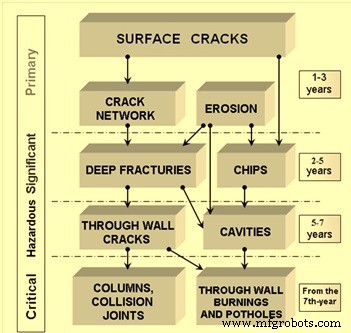
Fig 1 Development of the damages of the oven walls
Further as the damage of the oven wall bricks become ever more conspicuous, the incidence of pushing failure and other problems which impede stable coke oven operation also go on increasing. Under these conditions, it becomes increasingly difficult to repair the problematic coke ovens efficiently with conventional methods. Therefore, early detection and quantitative analysis of the damaged parts of oven walls is essential for planned and timely repairs of the oven refractories.
The coke oven refractory repair work requires considerable expertise. The coke oven wall refractory hot repair techniques are to meet the following criteria.
- There is no interruption to the production cycle.
- The method is reliable and provides a long life performance of the repaired portions of the wall.
- The method is simple , cost effective and time saving.
The refractory repair work can be carried out either in cold condition (known as cold repairs) or in hot condition (known as hot repairs). There are three types of hot repair methods applied for coke oven brick repair. These are described below.
Cold repairs
If an entire battery of through walls is to be replaced from the oven floor to the underside of the oven roof, the repair may be performed with the battery refractory cooled to atmospheric temperature. This type of repair which is carried out after cooling of the battery is known as cold repair of the battery.
The replacement of the through walls of an entire battery is accomplished by permitting the battery to be cooled down under controlled conditions before the repairs are made. The cool down may take up to 21 days during which time pressure is maintained on the oven walls by adjusting the upper and lower tie rods. The oven roofs must be supported. After the walls are rebuilt and before heat up, all the checkers are removed from the regenerator and any cracks in the pillar walls must be cleaned and packed with ceramic floss before the checkers are replaced so as not to hinder brickwork expansion during heat up.
The repaired battery is heated up in the same manner as a new battery.
A repaired battery with all new through walls, with proper maintenance can be expected to have a life of approximately 15 to 20 years at a fraction of the cost of a new coke oven battery.
Guniting repairs
As regards to the gunite procedures there are the dry and wet gunning and the spraying methods. In order to achieve an optimum service life of the coated gunning materials, many factors have to be considered. This begins with the different gunning machines, gunning equipments and accessories and ends with the economical and ecological processing.
At the processing of refractory repair products, it is important that always the optimum mixing ratio of material and water need to be adjusted. Especially at the gunning repair, an even material flow is important in order to reduce the developing of dust and rebound.
For the gunning repair of coke oven brick repairs, normally a rotor gunning machine is used. Here the dosing is carried out by a system, which consists of rotor and packing washers. The drive is done by an electric gear motor or a compressed air motor. The machine is solid, handy, mobile and suitable for gunning capacities of 0.25 cum /hr to 4.0 cum/hr.
Guniting repairs are not very effective repairs and provides temporary and rather cosmetic results.
Ceramic welding
Ceramic welding is a widely recognized method of repair. Ceramic welding technology provides ample opportunities for repair of linings of various physical and chemical composition to increase service life of high temperature reactors. This technology was developed in Europe for application in glass furnaces. This technology was later adapted to coke ovens for carrying out of the hot repair of the damaged refractories in the coke oven walls. The technology provides maximum resistance of repaired areas with minimal negative impact on the brickwork. Long standing of repaired areas of coke oven refractory can be achieved based on the advanced ceramic welding technology using high quality materials.
The ceramic welding process was first applied in the 1970s. This hot repair process is used to repair the coke oven refractory at operating temperature with minimal disruption to production. The repair material is ceramic bonded to the damaged refractory, utilizing a fusion process that generates an exothermic reaction in excess of 2200 deg C. The bond strength of ceramic welding allows for a superior repair that restores structural integrity to the original brickwork.
Before the ceramic welding, a pneumatic blasting system is used to clean the refractory. This cleaning process is to be carried out with minimal trauma to the surrounding refractory.
Ceramic welding accomplishes what the name implies which is the welding of silica brick inside the coke oven. This is accomplished by conveying a powder mixture, rich in silica, through a small pipe lance via an oxygen enriched compressed air stream. The powdered silica mixture is jetted out of the end of the lance and ignites, almost explodes, against the hot wall of the coke oven. The heat of the reaction penetrates the silica brick creating a plastic zone of silica. The reaction also turns the powder silica mixture into a molten mass, which bonds to the aforementioned plastic zone on the silica brick. The appearance is similar to that of a welding joint. Also, the effects are similar, as new, equally strong material is deposited onto existing worn and cracked silica brick. The following aspects are important for the ceramic welding.
- Affinity of chemical and mineral composition of the ceramic welding materials to the characteristics if the brickwork to be restored
- Identity of the structural phase composition of refractory material
- Strong inter atomic (crystalline) linkage of welded layer and the oven wall brickwork
Ceramic welding method can not only weld cracks and chips, but also large area defects, such as cavities. Furthermore, the technology allows for reliable welding of joints of old and new brickwork laying.
Properly installed, ceramic welding material has provided twenty years of service. However, the average ceramic weld will last approximately 10 years.
Scheme for ceramic welding is shown in Fig 2.
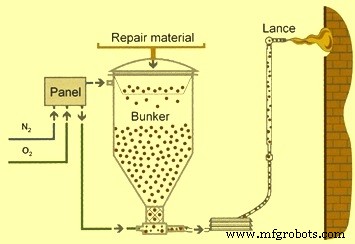
Fig 2 Scheme for ceramic welding
Rebricking of the hot coke oven walls
Hot heating walls rebricking to the various depth down to complete rebricking is also a recognized effective method of repair. Brickwork repairs usually undertaken are the replacement of end flues, the replacement of oven walls between oven floor and oven roof, and emergency repairs inside the oven chamber. These repairs are performed while the battery is in the hot condition making coke.
Oven wall brickwork repair may consist of the placement of through walls (pusher side to coke side) above the oven floor and below the oven roof. At the same time brickwork repairs may be done in the corbel area, and face brickwork and individual oven roofs may be replaced.
The repair is done with the battery in the hot condition with one or two buffer ovens (empty ovens) on each side of the wall being repaired. The other ovens of the battery may be producing coke. Before demolition of the damaged wall, roof support beams must be added in the adjacent ovens, insulating panels must be installed on the adjacent hot walls, charging car rail bridges must be installed on the oven top, and support provided for the oven roof under which the wall will be replaced. Care must be taken to maintain the heat in the regenerators and on the adjacent walls. The following is the main characteristics of this type of repairs.
- Original shapes of silica bricks are used.
- Laying is executed with design bricks bonding at each course, including the joint of old and new parts.
- Partial heating up and expansion of brickwork layers takes place continuously owing to heat conductivity and radiant heat exchange from the adjacent heated walls and rest parts of the repaired walls.
- Final heating up of the repaired wall is carried out and usually takes around 8 to 10 days,
- Residual growth of brickwork (at final heating up to working temperatures after repair) is insignificant, that provides durability and gas tightness of the executed new brick work.
The best results of realization of hot repairs combining the processes of brickwork laying and partial heating up of laid brickwork are achieved under the following conditions.
- Silica brick of high quality is used for repair
- Repair is carried out at one wall simultaneously
- The depth of rebricking are not to be less than 4 verticals, including silica and fireclay vertical flues roofing and oven roofing zones
- During repair of heating wall the oven sole bricks and damaged bricks of the lower courses of the end part of heating wall are also to be replaced (as well as in coking chamber)
Safety of the adjacent walls is achieved due to temperature maintenance (750 deg C to 850 deg ?) in heating walls during the repair, thus excluding modification transformations of silica.
The basic problem in using of silica refractories in hot repairs is maintenance of durability and gas tightness of a continuous vertical joint between the old and new brickwork portions due to deformations at heating, caused by significant thermal linear expansion of silica (1.2 % to 1.4 %). Due to this, repairs of coke oven brickwork are carried out in some countries using modules of fused quartz, having small thermal expansion coefficient of 0.2 % to 0.3 %.
Advantages of the this repair method are as follows.
- The repair extends the life of the coke oven batteries by 7 to12 years provided technological discipline of operating the battery is maintained.
- Since the repair is taken only of worn out/damaged chambers, the production from the battery does not stop unlike cold repairs which lasts for more than 12 months with no production from the battery.
- During the repair of such coke ovens, the worn out parts of anchorage (flash plates, door frames, parts of anchor columns, tie rods) and refractory brick work is replaced. This does not deteriorate the condition of balance brickwork and anchorage which is not replaced.
- Hot repair of the battery has more techno-economical advantages over cold repairs. Repair cost is 30 % to 40 % cost of the cost of the cold repairs.
Manufacturing process
- Microwave Oven: Design, Manufacturing, and Future Innovations
- Advanced Automation & Control Systems for Coke Oven Operations
- How Coke Oven Gas is Generated and Used in Ironmaking
- Optimizing Coke Oven Battery Performance for Metallurgical Operations
- Coke Oven By-Product Plant: Optimizing Gas Capture and Energy Efficiency
- Coke Oven Gas Injection: Boosting Blast Furnace Efficiency and Reducing CO2 Emissions
- Optimizing Direct Reduced Iron (DRI) Production Using Coke Oven Gas as a Reductant
- Optimizing Coke Production in Byproduct Coke Oven Batteries
- How Byproduct Coke Oven Batteries Produce Coke for Steelmaking
- Comprehensive Capital Repairs for Blast Furnaces: Relining, Shell Repairs & Equipment Overhaul