



Coldry: Advanced Low-Rank Coal Drying Technology for High-Value BCE Pellets
Coldry technology for low rank coal drying
Coldry technology is being developed by Environmental Clean Technologies (ECT) Limited, Australia. The technology consists of expelling of water from a wide range of low rank coals (lignite coals and sub-bituminous coals) containing up to 70 % moisture into high calorific value (CV) black coal equivalent (BCE) pellets with a moisture content of around 10 %. The BCE means that the net energy value of the Coldry pellets is similar in range to that of many black coals.
Coldry technology is a patented process which changes the naturally porous form of low rank coals to produce a dry and dense pellets by a process which is called as ‘brown coal densification’(BCD). The technology is based on research initially conducted by CRA and University of Melbourne in the early 1980s. The technology has been demonstrated at pilot plant scale at Bacchus Marsh Coldry plant. This plant was commissioned in 2004, enhanced with a water recovery system in 2007, and upgraded in 2011 so that it can produce up to 20,000 tons per annum of Coldry BCE pellets. The process has been tested and proven successful on a wide range of low rank coals.
Principle of the process
The Coldry process combines two unique aspects namely (i) brown coal densification, and (ii) waste heat utilization. The process stimulates a natural chemical reaction within the coal. This reaction polymerizes active sites in the coal compounds and expels chemically bound water. The polymerization of the active sites collapses the coal pore structure and expels the physically trapped water. The ejected water migrates to the surface of the coal pellets. The surface water is evaporated by the utilization of waste heat from an adjacent power plant (PP).
BCD is a natural phenomenon whereby the physical structure of the coal is transformed from a wet, soft, friable raw material to a dense, dry, hard material. It takes a very specific type of processing to apply shear-stress over time to trigger BCD. The primary processing equipment design and operating parameters are tailored to the characteristics of the raw coal.
The application of the right amount of mechanical shear to the raw coal results in a soft and malleable coal ‘paste’ and this enables low pressure extrusion of the paste to form pellets. The fundamental here is that the physically trapped moisture is mobilized and, as this moisture migrates to the surface of the pellets and evaporates, the porous structure of the pellet collapses and densifies.
Control of the drying rate within a predictable timeframe is important aspect of the Coldry process. Further, since generation of heat through traditional methods is relatively expensive, Coldry process harnesses the waste energy resources and directs the heat to low temperature drying of the pellets. BCD proceeds ideally in the range of 40 deg C to 70 deg C.
The chemistry of the Coldry technology is shown in Fig 1.
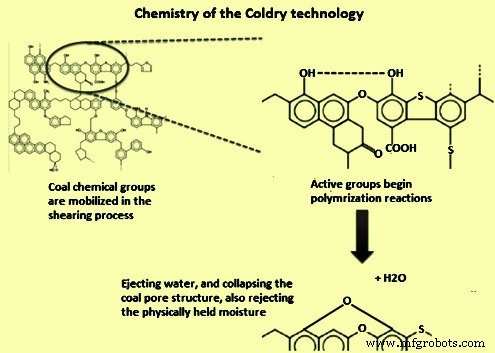
Fig 1 Chemistry of Coldry technology
Coldry technology process has the following three distinct process stages.
- Mechanical shearing – It is for the release of physically trapped moisture, which is achieved through destruction of the porous structure of the coal. This process of mechanical shearing results into coal slurry which is of suitable consistency for extrusion.
- Extrusion – Extrusion is carried out of the coal slurry to produce pellets of optimal dimension for subsequent drying.
- Drying – Drying is carried out to evaporate the mobilized moisture within the pellets thus delivering a finished product having moisture content less than 15 %. For drying, waste energy from an adjacent PP is utilized. Low grade waste energy from any other source can also be used for the drying of the pellets.
The process of coal drying
The Coldry process has the following six steps. The process flow sheet is shown in Fig 2.
- Screening and feed control – The low rank raw coal having moisture content in the range of 30 % to 70 % is ground to a size which is less than 8 mm. The ground coal of soft friable consistency is fed into a surge bin and screened. Surge bin is a storage hopper which is having automatic, variable speed feed controller. The screening of the ground coal removes the oversize and contaminants (foreign objects) prior to the addition of small amount of water. The screening of the ground coal ensures a uniform feed into the next process step. The amount of water which can be added depends on the as received moisture in the coal and it can be up to 5 %.
- Attritioning and extrusion – The coal after water addition is fed to an ‘attritioner’. In the attritioner the faces of the coal are rubbed and sheared to form a coal paste. The intensive mixing during the rubbing of the coal faces initiates a natural exothermic chemical reaction within the coal and this generates a natural process for ejecting both the chemically trapped as well as physically absorbed water within the coal pore structure. The reaction gets accelerated when this plasticized mixture is extruded under low pressure. The extruded coal is sent to the ‘conditioning unit’ through a conveyor belt.
- Conditioning – The conditioning is done on conditioning belt where the extruded coal paste pellets are heated for around an hour with the warm air at 40 deg C. The conditioning of the extruded coal carry out the surface drying of the coal for providing sufficient green strength to it, so that it can withstand its transition to the next step of the ‘pack bed dryer’ (PBD). The toughness of the extruded coal is described by an increased level of a dry surface and the firmness. Further, with hardening, the product contracts and separates into pellets. Warm air needed for evaporating surface water during the conditioning as well as for pack bed drying is produced through the heat exchange with the waste heat from an adjacent PP.
- Pack bed drying – The incoming moist coal pellets from conditioning unit are further dried in the vertical PBD to their ultimate moisture level. Warm air from an adjacent PP is circulated through the dryer for the removal of the moisture from the pellets. The cross-linking reaction come to completion within the dryer thus increasing the strength to levels sufficient to withstand bulk handling and transport. The final moisture in the dried pellet is normally in the range of 10 % to 14 %. The factors affecting the final moisture content are (i) the moisture content of the run-of-mine coal, (ii) characteristics of the feed coal, (iii) the temperature provided by the heat exchanger unit, and (iv) time of drying.
- Water recovery- The warm air leaving the PBD is at around 30 deg C and is highly saturated. The moisture content of this saturated warm air condenses when it is chilled. This recovered water is collected and can be used in the adjacent PP or any other place since it has no pollutants.
- The product Coldry pellet – The incoming low rank coal has now been converted into a BCE product through permanent removal of structural and physically trapped water. The BCE product of the process is known as Coldry pellet. It has high energy content, is stable, and does not rehydrate. It can be transported for use. The typical characteristics of the Coldry pellets are (i) diameter -16 mm, (ii) length – 45 mm, (iii) bulk density – around 700 kg/cu cm – 750 kg/cu cm, (iv) moisture content- around 12 %, and (v) high heating value – 5550 kcal/kg.
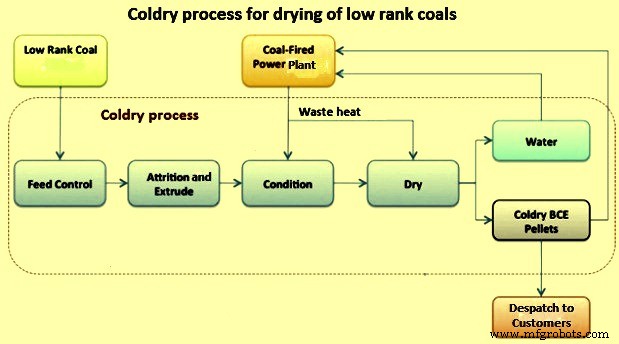
Fig 2 Flow sheet of Coldry process
Commercial scale design and integration with power plant
Based on the Coldry pilot plant the design of the commercial-scale Coldry plant has been made ready. The Coldry commercial plant is designed to be modular and hence scalable. The modular approach means all sections of the plant can be fabricated off-site, then transported in containers and assembled.
The modules of the Coldry plant have been designed to produce (i) 340,000 tons per annum of Coldry pellets from 60 % moisture coals, 440,000 tons per annum of Coldry pellets from 50 % moisture coals, or 600,000 tons of Coldry pellets from 40 % moisture coals.
The Coldry process can be integrated with a PP. The pulverizer at the PP grinds the Coldry pellets into coal powder suitable for injection into the PP’s pulverized coal combustion boiler. The cooling water from the PP’s condenser which is at higher temperature is pumped to the Coldry process for heat exchange. Return water from the Coldry heat exchanger is at a lower temperature but still needs further cooling. This recovered water from the Coldry process can be fed to the PP’s cooling circuit thus reducing the need to take water from other sources. The integration of the Coldry process with a PP is shown in Fig 3.
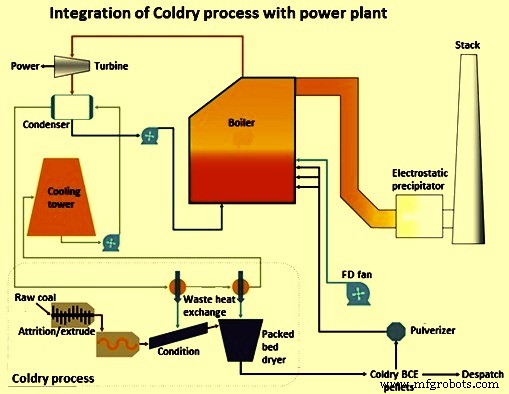
Fig 3 Integration of Coldry process with power plant
Benefits of the Coldry process
Coldry process has several benefits. The benefits are described below.
Process benefits – The process benefits of the Coldry process are (i) It harnesses low grade waste energy as its main source of energy and hence the process is economical and reduces the CO2 footprint, (ii) it reduces evaporative water loss at the adjacent PP (one ton of water recovered in the process equates one ton of evaporative water loss through the PP’s cooling towers), (iii) it enables recovery of up to 95 % of the water expelled in the drying of the raw coal, (iv) the process is simple and mechanical providing high reliability and easier maintenance, (v) the process takes place at low temperature and low pressure thus reducing energy consumption and increasing equipment life, (vi) the process is modular and consists of pre-fabricated component for easier installation, and (vii) it produces high quality water as by-product which is ready for immediate industrial use without expensive treatment, and becomes potable with minor filtering.
Product benefits – The benefits of the Coldry pellets are (i) the pellets has enhanced calorific value, (ii) the pellets do not reabsorbs atmospheric water, (iii) pellets have low risk of spontaneous combustion and are suitable for transportation, (iv) pellets retain high value volatile matter of the raw coal thus ideal feedstock for downstream processes such as gasification, coal to liquids and other coal derived chemicals, and (v) low ash levels derived from the raw coal (similarly with sulphur).
Manufacturing process
- HIsarna Ironmaking Process: Ultra‑Low‑Carbon Steel Production
- Advanced Technologies Enhancing Coking Processes in Byproduct Coke Ovens
- CONARC: Merging Converter and Electric Arc Furnace for Superior Steel Production
- Steel Rolling: Precision Manufacturing Process Explained
- Optimizing Sintering Technology and Machine Design for Iron Ore Production
- Revolutionary WTA Technology Enhances Lignite Coal Drying Efficiency
- PERED Direct Reduction Technology – Accelerated, Energy‑Efficient Iron Production
- Coldry: Advanced Low-Rank Coal Drying Technology for High-Value BCE Pellets
- Pristine‑M: Advanced Low‑Moisture Coal Drying for Cleaner, Efficient Fuel
- Optimizing CNC Machining for Thin‑Walled Parts: Proven Techniques & Solutions