



Understanding How a Shaper Machine Operates: A Practical Guide
Shaper machine is a type of machine tool which is used to machine flat surfaces in horizontal and vertical planes. In this, a single point cutting tool or a form tool is used which reciprocates over the work piece. The machine works in two stokes i.e. one is a forward stroke or cutting stroke and the second is backward or return stroke. The cutting of material is done only in forward stroke. The work piece mounted in a vice on the machine bed and in shaping machine feed is provided to bed i.e. work piece moves upward and downwards according to the requirement or type of machine after each stroke is completed. The cutting tool is attached with the ram which moves in reciprocating motion with the help of feed drive mechanism. In shaper machine, rotary drive motion is converted into reciprocating motion.
Shaper Machine:
Principle of operation:
The working principle is based on the quick return motion mechanism (QRMM). QRMM reduce the return time which increases the machining speed. During the machining process, cutting stroke has slow speed while return stroke has high speed.
Construction:
The construction of the shaper machine is similar to the conventional machine tools but due to the different cutting operation and the mechanism it has slightly different in construction. The main parts of the shaper machine are as follow:
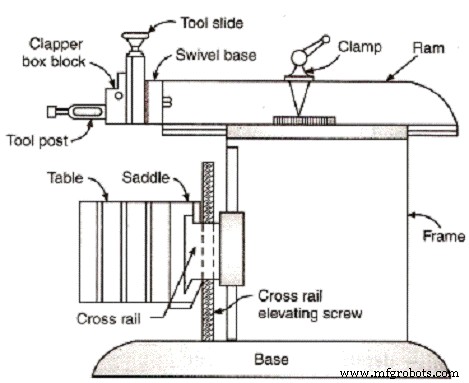
1. Base: Base is made from the hollow casting. It is the foundation of any shaper machine that’s why it is made up of cast iron which provides the proper strength to the machine bed. The base of any machine tool helps to reduce the vibration so we can say that base work as damper while the machine is under working operation.
2. Ram: Ram is the reciprocating part of the machine which is responsible for the cutting operation. A single point cutting tool is attached with the ram and ram reciprocates in the guideways of the column.
3. Frame: Frame is the basic structure of the machine it is also made with the casting and attached on the base. It provides casing and support to the different parts of the machine such mechanisms, table and ram.
4. Table: Table is a metallic structure having T slots on its top. It is attached on the frame of the machine which helps to support the work piece with the help of some vice. The movement of the working table is controlled by using an automatic feed mechanism. The table can slides crosswise according to the machining requirements with the help of an apron clamping box. With the help of it, we can easily measure the twisted angle of the tool. The feed is provided to the table with the help of ratchet and pawl mechanism. The feed is provided to the table through the lever form the ratchet mechanism.
5. Tool head: The primary function of the tool head is to hold the tool at an exact position. It is mounted on the ram and moves in reciprocating motion with the ram. A clamper is attached on the tool head, its function is to lift the tool upward in return stroke to prevent the damage of wear of the tool. We can rotate the tool head at any angle as per our requirements for machining the workpiece at various angles.
6. Lubricating Pump: Its function is to pump the oil from the bottom reservoir into the various parts of the machine. Lubrication is very important for the proper and smooth functioning of the shaper machine.
Working Operations:
As we already discussed the basic principle and components of the Shaper machine so you can easily understand the working operation of any shaper machine. The working of the shaper machine is as follow:
- It is used to machine a flat surface only so a flat work piece is set on the table by using a vice. Shaper machine is able to machine horizontal as well as in vertical flat surfaces.
- After mounting the work piece a single point tool is required for cutting the excess material. The cutting tool is inserted into the tool head which is connected to the ram at the backend. The cutting tool always put in a vertical position.
- After all this initial procedure the main working starts. As the motor drives start the quick return motion mechanism come into play which is responsible for the major cutting operation in the shaper machine.
- The rotary motion of the motor drive is converted into reciprocatory motion due to this ram starts reciprocating and machining starts.
- While the machining process due to the quick return motion mechanism the return time reduced which increase the machining speed and reduce the idle time during the return stroke.
- During the return stroke, the cutting tool moves upward with the help of clamper which is attached on the tool head. Generally, in shaper machine, the machining is done only in the forward stroke and to avoid machining in return stroke clamper is required. This operation provides good surface fishing and increases the tool life by reducing its wear rate.
Applications:
Shaper machine has a very low productivity rate due to its less speed of cutting that’s why it is not used for mass production. Generally, the shaper machine is used for small machining processes where fewer numbers of parts are required for machining on a small scale. The main applications of the shaper machine are as follow:
1. It is mainly used for machining of flat surfaces in different planes i.e. horizontal, vertical and inclined planes.
2. Slots of different shapes such as V-slot, T-slot are produced on a flat surface with the help of single point cutting tool.
3. Some special kind of machining is done with the help of shaping machine such as cutting grooves, cutting of external keyways and splines, teeth cutting of rack etc.
This is all about shaper machine. If you have any query regarding this article, ask by commenting. If you like this article, don’t forget to share it on social networks. Subscribe our website for more informative articles. Thanks for reading it.
Manufacturing process
- CNC Machine Tools: History, Design, and Future Trends
- Selecting CNC Machine Tools: A Professional Guide to Tool Life and Productivity
- Mastering CNC Milling: A Complete Guide to Operation and Setup
- Maximize CNC Machine Accuracy: A Practical Guide to Precision and Reliability
- Corner Engagement: Mastering Precision Milling for Superior Corner Quality
- Understanding the Mechanics of a Milling Machine
- Understanding Shaper Machines: Key Components and Operation
- Punch Press Machines: How They Work & Why Manufacturers Choose Them
- Adding a New Tool to Your CNC Machine: A Step‑by‑Step Guide
- Comprehensive Guide to Setting Up a CNC Milling Machine