



CNC Machine Tools: History, Design, and Future Trends
Background
CNC, or Computer Numerical Control machines, are advanced metalworking tools that craft complex parts essential to modern technology. Evolving alongside computer advances, CNC systems now perform as lathes, milling machines, laser cutters, abrasive jet cutters, punch presses, and press brakes, among others. This article explores the most common CNC types—lathes and milling machines—highlighting their development, design, and manufacturing processes.
History
While woodworking lathes date back to biblical times, the first practical metalworking lathe was created by Henry Maudslay in 1800. Maudslay’s design clamped a workpiece and rotated it, allowing a cutting tool to machine the surface. Operators guided the tool with handwheels, achieving dimensional accuracy through visual feedback on graduated dials. Each part required the same sequence of manual movements, limiting repeatability and efficiency.
In 1818, Eli Whitney introduced the first milling machine. It featured a rotating spindle with a fixed workpiece, which the operator moved via handwheels. The machine used X (left‑to‑right), Y (front‑to‑back), and Z (up‑down) axes, with optional horizontal or vertical rotations adding a fourth axis, and some machines later incorporated a fifth axis for spindle pivoting.
Manual operation led to high scrap rates and low productivity. Early automation attempts used cams to move tools or worktables in predetermined patterns. Though challenging to set up, cam machines offered repeatable results and are the ancestors of today’s Swiss precision machines.
Early Design to Present Day Operation
John T. Parsons revolutionized CNC in the late 1940s while machining helicopter rotor blades. By integrating an IBM computer, he produced highly accurate contour guides, earning an Air Force contract for an automatic contour‑cutting machine. This pioneering system used a card reader and servomotors to replicate operator motions with unprecedented precision.
By the 1960s, automated machines became more affordable. They employed direct‑current electric drives controlled by a tape reader that interpreted punched holes as electrical impulses. These “NC” machines relied on simple computers without memory, with programs written on paper tape. The tape’s length determined program size.
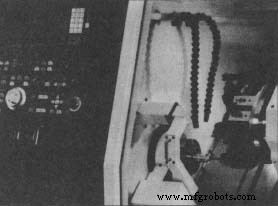 This 1980s CNC chucking machine demonstrates the synergy of machine tool and computer, sourced from the Henry Ford Museum & Greenfield Village.
The collaboration between industry, academia, and the military shaped CNC’s evolution, illustrating the collective effort behind modern manufacturing technology.
Advances in integrated electronics phased out tape, leaving magnetic memory as the primary storage medium. Modern CNC controllers load programs from digital files, often using G‑code commands like M03 (spindle start) and G99 (read auxiliary input). Conversational programming is now available, allowing operators to input commands in plain language, speeding up training while still relying on underlying G‑code.
Controllers also feature automated tool selection: by entering a feature’s location, diameter, and depth, the machine selects the optimal cutting method. Some advanced systems accept a CAD model, automatically calculating tool speeds, feeds, and paths—eliminating the need for a separate program.
Modern Design and Raw Materials
Structural integrity is paramount. The spindle—often the machine’s strongest component—is supported by large bearings and features automatic clamping to secure workpieces or tools swiftly. Cast iron or Meehanite once dominated machine frames, but contemporary designs favor hot‑rolled steel and stainless steel weldments to reduce cost and enable intricate geometries.
Tool magazines can hold up to 400 tools, with cycle times between two and eight seconds. A transfer arm, or tool bar, retrieves and deposits tools as dictated by the program. Some machines operate as cells, combining multiple units into Flexible Machining Cells that run autonomously—often referred to as “lights‑out” manufacturing.
The Manufacturing Process
Modern CNC machines are typically standardized, enabling mass production and quick deployment. Prices range from $50,000 for a vertical center to $5 million for a full Flexible Machining System.
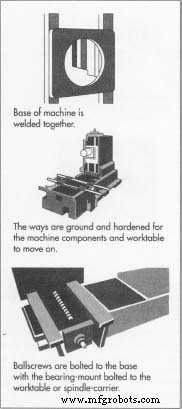
Welding the Base
- Cast or welded base undergoes heat treatment to relieve stresses and normalize the metal.
- Mounting areas for the ways are machined to specification.
Bolting the Ball‑Screws
- Ball‑screws convert rotary motion to precise linear motion for bed or spindle movement.
- They are bolted to the base, with bearing mounts secured to the worktable or spindle carrier.
Mounting the Spindle
- The spindle is machined, ground, and bolted to its drive motor and carrier.
The Controller
- Separate from the machine, the controller houses memory, power supplies, and circuitry.
- It receives continuous position data from the machine’s slides and displays real‑time information on a screen.
- During test runs, the controller calibrates correction factors stored in dedicated memory to maintain accuracy.
Quality Control
Quality is integrated from design to delivery. Controllers detect impending crashes, triggering emergency stops. CNCs are shipped with protective packaging and installed by factory‑trained technicians. Comprehensive manuals accompany each unit.
The Future
Emerging concepts include spider‑like machines with spindle suspensions on six telescoping ball‑screw struts, offering unprecedented contouring capabilities. While development costs are high, advances in AI and computing promise faster, more intuitive CNC systems. Although sophisticated models will remain premium, foundational three‑axis machines will become more affordable, expanding accessibility across industries.
Manufacturing process
- Mastering CNC Milling: A Complete Guide to Operation and Setup
- What Is CNC? – Understanding Computer Numerical Control for Modern Manufacturing
- Maximize CNC Machine Accuracy: A Practical Guide to Precision and Reliability
- Suzie Model One: Precision CNC PCB Cutter
- Build a Fully Functional CNC Machine with Arduino Nano R3
- Build a Triple-Function CNC Machine: Engraving, Laser Cutting, and Pen Drawing
- The CNC Machine Tool Production Journey – From Fabrication to Installation (Part 2)
- Three Proven Techniques for Building Five-Axis CNC Machines
- Expert Tool Grinding Services for CNC Machine Tool Industry
- Comprehensive Guide to Setting Up a CNC Milling Machine