



Forging vs Casting: Key Differences in Metal Fabrication
Today I am going to tell you about difference between Forging vs Casting. Casting and forging are both industrial processes of metal forming and shaping. Different process used in different conditions. The main difference between casting and forging is that the metal is compulsory to heat and convert into liquid stage in casting but in forging metal is converted into desire shape by applying pressure with or without applying heat. If the metal is preheated into forging it does not convert into liquid stage. But before differentiate this both terms; you have to know about what is casting and what is forging. So first I am going to tell you about these terms.
Forging vs Casting:
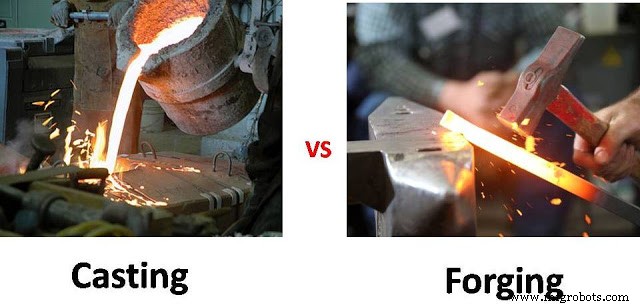
What is casting?
Casting is a process in which metal is heated until molten stage and pour this liquid metal into a mold or cavity where it is allow solidifying. This process converts the metal into desire shape. It is useful to make complex structure. Most of the industrial structures parts are like lathe machine bed, milling machine bed make big base of other machinery part, IC engine componentsetc. are made by this process.
Advantages of Casting
- This process can form very large structure which is impossible to form by other process.
- It can make any complex and unsymmetrical structure.
- The structure formed by this process has high compressive strength.
- It can attain wide range of properties.
- This process can attain high accuracy.
What is forging?
On the other hand forging is the process of converting metal into desire shape by applying pressure and with or without heat. When the metal is heated before applying pressure the process is called hot forging. In forging metal is heated before below critical temperature or below molten stage. Rolling, pressing, Wire drawing etc. is various types of forging. All sheets, smallcomponent, wire etc are formed by this process.
Advantages of Forging:
- It produces tougher product compare to other.
- The product made by forging has high impact or tensile strength.
Tabular form of Difference between Forging vs Casting
| S. No. | Casting | Forging |
| 1. | The metal is heated until it converts into molten stage. | The metal is heated below recrystallization temperature. |
| 2. | The product produce by it have high compressive strength compare to forging. | It has low compressive strength. |
| 3. | It has low fatigue strength. | It has high fatigue strength. |
| 4. |
Imperfection or directional defecates does not improve in casting. |
Directional defect are refined in forging. |
| 5. | It is less reliable or has low strength. | It is high reliable. |
| 6. | It is costly sometime and has high lead time. | It has low lead time and cheap compare to casting. |
| 7. | The product has low tensile strength. | This produces high tensile strength. |
| 8. | It required a secondary finishing operation. | It does not require a secondary operation. |
Key Properties of Moulding Sand for High-Temperature Casting
Hot Working vs Cold Working: Key Differences in Metal Forming
Manufacturing process
- Forging vs. Forming: How These Metalworking Processes Differ
- Metal Inert Gas vs. Metal Active Gas Welding: Key Differences Explained
- 11 Proven Metal Casting Techniques for Precision Manufacturing
- Metal Casting Design: Crafting Durable, Cost‑Effective Components
- Forging, Stamping & Casting: Understanding Their Key Differences
- Metal Fabrication vs. Metal Welding: What Sets Them Apart?
- Metal Fabrication vs. Welding: Key Differences Explained
- Die Casting vs. Stamping: Key Differences Explained
- Casting vs Forging: Key Differences and Applications
- Sand Casting vs Forging: Choosing the Right Metal Fabrication Method